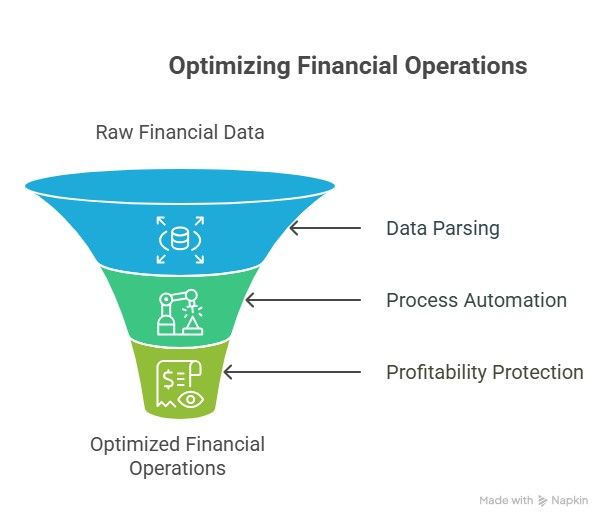
1. Parsing: Where the story begins
Before reconciliation. Before reporting. Before audits or insights. There’s parsing.
Parsing is the first and most painful hurdle in any finance operation. It’s the step where raw, fragmented, often unreadable data from banks, ERPs, payment gateways, and billing systems needs to be ingested, cleaned, and contextualized.
And here’s the truth: Most enterprises are still failing at it.
The challenge:
- Mastercard files arrive in IPM format.
- Bank files come in MT940 or BAI2.
- Invoices and refunds are logged differently across your ERP and CRM.
- Timestamps are mismatched. Field names are inconsistent. IDs don’t align.
- And it's all updated on different cadences—daily, hourly, or not at all.
This means your finance teams are spending hours—if not days—just trying to make the data usable before they can even think about reconciliation or reporting.
Why It Matters:
Without parsing, nothing else works. You’re building financial logic on dirty data, which leads to blind spots, broken processes, and bad decisions.
At Optimus, we’ve built parsing logic that ingests hundreds of file types, normalizes fields using AI mapping, and adds business context to every transaction—automatically. That’s the groundwork for everything else.
2. Processes: Automation is not enough
Once the data is clean, what happens next?
That’s where most companies stumble again. Because their processes—reconciliation, fee validation, exception handling—are either manual, outdated, or just non-existent.
The reality on the ground:
- Teams still reconcile at the summary level, not at the transaction level.
- Chargebacks and disputes are tracked in spreadsheets.
- Refunds aren’t always tied back to original authorizations.
- Exceptions are discovered weeks later, long after they’ve hurt cash flow.
This isn’t just inefficient. It’s risky. According to a recent report by The Hackett Group, 61% of finance leaders say manual financial processes are their #1 barrier to achieving real-time insights.
The Fix:
Modern finance teams need a living, breathing system of processes—ones that adapt to their scale, handle edge cases automatically, and surface what really matters.
That’s exactly what Optimus Payment Reconciliation Module does. From transaction-level reconciliations to exception workflows, our platform ensures your team works on exceptions, not spreadsheets.
It’s not just automation. It’s intelligent orchestration.
3. Profitability: The metric that matters most
You can parse all the data in the world. You can build beautiful processes.
But the ultimate question remains: Are we leaking revenue?
And most businesses are.
Common forms of leakage:
- Incorrect fees charged by PSPs or banks
- Unclaimed refunds or double settlements
- Disputes not tracked or responded to in time
- Currency conversion losses hidden in layers of accounting
These don’t just cause rounding errors—it’s millions left on the table.
The strategic shift:
Profitability isn’t just about more sales. It’s about smarter financial operations.
With a platform like Optimus Profit Protection (suggested link), teams can finally track where losses happen, benchmark against contracts, and close those gaps in near real-time.
This isn’t back-office optimization—it’s frontline impact.