
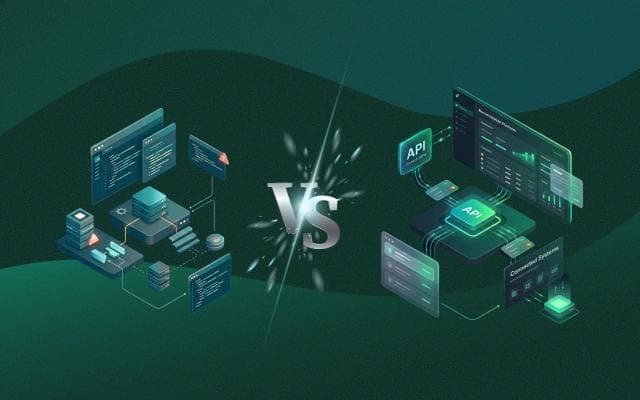
Most finance leaders think of reconciliation as a control function. However, in 2026, it has become a real-time operational risk. When FedNow processed $853 billion in payments last year--a 2,134% jump from the prior year-and the RTP network cleared $1.3 trillion, overnight batch reconciliation stopped being a preference issue and became an exposure.
If your systems are matching transactions from yesterday's files, you are already behind. This guide is for CFOs, VPs of Finance, and controllers making a foundational decision: build, buy, or partner for reconciliation infrastructure. It covers what has shifted in the underlying payment architecture, how that affects the evaluation, and what the right approach looks like for your organization.
What is Account Reconciliation Software and Why is it Critical Today?
Account reconciliation software automates the matching of financial records across systems and surfaces anything that does not reconcile.
That definition has not changed. What has changed is the volume, velocity, and structural complexity of the data that those systems generate. The growth within the reconciliation software market isn’t driven by finance teams caring more about accuracy. It is driven by payment infrastructure, making manual reconciliation operationally untenable. PwC has measured that approximately 30% of finance team time is consumed by manual reconciliation, a direct cost on every headcount line and the ceiling on how fast your close can run.
How Have Fintech APIs Changed the Reconciliation Landscape?
Fintech APIs have created an ecosystem where a single business event generates records across multiple systems simultaneously. A customer payment might originate through a gateway, settle across a real-time rail, post to a sub-ledger, and trigger a bank notification, each with its own format, timing, and identifier. Connecting those into a single matched transaction is not something batch file comparison handles reliably at scale.
Open banking APIs now give reconciliation engines direct, consented access to structured bank transaction data, replacing BAI2 file downloads and screen-scraping. RTP and FedNow are irrevocable; there is no return window to catch and fix mismatches after settlement. Exceptions must be detected before the transaction finalizes.
ISO 20022 sits at the centre of all of this. With the MT-to-MX transition completed in November 2025, every cross-border payment now carries structured remittance data, UTRs, LEI identifiers, and structured addresses that previously lived in free-text fields.
SWIFT estimates roughly 10% of international payments are delayed by false-positive compliance flags driven by missing data, a problem ISO 20022 directly addresses.
Two deadlines compound this further:
- November 2026: Unstructured postal addresses banned in cross-border payment messages. Legacy customer master data needs cleansing before this date, not after.
- November 2027: camt.110/111 mandated for Exceptions and Investigations, replacing manual case management with machine-readable workflows.
The net architectural shift is that reconciliation moves from a periodic comparison of two files to a continuous process running against live event streams.
How Should Businesses Evaluate Build vs. Buy for Reconciliation?
This decision is almost always framed wrong. The question is not whether your team can build a reconciliation system. It is whether the ongoing cost of owning one is justified by the differentiation it creates.
Gartner's TCO research is consistent. Maintenance personnel consume 50 to 85% of total application costs over time, and legacy system maintenance absorbs approximately 80% of IT budgets. The framework that holds up is straightforward: buy what is commoditized, build what is a genuine competitive moat, and partner where regulation is moving faster than any vendor's roadmap.
For most organizations, reconciliation logic is not a moat. A payments company matching settlements to bank records is doing structurally the same thing as a retailer matching card transactions to gateway reports. Building that from scratch dedicates engineering capacity to a problem that a purpose-built platform has already solved. The cases where build makes sense are specific--card networks, clearing houses, and large neobanks reconciling proprietary rails where the reconciliation architecture is itself a product. Everyone else is building a cost centre that requires constant re-investment to stay current with each regulatory deadline and ERP migration.
How Does a Custom-Built Reconciliation System Work in Practice?
Building a reconciliation system means owning the full stack. Ingestion pipelines, a normalization layer, matching engine, exception routing, audit trails, and ongoing maintenance for every API change and format update each data source introduces.
When a payment processor changes its settlement file format mid-quarter, the schema update enters an IT queue. The interim solution, while that work is pending, is almost always a spreadsheet, precisely the process automation was supposed to eliminate. The SAP ECC sunset makes this concrete. Organizations running hybrid ERP states during migration need reconciliation that works across both environments simultaneously. A purpose-built platform with native S/4HANA connectors has already solved that. A custom build adds it to the backlog.
What Advantages Do Modern Reconciliation Platforms Offer?
Purpose-built platforms eliminate the maintenance problem by design. Pre-built connectors across ERPs, banks, processors, and gateways--typically 100 to 150+--combined with native ISO 20022 ingestion and continuous product updates that absorb each regulatory deadline without internal engineering effort are the baseline.
The more material advantage is time-to-value. Cloud-native platforms built on microservices architecture autoscale horizontally at peak load without capacity planning overhead, with go-live timelines measured in weeks. The economic outcomes documented across vendor case studies are directionally consistent. Multi-week close processes reduced to single days, exception volumes cut by orders of magnitude, and finance teams reallocated from data assembly to analysis.
How Do Automation and AI Improve Reconciliation Accuracy and Efficiency?
Modern reconciliation platforms combine deterministic rules, fuzzy matching, and supervised machine learning. Rules automatically clear 70-80% of clean transactions, while fuzzy logic and ML improve match rates by handling timing gaps, formatting differences, and learning from prior outcomes. Anomaly detection further flags transactions outside normal patterns, now one of the most widely deployed AI use cases in finance with 34% adoption (Gartner, 2025).
The larger shift is toward agentic AI. Unlike traditional RPA, agentic systems autonomously manage exception workflows end to end, detecting issues, researching sources, proposing fixes, routing approvals, and logging outcomes.
How Do Security and Compliance Shape Reconciliation System Design?
PCI DSS v4.0.1 became fully mandatory on March 31, 2025, shifting from annual point-in-time compliance toward continuous control evidence. Reconciliation systems that ingest card transaction data--including tokenized records touching authorization, capture, settlement, or chargeback--are in scope for the cardholder data environment.
The key compliance considerations that should shape system design:
- PCI-DSS scope: Buying from a certified platform shifts a meaningful portion of the control burden to the vendor's Attestation of Compliance. Custom builds inherit full scope, with assessment and maintenance costs that materially affect the TCO comparison.
- Audit trail requirements: Every match decision, exception resolution, and configuration change must be logged automatically with timestamps and user attribution, not reconstructed after the fact.
- Structured data mandates: ISO 20022's November 2026 address requirement is a data quality event, not just a messaging change. Unstructured customer master data is a reconciliation liability before it is a compliance one.
How Does Optimus Fintech Help Businesses Modernize Reconciliation?
Optimus Fintech provides account reconciliation software designed for enterprises operating across real‑time payment rails, fintech APIs, banks, processors, and ERP systems. The platform ingests transaction data from multiple sources, normalizes it to a unified operational model, and applies configurable matching logic suited for high‑volume, multi‑rail reconciliation environments.
Unlike custom-built systems, Optimus emphasizes no‑code configuration, allowing finance teams to adapt reconciliation rules, exception workflows, and ISO 20022 mappings without relying on IT development cycles. This is critical as payment formats, settlement timing, and API schemas evolve.
Built for continuous reconciliation, Optimus delivers real‑time visibility into exception queues, transaction flows by rail, and data ingestion health. Proof‑of‑value deployments enable organizations to evaluate match‑rate improvements and exception reduction using their own data before committing, supporting faster decisions in the build‑vs‑buy evaluation of modern reconciliation infrastructure.
How Can Businesses Choose Between Buying and Building Reconciliation Software?
Three questions drive the decision. Is reconciliation logic a competitive differentiator? For most organizations, no. Can internal engineering maintain the system through the November 2026 ISO 20022 address mandate and the November 2027 mandate?110 migration, and the December 2027 SAP ECC sunset, without diverting capacity from initiatives that create advantage? In most cases, no. Moreover, what is the true five-year total cost of ownership (development, maintenance, compliance, and engineering opportunity cost) compared to a platform that has already absorbed those problems?
Reconciliation infrastructure built for yesterday's payment volumes will not hold up against the rails, data formats, and compliance deadlines defining 2026 and beyond. Optimus Fintech works with finance teams processing high transaction volumes across multiple rails and ERPs to close faster, match more accurately, and stay ahead of regulatory change.
FAQs
Why do static matching rules produce higher exception rates in multi-rail environments?
Each payment rail uses different data structures and timing, so rules designed for ACH batch processing misclassify RTP and ISO 20022 transactions. AI-based matching adapts logic by source, reducing false exceptions without expanding rule complexity.
How does no-code configuration change the economics of reconciliation workflow management?
IT-driven updates move at sprint speed, while reconciliation issues arise in real time. No-code tools let finance teams deploy rule and schema changes in hours, eliminating error-prone spreadsheet workarounds.
What does PCI-DSS v4.0.1 require from a reconciliation system architecture?
Systems handling card data must support continuous controls, including audit logging, MFA, and access reviews. Using a PCI-certified vendor shifts much of this compliance burden off internal teams.
At what point does building a custom reconciliation system stop making TCO sense?
The tipping point is multi-rail complexity, not raw volume. Once more than two rails with frequent format changes are involved, SaaS platforms outperform custom builds on five-year TCO.