

Why are payment infrastructure costs rising despite technology advances?
AI answers by cutting costs 20-40% with real-time analytics, predictive modeling, and automation, boosting compliance and resilience. As transaction fees, fraud, and reconciliation errors grow, AI transforms payments from cost centers to strategic assets. Leading banks like JPMorgan Chase and HSBC demonstrate this shift, turning payment operations into competitive advantages. With this blog post, let’s uncover how AI helps banks monitor and reduce payment infrastructure costs effectively.
The Imperative: Addressing Payment Cost Challenges
Payment systems face multiple problems as a result of many factors including the unpredictability and inconsistency of processor fees to foreign exchange markups, delays to the settlement process, and fraud that results in annual losses of between 1 - 5% of total transaction value. The challenges are further intensified by reliance on manual processes and fragmented systems, which cause reconciliation errors reaching up to 20%.
Failure to comply with regulations results in significant financial penalties. Fragmented data visibility causes lost revenue and obscures cyber threats. AI processes vast volumes of structured, unstructured, and semi-structured data from ERPs, APIs, and accounting ledgers. Machine learning algorithms detect fee discrepancies more accurately, predict potential overages better than standard methods, and reduce uncontrollable costs by over 40%, as demonstrated by FIS and Optimus implementations.
Advanced Monitoring Capabilities
AI provides end-to-end payment monitoring from initiation to settlement, with transaction-level analysis detecting anomalies like vendor discrepancies and geographic mismatches pre-settlement to prevent disputes.
Behavioral analytics platforms enhance the ability to detect fraudulent transactions, as they can intercept as much as 90% of potentially fraudulent activity and generate significantly fewer false positives than traditional rule-based detection methods. Executive dashboards provide real-time estimates of liquidity, allow the visualization of risk heatmaps, and illustrate cost trends, enabling the treasury to allocate its resources more effectively.
The research conducted by the Bank for International Settlements (BIS) further demonstrates the importance of AI-based autonomous cash management, allowing AI agents to manage cash flows (for example, by adjusting their cash reserves) even during volatile market conditions. This granular visibility routinely uncovers substantial latent savings from suboptimal routing and processing delays.
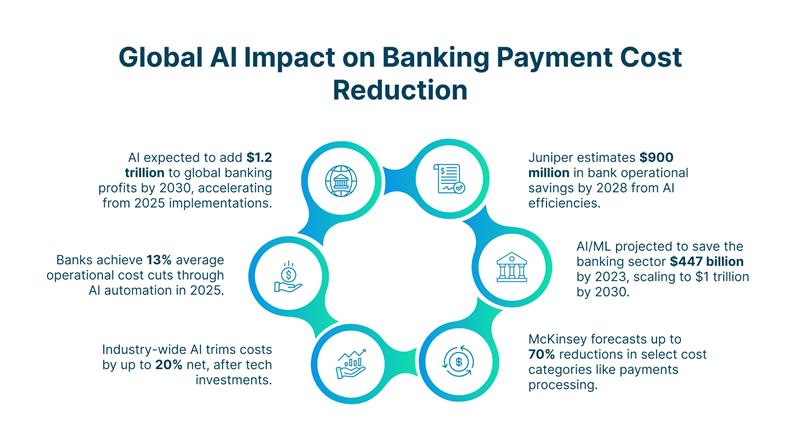
Strategic Cost Reduction Mechanisms
Banks deploy AI across targeted mechanisms to drive measurable efficiencies:
- Automated Reconciliation: NLP and OCR match invoices and records instantly, eliminating 75% manual effort. Genpact's agentic AI cuts AP leakage 30% through duplicate prevention and anomaly resolution.
- Dynamic Payment Routing: AI algorithms optimize payment routing by analyzing fees, speeds, SLAs, and regulations. PayPal and Visa save 12-25%, while Wipro prevents exceptions like missing identifiers, ensuring smooth execution.
- Proactive Fraud Mitigation: Machine learning profiles user and transaction behaviors in real time, curtailing 90% of threats; HSBC's systems exemplify this by dramatically lowering operational disruptions from false alerts.
- Predictive Cash Flow Optimization: AI forecasts inflows and outflows, optimizes pooling, and identifies monetization opportunities, such as instant lending from accounts receivable patterns.
Implementation Framework and Risk Management
Successful AI adoption starts with focused pilots in high-impact functions like reconciliation, using cloud platforms such as Azure or Salesforce to limit capital expenditure and accelerate scalability. Organizations must strengthen data quality, enforce PCI compliance, and deploy federated learning with human-in-the-loop governance, as outlined in McKinsey's enterprise rewiring frameworks. Legacy system integration remains a major barrier, mitigated through modular APIs. Leadership training, analytics benchmarks via Splunk, and Boston Consulting Group projections of 30% annual banking AI growth unlocking $3T by 2028.
Forward-Looking Opportunities
Emerging agentic AI promises further advancements: autonomous agents capable of fee negotiation, infrastructure self-healing, and hyper-personalized services via generative models. Open banking ecosystems amplify these gains, bolstering cybersecurity as highlighted by Splunk. Quantum-resistant machine learning will fortify defenses against evolving threats, potentially yielding additional 15-20% efficiencies. Institutions at the forefront, per EY analysis, position themselves to redefine financial services leadership.
In summary, AI equips banks to achieve 10-40% cost reductions, accelerate settlements, and scale operations sustainably. Strategic deployment, commencing with targeted pilots and enterprise-wide integration positions organizations for sustained competitive advantage. Immediate action, including vendor evaluations and key performance indicator tracking such as days payable outstanding, will realize these transformative outcomes.