

The digital payments landscape has transformed dramatically over the past decade. Yet a persistent paradox remains: as transaction volumes have grown exponentially, so has payment leakage across every sector. Most organizations misdiagnose the problem. They treat payment leakage as primarily a fraud issue. This perspective is fundamentally incomplete.
Payment leakage is fundamentally a data problem. Without real-time insights derived from comprehensive transaction data, organizations operate without visibility into revenue loss. Detection becomes impossible. Prevention becomes reactive rather than proactive. Recovery becomes improbable. The financial impact compounds daily.
The Scale of the Challenge
Current market data presents an unsettling picture. Merchants are projected to lose $52.84 billion to online payment fraud in 2025. This represents a significant acceleration. Global e-commerce fraud losses continue to expand at a CAGR of 27.4%. This growth rate outpaces revenue expansion in most sectors.
The true cost extends beyond the transaction amount. Retailers lose $4.61 for every dollar of e-commerce fraud. This multiplier effect reflects chargeback fees, operational remediation costs, customer acquisition replacement, and reputational damage. The compounding effect accelerates losses.
The 2024 data is particularly instructive. Merchant e-commerce fraud losses totaled $115.32 billion. This represents a substantial year-over-year increase. Regional performance deteriorated significantly. E-commerce fraud in North America increased 207% between Q1 2024 and Q1 2025.
Traditional fraud systems are insufficient against sophisticated, data-intensive modern payment threats. Impact distribution varies across merchant segments. 12% of online retailers lost over $30 million each in 2024. Mid-market merchants face proportional exposure. 25% of online merchants lost $5 million or less, while 30% lost between $5 million and $10 million. Exposure is distributed across all merchant classes.
Payment Leakage Sources and Mechanisms
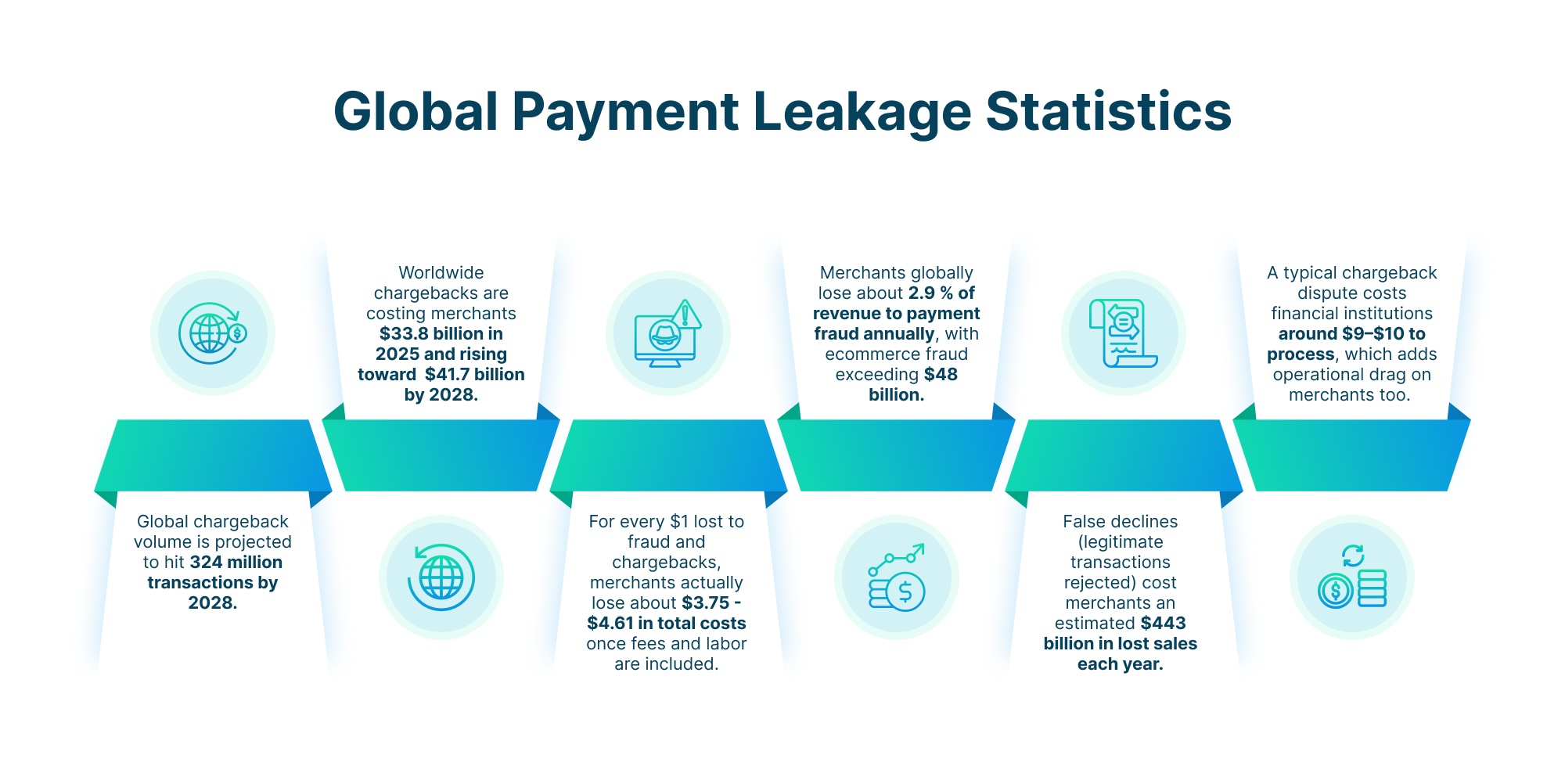
Payment leakage emerges from multiple concurrent sources. Understanding these mechanisms is essential for effective mitigation strategies.
Credential Compromise and Data Breaches
The volume of compromised payment data has reached unprecedented levels. 269 million payment records were posted across dark and clear web platforms. This represents a critical inflection point in criminal capability. Attackers now possess at scale the credentials and card data required for sophisticated fraud operations.
E-commerce infrastructure remains highly vulnerable, with nearly 11,000 Magecart infections, triple 2023 levels exploiting unpatched flaws like CosmicSting through opportunistic attacks. Meanwhile, synthetic identity fraud surged 311% year-over-year, now accounting for 29% of e-commerce transaction fraud losses as criminals systematically create false identities for unauthorized purchases.
Chargeback Fraud
Chargeback fraud represents a distinct category of payment leakage requiring separate analysis. 39% of retailers experienced chargeback fraud in 2024. This prevalence indicates systematic exposure across the merchant population.
Customers receive goods, then dispute charges as unauthorized—a practice termed “friendly fraud,” responsible for 28% of e-commerce fraud losses. Global chargebacks are projected to reach $9.40 billion in 2025, creating pure revenue leakage. Without comprehensive transaction data and documentation, merchants frequently lose these retroactive disputes.
Transaction Processing Failures
Operational failures represent a less visible but equally material source of leakage. Failed authorizations result in lost revenue and reduced conversion rates. Adyen's machine learning optimization achieved a 29% reduction in transaction failures in 2024. This improvement demonstrates the performance gap in legacy systems.
Traditional payment gateways fail to optimize across diverse payment corridors. Single-integration approaches cannot route transactions through optimal pathways. Legitimate transactions that should be approved are declined. Sales disappear. Revenue evaporates.
False-Positive Decline Rates
Overaggressive fraud prevention creates secondary leakage. 1 in 20 verification attempts, 5% are legitimately classified as fraudulent in 2025. However, fraud detection systems typically decline 10-fold that number. The consequence is significant customer friction.
Legitimate customers experience transaction rejection. Cart abandonment increases. Customer acquisition cost replacement occurs. Competitive switching accelerates. The organization incurs losses not from fraud, but from false-positive prevention mechanisms.
The Underlying Problem: Data Fragmentation
Across payment ecosystems, fragmented data silos prevent organizations from accessing transaction data holistically, increasing decision latency and limiting actionable intelligence. When properly integrated, payment data reveals portfolio-wide trends, strengthens fraud detection, expands automation, and surfaces revenue opportunities. Migration to unified architectures such as ISO 20022 requires investment, but it fundamentally enhances data structure and interoperability. Early adopters unlock scalable insights, improve operational ROI, and build a compounding competitive advantage through standardized, intelligence-driven operations.
Data-Driven Prevention Framework
Organizations must transition from reactive fraud detection to predictive prevention systems. This shift requires sophisticated data infrastructure and advanced analytical capabilities.
Current performance benchmarks demonstrate measurable benefits. AI-powered fraud detection systems achieve 95% accuracy in identifying suspicious transactions. Real-time AI monitoring reduces fraud losses by 30% for institutions with implementation maturity. Predictive analytics with AI achieves 83% accuracy in identifying potential fraud patterns before transaction completion.
Payment Orchestration as Operational Leverage
Advanced payment orchestration transforms transaction optimization. API-first models improve success rates by up to 45% over legacy gateways through intelligent, dynamic routing. Each transaction is evaluated individually, selecting optimal pathways in real time. Payments that would fail via single gateways succeed, significantly increasing authorization rates and customer approvals.
Performance improvements extend to operational efficiency. By 2027, AI-driven orchestration is expected to reduce payment reconciliation time by 35%. Automation reduces manual intervention requirements. Error rates decline. Cash flow acceleration improves. Reporting timeliness increases.
Conclusion
Payment leakage in online transactions represents the largest hidden expense in contemporary fintech operations. It is simultaneously an organization's greatest operational efficiency opportunity. Organizations that transition from reactive fraud management to proactive, data-driven payment optimization capture significant competitive advantage.
These organizations convert what appears to be insurmountable leakage into controlled, measured operational losses. Authorization rates improve demonstrably. Customer experience quality increases and market positioning strengthens.
The fintech companies that achieve operational excellence in payment leakage prevention will emerge as market leaders. Not through feature innovation, but through eliminating revenue leakage that competitors accept as inevitable.