

Let’s face it, payment cost management used to be a reactive game. Finance teams would close the books, tally up fees, reconcile payments and then find out they had overspent or left money on the table. But now, predictive analytics, powered by AI and machine learning, is shifting the paradigm from “fix it after it happens” to “avoid it before it does.”
Predictive analytics uses historical and real-time data to forecast future outcomes, whether it’s payment timing, cost behaviors, or risk flags. Rather than combing through spreadsheets, finance teams now have tools that can anticipate payment patterns and cost drivers.
Predictive modelling is expected to become a key driver in forecasting and budgeting for businesses, as indicated in research by the financial services industry, which found that predictive models achieve forecast reliability rates of approximately 95% to 98% on large datasets.
With predictive models, companies can avoid the occurrence of unexpected costs and have the information necessary to support strategic decisions. This allows finance teams to be much more proactive in their efforts to optimise the financial performance of their companies.
The scale of impact: Research-backed results
The financial impact of this shift is substantial and well-documented by leading research organizations. According to Gartner's 2025 analytics predictions, AI and data analytics are revolutionizing decision-making across enterprises.
Organizations deploying AI-powered payment analytics experience approximately 40% reduction in uncontrollable payment costs through advanced forecasting capabilities, while simultaneously preventing roughly 90% of overcharges from affecting their financial outcomes.
McKinsey's 2025 Global Payments Report reveals that AI implementations in payment infrastructure are delivering substantial operational improvements through real-time analytics, predictive modeling, and automation.
Companies including PayPal use AI to analyze, predict, and optimize payment routes based on transaction costs, processing times, and network congestion. Similarly, Visa uses AI to make settlements more efficient by using insights into clearing and settlement cycles to better time fund transfers and reduce operational costs.
Cost reduction extends to specific operational areas. Automated reconciliation and intelligent payment optimization achieve substantial efficiency gains in payment processing. Procurement teams using predictive analytics report 25-40% faster response times to payment disruptions and improved fraud detection by identifying anomalies in invoice patterns and approval flows before settlement.
Real-time anomaly detection: Prevention over correction
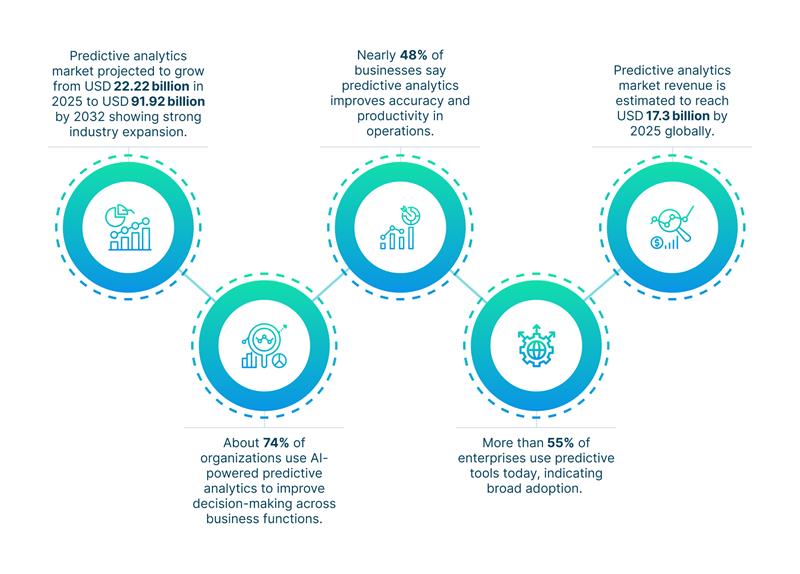
One of the most impactful applications of predictive analytics is continuous transaction monitoring. Traditional payment systems wait for monthly reconciliation to identify problems by then, costly errors and overcharges have already affected the bottom line.
Advanced machine learning systems flip this paradigm entirely by analyzing vast transaction datasets in real time, flagging unusual payment amounts, unexpected vendor changes, and potential fraud signals before settlement occurs.
This proactive approach catches irregularities that human reviewers would miss, preventing problems rather than responding to them after the fact. According to recent industry analysis, financial networks using machine learning models can analyze transaction patterns in milliseconds. These models block fraudulent activity while reducing false positives that frustrate legitimate customers. The result is measurable cost avoidance and improved operational reliability.
Forecasting and process optimization
Finance departments can use predictive analytics to gain insight into patterns that may previously have gone unnoticed using traditional analytic techniques; for example, AI-enabled approaches allow for automation as well as generating productivity increases through enhanced data management via augmented capabilities such as natural language processing, according to Gartner’s 2024 data and analytics trends overview.
The enhanced predictability of invoice submissions will allow accounts payable (AP) departments to plan accordingly for the peak season of invoicing at the end of each quarter. Additionally, predictive analysis allows for determining the probability of suppliers accepting a specific discount for early payments based on previous history. Thus, predictive analysis allows for optimizing cash management and increasing working capital efficiency.
Overall, organizations are moving from reactive approaches to decision making around finances to developing a real-time, data-driven strategic financial plan using predictive analysis.
Predictive analytics enables finance teams to anticipate patterns that would be invisible using traditional methods. Gartner's 2024 analysis emphasizes how organizations are using AI-enabled tools to automate and improve productivity through augmented data management capabilities including natural language processing.
Accounts Payable teams are now able to anticipate when submission patterns will peak (such as when more invoices are submitted at the end of a quarter), allowing them to pre-emptively mobilize resources to prevent bottlenecks in processing. Predictive models also provide insight into the likelihood of suppliers accepting discounts for early payment based on various rates.
By enabling organizations to better manage cash and optimize working capital usage, these capabilities have fundamentally changed how AP teams are able to make decisions about their profession and strategically plan their finances using data-based forecasts.
Transforming labor and operational efficiency
The labor productivity improvements are transformative. A research on AI in the workplace documents how AI agents can now orchestrate complex payment tasks including processing payments, checking for fraud, and completing supporting actions. In practical payment operations, complex reconciliations that once took days now happen in real-time.
McKinsey's State of AI 2024 report also reveals that organizations are already seeing material benefits from AI use, reporting both cost decreases and revenue improvements. More than half of organizations report cost reductions in supply chain and service operations when deploying AI across multiple functions.
At scale, this translates to expanding transaction volumes without proportionally increasing headcount, freeing finance teams to focus on strategic activities like cash flow planning, budgeting, and vendor relationship management.
Enterprise-wide cost management and competitive advantage
Analysis of AI economic potential indicates that generative AI applied to customer care and operational functions could increase productivity by 30-45% of current function costs. When applied to payment operations, this translates to meaningful cost reductions through automated exception handling and intelligent decision-making.
Real-time compliance checking and AI-powered risk detection systems reduce both financial losses and regulatory penalties while maintaining operational efficiency. Organizations leading this transformation are establishing sustainable competitive advantages.
Gartner forecast says that by 2029, 10% of global boards will use AI guidance to challenge executive decisions material to their business, reflecting how thoroughly AI is embedding itself into strategic financial governance.
Payment cost management has traditionally been viewed as a necessary but unglamorous operational function. Predictive analytics elevates it into a source of competitive advantage, enabling organizations to uncover hidden savings and optimize vendor relationships through strategic payment timing. It also allows leaders to make working capital decisions grounded in data-driven forecasting.
In conclusion, the question isn't whether predictive analytics improves payment cost management; research confirms it decisively does, but rather how quickly individual organizations can adopt and deploy these capabilities to secure their competitive position.