

Interchange fees are a significant expense for businesses that accept card payments, often constituting 70% to 95% of total processing costs. These fees are charges imposed by card networks like Visa and Mastercard to compensate card issuers for the risks and costs associated with providing credit, debit, and prepaid cards. Interchange optimization is the strategic process of minimizing these fees by refining payment processes to ensure each transaction qualifies for the lowest possible rate.
What Are Interchange Fees?
When a customer makes a purchase using a card, the transaction involves multiple parties:
- Merchant: The business accepting the card payment.
- Acquiring Bank (Acquirer): The merchant's bank that processes card payments.
- Card Network: Entities like Visa or Mastercard that facilitate the transaction.
- Issuing Bank (Issuer): The customer's bank that issued the card.
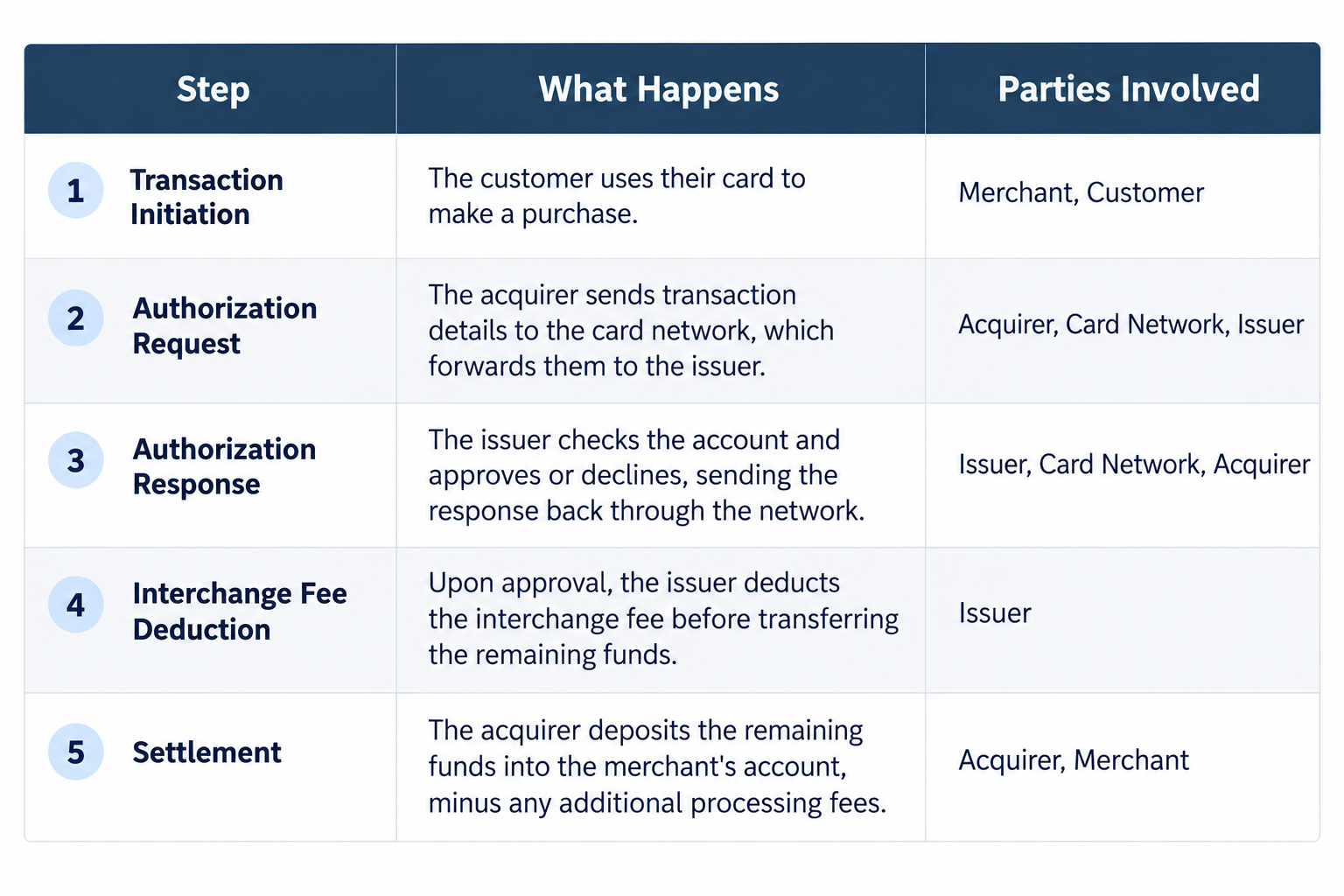
The transaction flow is as follows:
- Transaction Initiation: The customer uses their card to make a purchase.
- Authorization Request: The acquirer sends the transaction details to the card network, which forwards them to the issuer.
- Authorization Response: The issuer checks the customer's account and approves or declines the transaction, sending the response back through the network to the acquirer.
- Interchange Fee Deduction: Upon approval, the issuer deducts the interchange fee before transferring the remaining funds back through the network to the acquirer.
- Settlement: The acquirer deposits the remaining funds into the merchant's account, minus any additional processing fees.
What Factors Influence Interchange Fees?
Several factors determine the interchange fee for a transaction:
- Card Type: Different cards (e.g., debit, credit, rewards, corporate) have varying interchange rates.
- Merchant Category Code (MCC): This code classifies the merchant's business type, influencing the fee structure.
- Transaction Method: Fees differ based on whether the transaction is card-present (in-store) or card-not-present (online or keyed-in).
- Transaction Amount: Higher transaction amounts can lead to higher absolute interchange fees.
- Processing Timeliness: Delays in settling transactions can result in higher fees or downgrades to less favorable rate categories.
How to Optimize Interchange Fees: Key Strategies
To reduce interchange fees, businesses can implement the following strategies:
- Accurate Transaction Data: Ensure all required data, especially for Level II and Level III transactions involving corporate or purchasing cards, is accurately captured and transmitted. This includes details like tax amounts, invoice numbers, and product descriptions.
- Prompt Settlement: Settle transactions daily to avoid higher fees associated with delayed processing.
- Encourage PIN Debit Transactions: For applicable businesses, promoting PIN debit transactions can lead to lower interchange rates compared to signature-based transactions.
- Monitor and Reduce Downgrades: Regularly review transactions to identify and address causes of downgrades, such as missing data or delayed settlements, which lead to higher fees.
- Review Merchant Category Code (MCC): Ensure your business is classified under the most appropriate MCC, as this affects fee structures.
- Leverage Payment Technology: Utilize advanced payment processing systems that support interchange optimization by automating data capture and ensuring compliance with card network requirements.
Benefits of Interchange Optimization
Implementing interchange optimization strategies can lead to:
- Cost Savings: Lower interchange fees directly reduce operating expenses.
- Improved Cash Flow: Retaining more revenue per transaction enhances overall cash flow.
- Competitive Pricing: Savings can be passed on to customers through lower prices, providing a market advantage.
- Operational Efficiency: Streamlined payment processes reduce errors and administrative burdens.
By understanding and actively managing the factors that influence interchange fees, businesses can significantly reduce their payment processing costs and improve their financial performance.
For more detailed insights and strategies on interchange optimization, consider consulting with payment experts who can provide tailored solutions to fit your business needs.
Take control of your card processing costs with smarter, data-driven decisions. With Optimus Fintech, you can automate fee validation, eliminate interchange downgrades, and unlock hidden savings across every transaction.
FAQs
What is an interchange fee, and what does Interchange++ pricing actually mean?
An interchange fee is the small charge paid to the cardholder’s bank every time you accept a card payment. Interchange++ shows all costs separately like bank fee, network fee, and processor fee so you know where your money goes and can manage costs better.
What is interchange optimization in card payments?
It means adjusting how card transactions are processed so they qualify for lower fees. Small changes in data or routing can reduce the cost per transaction.
Why do some card transactions cost more than others?
Fees vary based on card type, data quality, and how the payment is processed. Missing or incorrect details often push the transaction into a higher fee category.
How can businesses lower their card processing fees?
They can send complete transaction data, use the right payment setup, and review how payments are routed. These changes help avoid extra charges.
Does interchange optimization require system changes?
In many cases, only small updates are needed in the payment setup. Even minor adjustments can improve how transactions are categorized and reduce costs.
How does interchange optimization impact revenue?
High fees reduce margins without being obvious. Lowering those fees means more money stays with the business without increasing sales.