

For decades, reconciliation has been one of the most operationally intensive functions inside enterprises. Finance teams, operations analysts, and shared service centers have spent countless hours manually investigating mismatches, validating exceptions, and coordinating across systems just to determine why transactions fail to reconcile.
The problem was never simply reconciliation itself. The real challenge has always been investigation.
When millions of transactions move across ERP systems, payment gateways, banks, POS systems, and third-party platforms, even a small percentage of exceptions creates a massive operational burden. Teams often spend more time investigating discrepancies than resolving them. As transaction volumes grow, enterprises are forced into a cycle of adding more analysts, more spreadsheets, and more operational layers just to keep pace.
That model is now changing.
Optimus is introducing a new category of operational intelligence through self-healing reconciliation — a system designed not only to identify breaks, but to autonomously investigate, classify, and resolve them before they become operational bottlenecks.
The Traditional Investigation Problem
In most enterprises, reconciliation breaks trigger a chain reaction:
- Analysts export data from multiple systems
- Teams compare records manually
- Finance and operations exchange emails to identify root causes
- Exceptions are routed through several approval layers
- Resolution timelines stretch from hours to days
The impact goes far beyond operational inefficiency.
Manual investigation creates:
- Delayed financial visibility
- Increased write-offs
- Higher operational costs
- Audit and compliance risks
- Slower month-end close cycles
- Burnout among finance and operations teams
In large retail and financial organizations, investigation volumes can easily reach hundreds of thousands of exceptions per month. Many enterprises have accepted this as an unavoidable cost of scale.
But the assumption itself is outdated.
The Hidden Challenge: Missing Matching IDs
One of the biggest reasons reconciliation investigations become so time-consuming is the absence of clean matching identifiers across systems.
In theory, every transaction should carry a common reference ID across payment systems, ERP platforms, settlement files, POS records, banks, and third-party processors. In reality, enterprises deal with fragmented data environments where:
- Reference numbers are incomplete
- Transaction IDs are truncated
- Formats vary across systems
- Merchant descriptors differ
- Settlement records arrive with inconsistent naming conventions
- Data fields are missing entirely
This forces analysts into manual detective work.
Teams often spend hours searching across spreadsheets, comparing timestamps, amounts, store IDs, approval codes, and narrative descriptions simply to determine whether two records represent the same transaction.
Traditional reconciliation systems struggle in these environments because they rely heavily on exact-match logic.
Optimus approaches the problem differently.
Intelligent String Matching: Creating Matching Intelligence Where IDs Do Not Exist
Optimus uses its proprietary intelligent string matching technology to create unique matching intelligence even when common matching IDs are missing.
Instead of relying solely on exact transaction references, the platform analyzes multiple transaction attributes simultaneously, including:
- Merchant descriptors
- Partial reference values
- Transaction narratives
- Time proximity
- Store or terminal information
- Settlement patterns
- Amount tolerances
- Historical transaction behavior
Using AI-driven contextual analysis, Optimus can identify relationships between records that traditional reconciliation systems would classify as unmatched.
The platform effectively creates dynamic matching fingerprints — unique transaction associations derived from contextual data patterns rather than rigid identifiers alone.
This is particularly powerful in enterprise environments where:
- Data quality is inconsistent
- Legacy systems lack standardization
- Multiple third parties participate in transaction flows
- Settlement formats vary by provider
- Cross-border payment systems introduce formatting differences
By intelligently generating matching relationships, Optimus dramatically reduces false exceptions and eliminates large volumes of manual investigation work.
What previously required analysts to manually compare records across multiple systems can now happen autonomously in seconds.
From Exception Detection to Autonomous Resolution
Traditional reconciliation platforms focus primarily on matching transactions and flagging exceptions.
Self-healing reconciliation changes the paradigm entirely.
Instead of simply identifying a mismatch, Optimus continuously analyzes the underlying transaction behavior, historical resolution patterns, system dependencies, and operational workflows to determine:
- Why the break occurred
- Whether it has occurred before
- What corrective action is required
- Whether the issue can be resolved automatically
- Which cases truly require human escalation
This transforms reconciliation from a reactive workflow into an autonomous operational engine.
The result is a dramatic reduction in manual investigation effort.
How Self-Healing Works in Practice
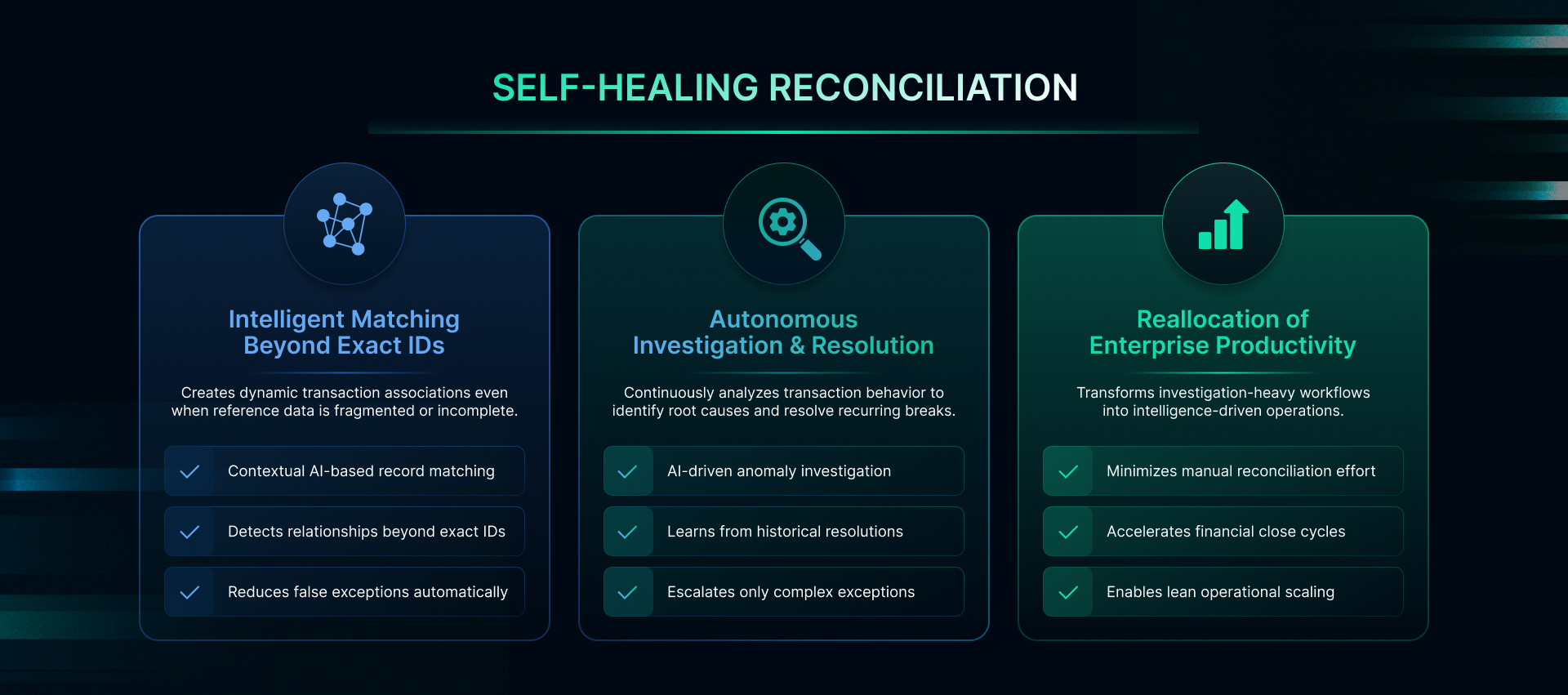
Optimus uses AI-driven intelligence to monitor and reconcile transaction flows across enterprise systems in real time.
When discrepancies appear, the platform:
- Detects anomalies instantly
- Identifies probable root causes
- Applies predefined remediation logic
- Learns from prior resolutions
- Automatically resolves recurring exception patterns
- Generates intelligent match associations when reference IDs are incomplete or missing
- Escalates only high-complexity cases to operations teams
Over time, the system continuously improves its ability to resolve exceptions autonomously.
This creates a compounding productivity effect:
- Fewer manual investigations
- Faster exception resolution
- Reduced operational overhead
- Higher reconciliation accuracy
- Shorter close cycles
- Better financial control
The Productivity Shift Enterprises Are Seeing
One of the most significant outcomes enterprises experience is not simply automation — it is operational reallocation.
Teams that previously spent entire days investigating transaction mismatches can now focus on:
- Financial analysis
- Strategic controls
- Process optimization
- Risk management
- Customer operations
- Revenue assurance
In many organizations, investigation-heavy workflows that once consumed hours can now be resolved in minutes or automatically closed without analyst intervention.
The ability to intelligently match transactions without clean identifiers is especially transformative. Enterprises no longer need perfectly standardized data environments to achieve high reconciliation accuracy.
This fundamentally changes how finance and operations teams scale.
Instead of hiring more analysts as transaction complexity grows, enterprises can scale transaction volumes while maintaining lean operational teams.
Why This Matters Now
The timing is critical.
Modern enterprises are facing:
- Rapid growth in digital transactions
- Increasing payment fragmentation
- Real-time commerce expectations
- Rising compliance requirements
- Pressure to reduce operational costs
At the same time, finance organizations are expected to deliver faster reporting cycles and greater accuracy with fewer resources.
Manual reconciliation models cannot keep up with this complexity.
Self-healing reconciliation introduces a scalable operational framework built for modern transaction ecosystems.
Beyond Automation: Creating Operational Resilience
The most important shift may not be productivity alone — it is resilience.
When reconciliation processes depend heavily on manual investigation, organizations become vulnerable to:
- Staff turnover
- Institutional knowledge loss
- Operational delays
- Human error
- Scaling limitations
Self-healing systems institutionalize resolution intelligence directly into the platform.
This creates operational continuity that is independent of individual analysts or tribal knowledge.
The enterprise gains:
- Consistent resolution logic
- Continuous learning
- Audit-ready traceability
- Faster operational response
- Improved governance
The Future of Enterprise Reconciliation
Reconciliation is evolving from a back-office necessity into a strategic intelligence layer for enterprise operations.
The next generation of platforms will not simply report exceptions. They will:
- Predict operational breaks
- Prevent recurring failures
- Resolve issues autonomously
- Continuously optimize workflows
- Create intelligent transaction associations even in fragmented data environments
Enterprises adopting self-healing reconciliation are already seeing the shift:
from investigation-heavy operations to intelligence-driven finance and operations management.
The result is not incremental improvement.
It is a complete redefinition of enterprise productivity.