

While many people perceive digital online payments to be attractive due their e.g., fast checkout, easy integration into digital wallets, or their tap-or-scan payment methods; there is a growing and evolving complexity in terms of the economics behind these types of transactions.
Evaluating online payments requires a clear view of the global marketplace before drawing conclusions. The scale of transformation over the past decade has been unprecedented. According to the Worldpay Global Payments Report, spending through digital payment methods in e-commerce and in-person transactions grew from $1.7 trillion in 2014 to $18.7 trillion globally in 2024, an almost eleven-fold increase in just ten years. Now, in 2026, that momentum has only accelerated. The total value of digital payments is projected to exceed $33.5 trillion by 2030, underscoring a structural and irreversible shift toward digital-first financial ecosystems.
With the ongoing expansion of major payment types such as mobile wallets, A2A payments, and real-time payment systems, online transactions continue to grow significantly year over year. This growth reflects a sustained structural shift from traditional payment methods to online financial systems.
Volume Is Exploding; But So Is Cost
As of 2023, there were approximately 2.4 trillion transactions processed by the global payment ecosystem with an average transaction value of about $1.8 Quadrillion, not including the trend towards a large-scale increase due to the adoption of digital payments into 2024 and 2025. Analysts estimate that global transactions via digital payment will reach approximately $20.09 Trillion by 2025 primarily due to mobile wallet transactions, account to account transfers, and instant payment rails across all major markets/regions.
The volume of transactions processed also indicates how widespread the use of online payments has become among both businesses and consumers and the ongoing digital transformation of economies with cashless contactless flows emerging as viable options to transact across the globe.
According to the 2023 Global Report, the Global Real Time Payments Network processed 266.2 billion transactions increasing over 40% year on year; thus demonstrating tremendous growth in the adoption rate of instant payments globally. Although there is efficiency and convenience in these transaction statistics, they also illustrate the growing complexities of the infrastructure, risk, security, and compliance associated with processing these large volumes of transactions.
Hidden Costs: Fraud, Compliance, and Infrastructure
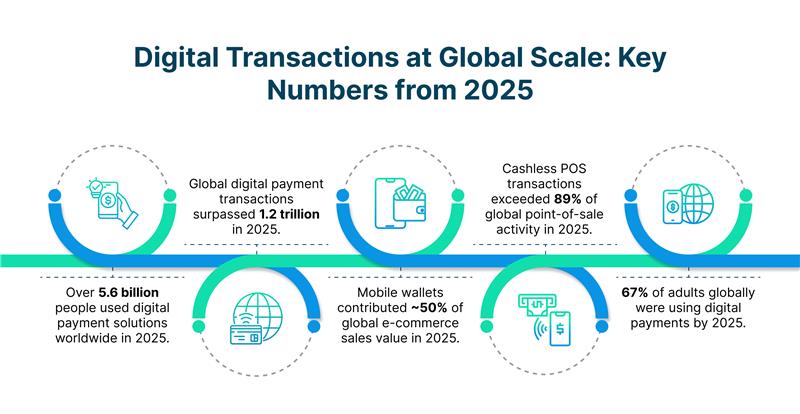
Behind that tap or scan sits a complex web of digital infrastructure, security layers, reconciliation engines, and compliance systems. As the number of transactions surges, so too do these costs and fraud is one of the most direct manifestations.
Globally, the cost of fraud and financial crimes related to online transactions has reached unprecedented heights. According to various market studies, it is projected that global online payment fraud will exceed $50 billion in losses in 2025 despite the increase in investment into fraud detection/prevention technologies.
In addition to being the most common type of payment fraud globally, Credit/Debit Card fraud is projected to grow from roughly $40 Billion in 2024 to approximately $48 billion in 2025. In addition to traditional payment rails, there are also numerous examples of broader cybercrime related to digitally enabled financial systems which incur huge losses (e.g., in 2024, the FBI reported that cybercrime costs globally exceeded $16 billion; this is a massive increase from the previous year and includes losses related to online financial fraud schemes, scams and account takeovers).
Within the crypto ecosystem, fraud is still a major risk. Although reported fraud statistics vary widely between sources, mining reports indicate that in 2024 more than $10.7 billion of crypto was sent to fraud; this clearly shows that digital financial fraud extends beyond traditional payments, and into decentralized finance.
Compliance: A Linear Cost Curve in a Non-Linear World
As digital ecosystems expand, so do the rules governing them.
From KYC and AML audits to cross-border data requirements and consumer protections, compliance demands scale with transaction volume. Unless automated, every uptick in volume, even those driven by everyday purchases can translate directly into bigger compliance teams and tools.
Where decades ago a few million transactions might be handled manually, today organizations routinely process billions, often with compliance teams struggling to keep pace without automation.
This is why leaders increasingly see AI not as a fringe optimization but as a foundational cost management tool.
AI: The Invisible Cost Controller
AI doesn’t eliminate complexity, it absorbs it. In fraud prevention, machine learning systems continuously learn from transaction patterns, spotting subtle anomalies that static rules miss. That means fewer false positives, fewer manual reviews, and better risk mitigation, all without proportionally adding headcount.
In infrastructure management, AI models can predict transaction peaks and allocate cloud resources dynamically, reducing waste. Given that industries often see 20–30% cloud inefficiency in digital scaling scenarios, intelligent resource management can materially lower expenses.
For compliance workflows, AI can automate exception detection and reporting, turning regulatory oversight from a linear cost center into a scalable engine.
The Strategic Inflection Point
Rapid digital adoption is not a temporary phase; it’s structural.
Globally, online payments now dominate commerce from e-commerce wallets to mobile POS systems and instant bank transfers. With total transaction value measured in the tens of trillions annually and volumes crossing into the hundreds of billions, digital platforms sit at the heart of modern economies.
For leaders, the message is clear:
Growth in online transactions will continue.
But if organizations treat automation as optional, costs will grow alongside volume, a linear cost model that eats margins.
AI reframes that model.
It turns transaction volume growth from a cost into a managed, optimized, and intelligent engine that scales without equally scaling expense.
In the age of online payments, AI is not a feature; it is a financial control mechanism.