

Have you ever taken the time to see what costs your payment systems are costing you over and above the fees you can see? In the digitally connected global economy, payments move in seconds across borders, currencies, and channels; but that speed is now hiding a growing problem. Many companies simply don't know that invisible, hidden costs are slowly stealing millions from their revenue every year.
These losses are buried in complex fee and cost structures, payment failures, and inefficient back office processes. And without real-time visibility, or automation, the hidden loses compounds, eating into margins and stalling growth.
This blog post walks you through what causes these invisible payment costs, the impact they have on businesses of all sizes, and how AI powered solutions like Optimus can finally uncover and solve the invisible leak.
The hidden drain of invisible payment costs
Invisible payment costs reflect fees and losses embedded deep within payment transactions that are easy to overlook:
- Micro-fees and hidden charges: Small fees charged at multiple touchpoints; from acquirers, payment gateways, intermediary banks, and FX providers can add up 1-4% or more per cross-border transaction. Many businesses struggle to reconcile these accurately due to inconsistent billing practices.
- Exchange rate markups: Even minor markups in currency conversion by payment providers can drain thousands annually for SMBs and millions for enterprises engaged in global commerce. Lack of real-time visibility compounds these costs.
- Payment issues and retries: When a payment fails, it results not just in a cost as a chargeback, it results in a cost of lost sales and customer trust and of operational effort to troubleshoot and remediate the chargeback.
- Manual reconciliation processes: Legacy back-office systems using paper-based manual reconciliation are slow and prone to error, and unable to manage the new volume and complexity of payments.
- Costs and processes for compliance: Managing evolving compliance requirements across jurisdictions increases back-office workload and costs, often buried in operational expenses.
These hidden factors collectively cause businesses, from small merchants to global enterprises, to lose millions in revenue every year. Most organizations don’t even realize the true scale of the problem.
Real-world impact on businesses
- Small-to-medium-sized businesses: Data shows that these businesses lose 5-8% of their international payment revenue, simply on account of hidden fees, which hinders their ability to grow.
- Enterprises: Enterprises make hundreds of millions of payments annually, and usually lose multi-millions based on opaque fee structures, complicated currency calculations, and cross-border requirements.
- Charitable and global organizations: Payment friction results in organizations losing millions in donations or use of a non-profit designation to fund their mission and activities.
How AI-powered payment reconciliation transforms the landscape
Optimus is an artificial-intelligence-based payment reconciliation platform trusted by Fortune 500 firms. It provides a unique solution to address the challenges associated with invisible costs relating to payments by:
- Automating manual processes: Aids in hastening the gathering, normalizing, and transforming of data without coding even in a highly regulated environment, which helps drive down operational and IT costs.
- Providing transaction-level accuracy: Enables you to detect all fees and anomalies with financial visibility in real time to avoid revenue leakage.
- Scaling globally: Has a multi-region, multi-currency enablement that supports an organization's day-to-day operations for smoother scaling without proportionally scaling teams.
- Enabling collaboration and better decision making: Facilitates better collaboration and business decision making for finance teams with accurate analytics and forecasting to aid smarter revenue optimization decisions.
- Risk management and compliance: AI anomaly detection can help identify new and emerging risks while helping to ensure compliance.
- Building stakeholder confidence: Transparency generated by accurate reporting adds various levels of confidence in funders and regulators.
By exposing invisible costs and making them visible and actionable, Optimus gives finance teams the tools to take back their millions in lost revenue while ensuring operational flexibility and compliance.
Key data points and benefits
- Hidden payment costs can account for 0.5–4% of annual revenue depending on business model and international exposure.
- AI payment platforms can lower manual reconciliation workload by up to 70%.
- Organizations with automated reconciliation can achieve zero revenue leakage and reclaim millions in lost margin.
- Real-time visibility into payment flows improves compliance, audit readiness, and trust among stakeholders.
Conclusion: From blind losses to financial clarity
Invisible cost of payments presents a common dilemma to businesses threatening profitability all over the globe. Businesses lose millions each and every year to hidden fees and inefficiencies without comprehensive visibility and sophisticated automation.
Solutions like Optimus automate comprehensive payment reconciliation with AI-driven applications, giving businesses' actionable insight to identify, measure, and eliminate payment leakages. It also enhances financial accuracy, collaboration, and risk management.
In a competitive marketplace, transparency and efficiency in payment operations are no longer optional. They are critical drivers of sustained growth and profitability for businesses of all sizes.
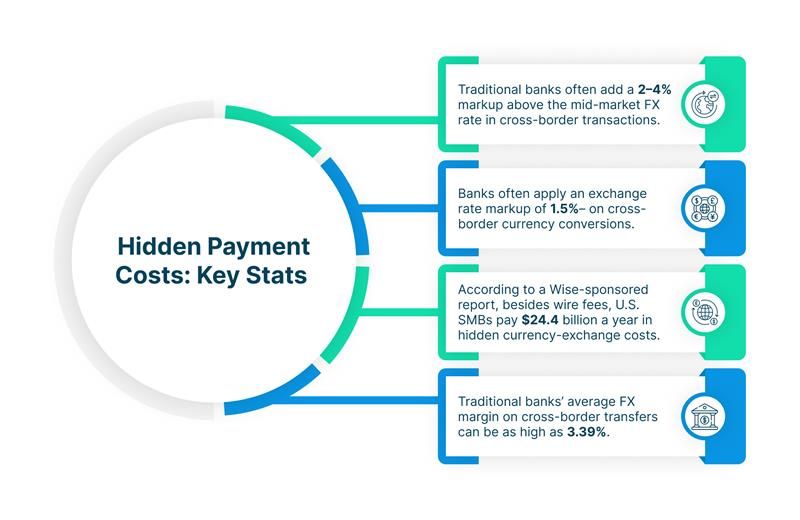
Hidden payment costs: Key stats
- Traditional banks often add a 2–4% markup above the mid-market FX rate in cross-border transactions.
- Banks often apply an exchange rate markup of 1.5%–7.5% on cross-border currency conversions.
- According to a Wise-sponsored report, besides wire fees, U.S. SMBs pay $24.4 billion a year in hidden currency-exchange costs.
- Traditional banks’ average FX margin on cross-border transfers can be as high as 3.39%.