

Auditors don't ask finance teams to promise their controls work. They ask for proof, and proof built from spreadsheets and manual sign-offs rarely survives the sampling process intact. SOC compliance, whether it's a SOC 1 report for controls over financial reporting or a SOC 2 report for data security and processing integrity, depends on evidence that a control operated consistently, not just that a policy exists on paper.
Agentic payment reconciliation is changing what that evidence looks like. Instead of software that simply flags a mismatch for a human to sort out, AI agents now investigate the discrepancy, reason through the likely cause, and resolve it within a defined confidence threshold, escalating only when a decision genuinely needs a human call. For SOX compliance accounting and SOC audit programs, that shift matters because it doesn't just speed up reconciliation, it generates a richer, more defensible audit trail than rules-based automation ever could. This guide covers how SOC 1 and SOC 2 differ, how agentic reconciliation differs from older automation, and what to look for in a platform built for audit-ready operations.
Key Takeaways
- SOC compliance splits into two distinct reports: SOC 1 covers controls over financial reporting, while SOC 2 covers data security, availability, and processing integrity. Many finance and fintech organizations need both.
- Agentic payment reconciliation uses AI agents that investigate exceptions and resolve them autonomously within a confidence threshold, unlike rules-based automation, which simply queues exceptions for a human to review.
- 8% of companies disclosed a material weakness in internal controls in a recent five-year study, and financial close and reporting was the process area with the highest concentration of weaknesses.
- Finance professionals at organizations using AI robustly spend 20 to 30% less time on data work, freeing capacity for the review and governance work SOC and SOX audits actually test.
- Gartner predicts more than 40% of agentic AI projects will be canceled by the end of 2027 due to inadequate risk controls, which is exactly why governance and audit trails matter more with agentic systems, not less.
What Is SOC Compliance? SOC 1 vs. SOC 2
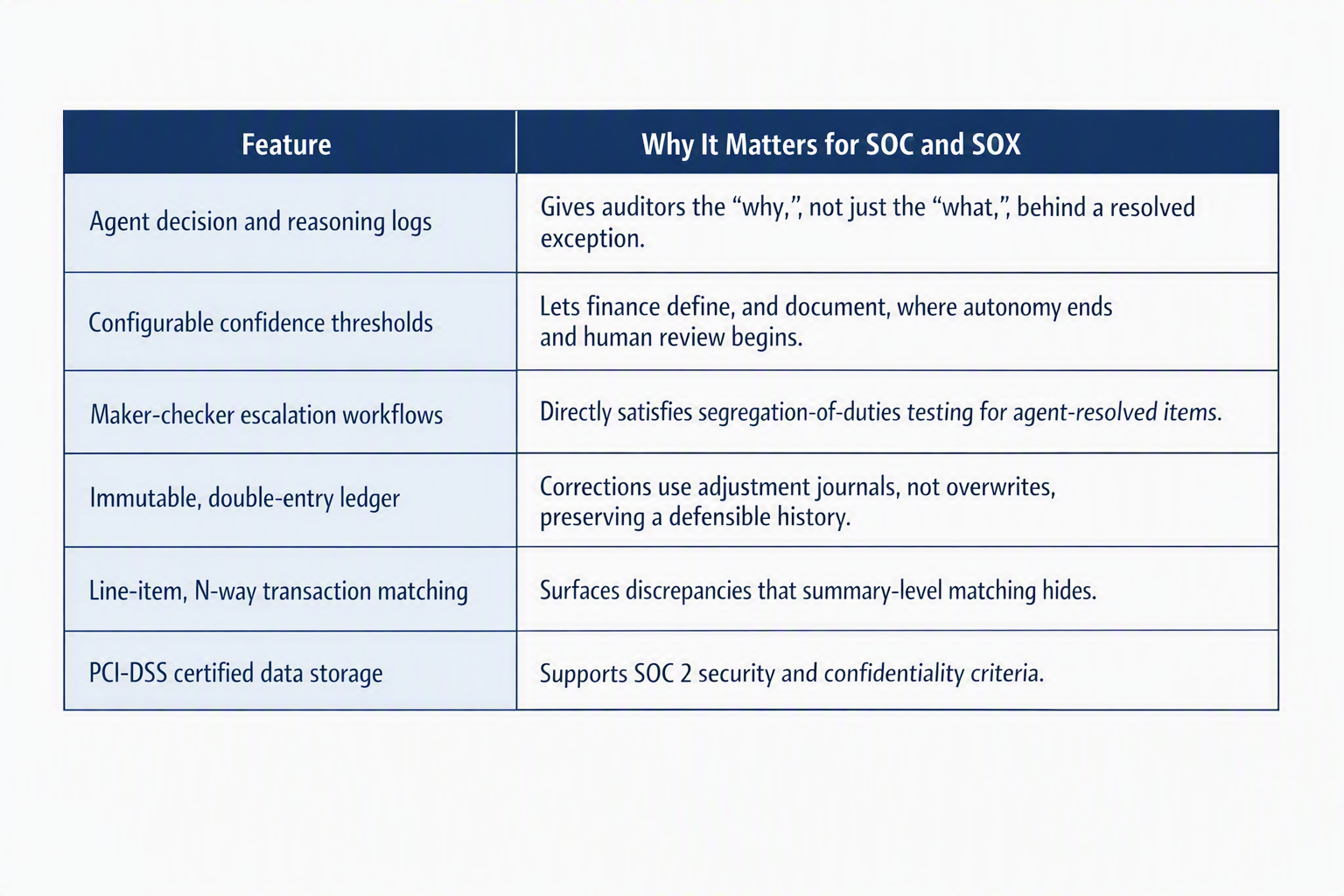
SOC compliance refers to a System and Organization Controls report issued after an independent audit of a company's controls. SOC 1 evaluates internal controls over financial reporting, the kind that matters when a vendor's service could affect a client's financial statements, such as billing, payroll, or transaction processing. SOC 2 evaluates operational controls across five trust service criteria: security, availability, processing integrity, confidentiality, and privacy.
Fintechs and finance platforms often need both. If your reconciliation, ledger, or payment processing touches a client's financial statements, that's SOC 1 territory. If you're also handling and securing their data as a cloud or SaaS provider, that's SOC 2. A Type I report is a point-in-time snapshot of control design; a Type II report tests whether those controls actually operated effectively over an observation window, usually three to twelve months, which is what most enterprise buyers require.
Automated vs. Autonomous vs. Agentic Reconciliation
The word "automated" gets used loosely, and it matters for compliance because each approach generates a different kind of evidence. Agentic payment reconciliation is a specific step beyond older automation, not a rebrand of it
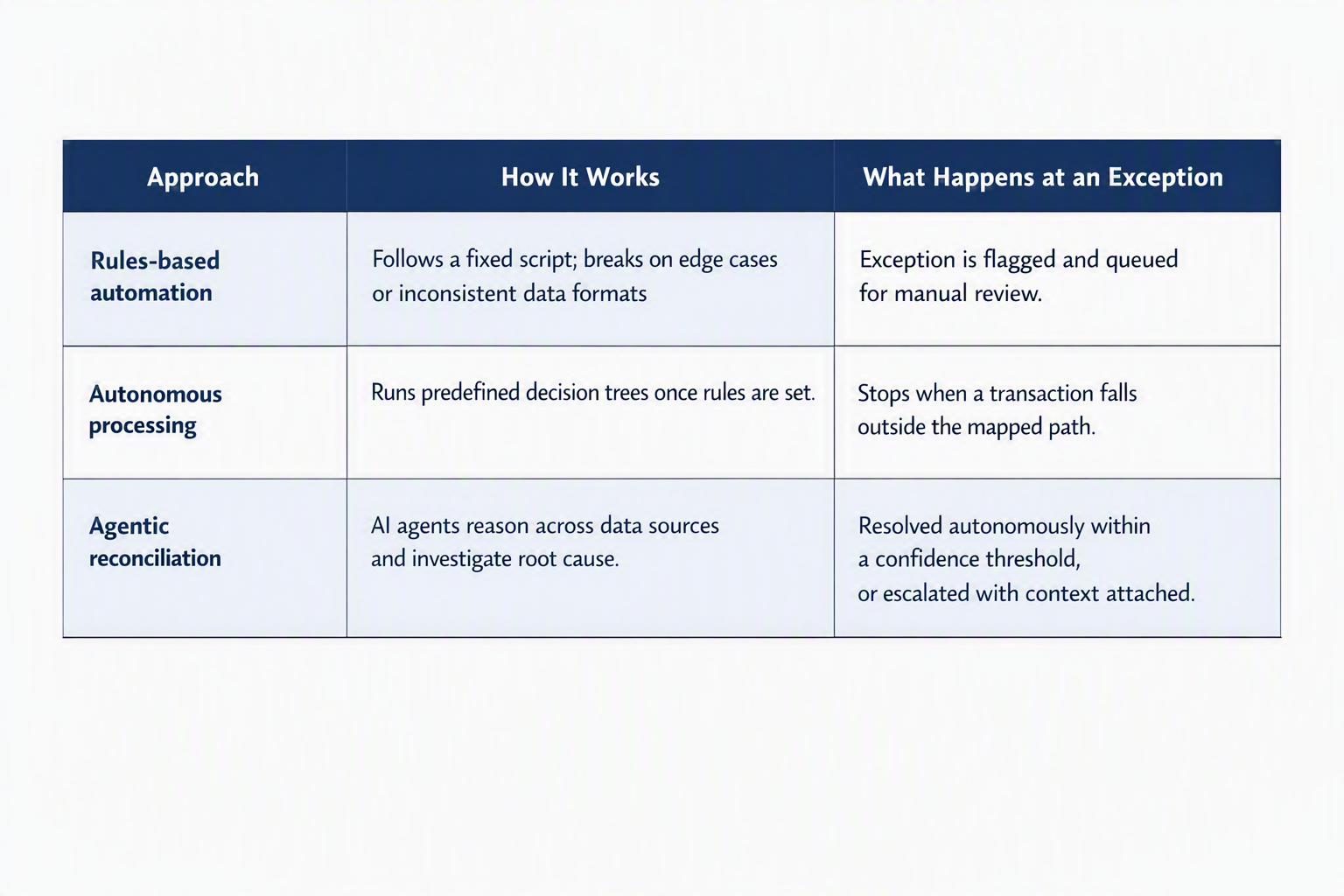
As Optimus frames it in its own comparison of agentic vs. autonomous financial operations, autonomy removes effort, while agency replicates judgment. That distinction is exactly what an auditor cares about: a system that can show why an exception was resolved a certain way produces stronger evidence than one that only shows that it was resolved.
SOC 1 vs. SOC 2 vs. SOX: How They Compare
Why Agentic Payment Reconciliation Strengthens SOC and SOX Compliance
Reconciliation sits at the intersection of all three frameworks because it's the mechanism that proves financial data is complete, accurate, and reviewed. SOX compliance accounting requires that companies record, process, summarize, and report financial data in a timely and accurate manner, demonstrated account by account. The gap narrows once reconciliation becomes agentic rather than merely automated.
- Material weaknesses concentrate in financial close: In a five-year study of annual report disclosures, 8% of companies reported a material weakness, and financial close and reporting was the process area with the highest concentration of them.
- Manual review capacity is scarce: Finance professionals at organizations using AI robustly spend 20 to 30% less time on data work, time that shifts toward reviewing agent decisions and exceptions, which is precisely the control activity SOC and SOX audits test.
- Spreadsheets remain the default, and the risk: 56% of financial institutions still rely on spreadsheets for reconciliation, a dependency that shows up repeatedly in auditor findings as a documentation and control gap.
- Leakage compounds the risk: Undetected fee discrepancies and missed chargebacks can erode 1 to 5% of EBITDA, a variance auditors will ask finance to explain if it isn't already documented.
How Agentic Payment Reconciliation Supports the Audit
A well-built agentic reconciliation platform uses specialized agents working in coordination, and each one generates a distinct artifact an auditor can sample against.
- Data Fusion Agent: Normalizes payment data from PSPs, banks, and ERPs into a consistent structure, creating a documented, repeatable ingestion process instead of ad hoc exports.
- Matching and Exception Agents: Perform N-way matching, investigate discrepancies autonomously, and log the reasoning behind each resolution, turning exception management into an evidenced control instead of an email thread.
- Orchestration Agent: Coordinates the workflow and routes escalations to a human reviewer, satisfying the segregation-of-duties control auditors test in every SOC and SOX walkthrough.
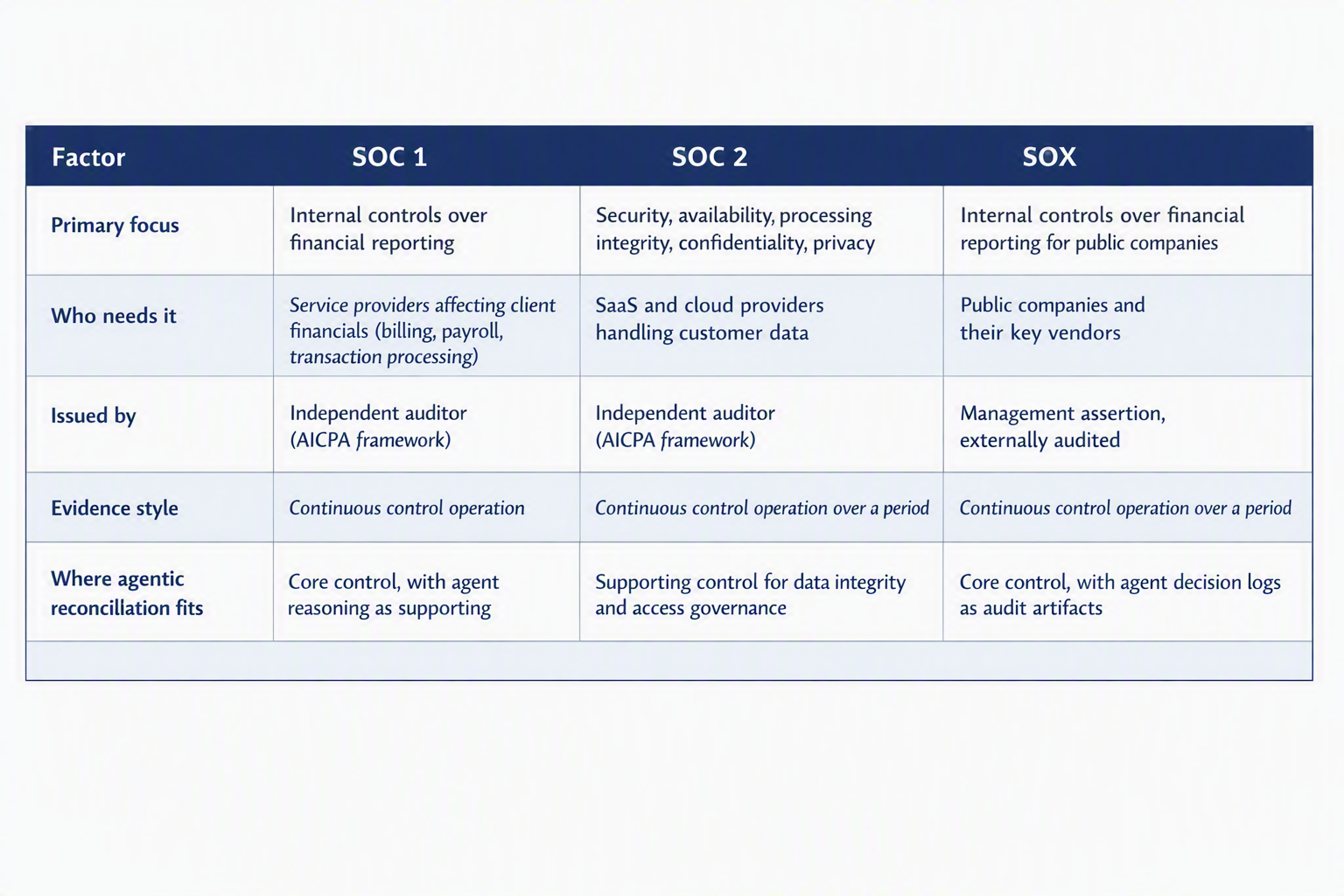
- Immutable audit trail: Corrections post through adjustment journals rather than overwrites, so every agent decision and human override is attributable to a timestamp and a source document.
Governance: Why Agentic AI Needs Stronger Controls, Not Fewer
Autonomy at the transaction level raises the stakes on governance. Gartner predicts more than 40% of agentic AI projects will be canceled by the end of 2027, citing inadequate risk controls as a leading cause. For SOC and SOX programs, that finding is a design requirement, not a reason to avoid agentic reconciliation.
- Confidence-threshold escalation: Agents resolve only what they can justify and route the rest to a human, with the threshold documented as a control.
- Explainable decisions: An auditor needs to see why an agent matched or adjusted an entry, not just that it did.
- Human-in-the-loop approval: Maker-checker workflows still apply; the agent prepares, a person approves anything outside its confidence band.
Common Reasons SOC and SOX Audits Fail
The same root causes surface across studies of control failures, and most trace back to undocumented or ungoverned processes, whether manual or automated.
- Lack of documentation and consistent procedures: The single most common driver of disclosed material weaknesses.
- Weak segregation of duties: One person, or one ungoverned agent, preparing and approving the same reconciliation is a finding waiting to happen.
- Summary-level, not line-item, reconciliation: Matching totals instead of transactions hides the individual discrepancies an audit sample is designed to catch.
- Unexplainable AI decisions: An agent that resolves exceptions without a logged rationale creates the same evidence gap a spreadsheet does, just faster.
Key Features to Look for in Agentic Reconciliation Software for Compliance
Not every tool marketed as "agentic" is built with audit evidence in mind. Evaluate vendors against this checklist:
Achieve Audit-Ready Operations With Optimus
Optimus builds agentic payment reconciliation software for high-volume finance teams that need to pass SOC 1, SOC 2, and SOX audits without a quarterly scramble. Explore the Security & Compliance overview for full details on certifications and controls.
- Coordinated agent architecture: A Data Fusion Agent, Matching Agent, Exception Agent, and Orchestration Agent each generate their own auditable trail.
- Confidence-based escalation: Agents resolve what they can justify and route the rest to a human reviewer, with the threshold itself documented.
- Immutable double-entry ledger: Every match and adjustment is logged and attributable, by design.
- PCI-DSS certified storage: Enterprise-grade security supporting SOC 2 criteria out of the box.
Frequently Asked Questions About Continuous Ledger Accounting
What is the difference between SOC 1 and SOC 2 compliance?
SOC 1 evaluates internal controls over financial reporting, relevant when a vendor's services could affect a client's financial statements. SOC 2 evaluates operational controls for security, availability, processing integrity, confidentiality, and privacy, relevant for SaaS and cloud providers handling customer data. Many finance and fintech companies need both.
What is agentic payment reconciliation, and how is it different from automated reconciliation?
Agentic payment reconciliation uses AI agents that match transactions, investigate discrepancies, and resolve exceptions autonomously within a defined confidence threshold, escalating to a human only when judgment is genuinely required. Rules-based automation, by contrast, follows a fixed script and simply queues every exception for manual review.
Does SOX compliance accounting require automated or agentic reconciliation?
SOX does not mandate a specific technology, but it requires timely, accurate financial reporting backed by demonstrable internal controls. Agentic reconciliation can strengthen that evidence by logging the reasoning behind each resolved exception, provided confidence thresholds and escalation paths are documented and governed.
How long does it take to become SOC 2 compliant?
A SOC 2 Type I report, a point-in-time assessment, typically takes 2 to 6 months. A Type II report, which tests controls over an observation window, usually takes 6 to 15 months end to end, including readiness work, the observation period, and fieldwork.
What is a material weakness in internal controls?
A material weakness is a control deficiency severe enough that a material misstatement in financial reporting might not be prevented or detected in time. The most common causes are missing documentation, insufficient accounting resources, weak segregation of duties, and, increasingly, ungoverned automation or AI agents.