

Your fraud prevention system just declined a $250 order. Congratulations—you stopped a fraudster.
Except you didn't. The customer was legitimate. They're a repeat buyer. Their card was valid. Their billing address matched. But your fraud filter flagged the transaction because they were shipping to their office address instead of home.
They won't retry the purchase. They won't call customer service. They'll buy from your competitor instead. And you'll never know you lost them.
According to research from Aite-Novarica, false declines cost merchants $443 billion annually globally—far outweighing the $48 billion in actual credit card fraud. Yet most businesses obsess over fraud rates while barely tracking the revenue destruction happening through overly aggressive authorization filters.
Here's the uncomfortable math: For every dollar you spend on processing fees, false declines are costing you $3 in lost revenue, wasted customer acquisition costs, and destroyed lifetime value.
The 65% Reality: Most Declined Orders Are Legitimate
Industry research consistently reveals a shocking truth: 60-65% of declined transactions are from legitimate customers, not fraudsters.
Your fraud prevention system isn't catching fraud at a 6% rate—it's rejecting good customers at a 4% rate while catching fraud at 2%. But because declined transactions disappear silently (customers don't call to complain they couldn't buy from you), most businesses never realize the magnitude of revenue they're losing.
Let's quantify this for a mid-size e-commerce business:
Monthly Metrics:
- Transaction attempts: 50,000
- Decline rate: 6%
- Declined transactions: 3,000
- Actual fraud (35% of declines): 1,050
- False declines (65% of declines): 1,950
- Average order value: $120
Monthly Impact:
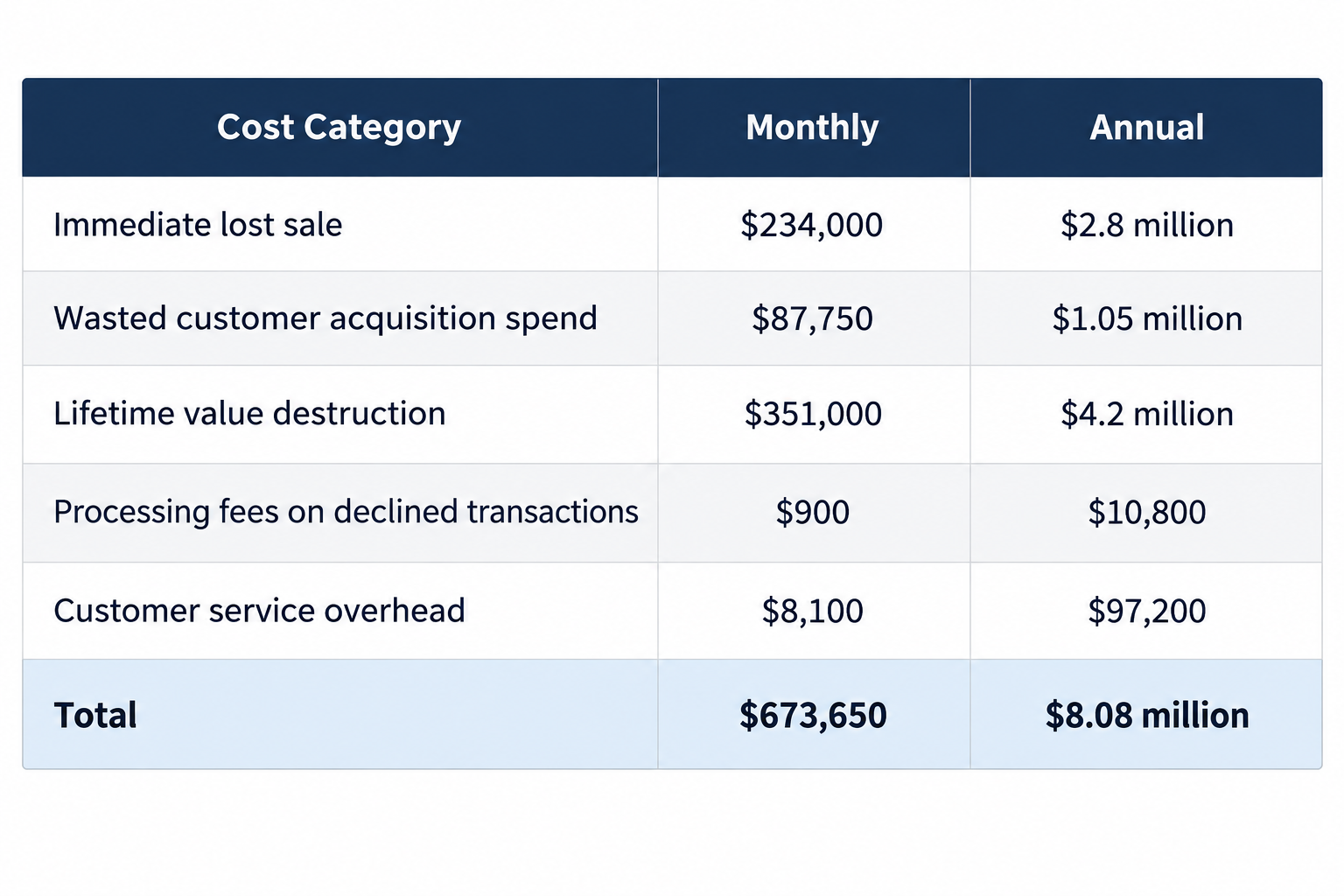
- Lost revenue from false declines: $234,000
- Annual lost revenue: $2.8 million
Now add the compounding costs:
- Customer acquisition cost waste: $45 CAC × 1,950 customers = $87,750 monthly
- Lifetime value destruction: If 40% never return, that's 780 customers × $450 LTV = $351,000 in destroyed lifetime value
- Processing fees paid on declined transactions: $0.30 × 3,000 = $900 monthly in fees for transactions that generated zero revenue
Total monthly cost: $673,650 | Annual: $8.08 million
Compare that to your annual processing fees. If you're processing $60 million annually at 2.5%, that's $1.5 million in fees. Your false declines are costing you 5.4x more than your processing fees—and most businesses aren't even measuring it.
Why Fraud Prevention Systems Over-Decline
Fraud prevention systems operate on a simple principle: when in doubt, decline. The perceived cost of approving fraud (chargebacks, lost merchandise, fees, rate increases) outweighs the perceived cost of declining legitimate customers.
This calculation is fundamentally wrong, but it persists because fraud is visible while false declines are invisible.
The Triggers That Kill Good Orders
Common fraud filter rules that generate massive false positive rates:
Billing/Shipping Address Mismatch: Customer ships to office, hotel, or friend's house → Declined. This single rule alone generates 20-30% false positive rates.
High Order Value: First-time customer places large order → Declined. You're rejecting customers precisely when they're most valuable.
Multiple Cards: Customer's first card declines due to bank error, tries second card → Declined as suspicious velocity.
International IP Address: Customer traveling abroad, expat shopping from home country → Declined. You're systematically rejecting international customers.
New Customer + High Value: Someone discovered your brand and wants to make a significant purchase → Declined. The best possible customer outcome gets rejected.
AVS Mismatch: Customer recently moved, card company hasn't updated address → Declined.
Understanding how to optimize authorization rates without increasing fraud risk requires moving beyond rigid rules to sophisticated pattern recognition that distinguishes legitimate from fraudulent behavior.
The Complete Cost Structure
A false decline doesn't just cost you the transaction value—it triggers a cascade of losses:
1. Immediate Lost Sale
$120 order × 1,950 monthly false declines = $234,000 in direct revenue loss.
2. Wasted Customer Acquisition Investment
You spent $45 in marketing to acquire each of these customers. 1,950 × $45 = $87,750 in marketing spend that generated zero return.
For subscription businesses, this is catastrophic. If customer acquisition for a $50/month subscription costs $150, and you decline them on their first payment attempt, you've lost $150 to acquire a customer who generates $0 in LTV.
3. Lifetime Value Destruction
Research shows 40-60% of customers who experience false declines never return. They don't contact you to resolve the issue—they just leave.
Conservative estimate: 40% of 1,950 = 780 permanently lost customers Average LTV: $450 Destroyed value: $351,000 monthly
This is the real killer. You're not losing a $120 transaction—you're losing $450 in lifetime value. The false decline multiplier isn't 1x—it's 3.75x before accounting for acquisition costs.
4. Processing Fees on Declined Transactions
Authorization fees apply whether transactions succeed or fail. At $0.30 per authorization:
3,000 declined transactions × $0.30 = $900 monthly in fees for transactions that generated zero revenue.
Small individually, but it compounds: $10,800 annually in pure waste.
5. Customer Service Overhead
Not all declined customers disappear silently. Some contact support, confused and frustrated:
- Declined customers contacting support: ~15% = 450 monthly
- Average support cost per inquiry: $18
- Monthly cost: $8,100 | Annual: $97,200
Support time spent explaining why legitimate customers can't buy from you is time not spent on activities that generate value. Automated payment analytics can identify systematic decline patterns before they require customer service intervention.
6. Competitive Advantage Loss
Where do declined customers go? To competitors. You're not just losing the transaction—you're potentially handing customers to competitors at the exact moment they're ready to buy.
This competitive transfer has market share implications beyond immediate revenue. Every false decline is a potential new customer for your competition.
The Fraud Prevention Paradox
Here's the uncomfortable truth: Most businesses would be more profitable with slightly higher fraud rates and significantly fewer false declines.
Consider two scenarios:
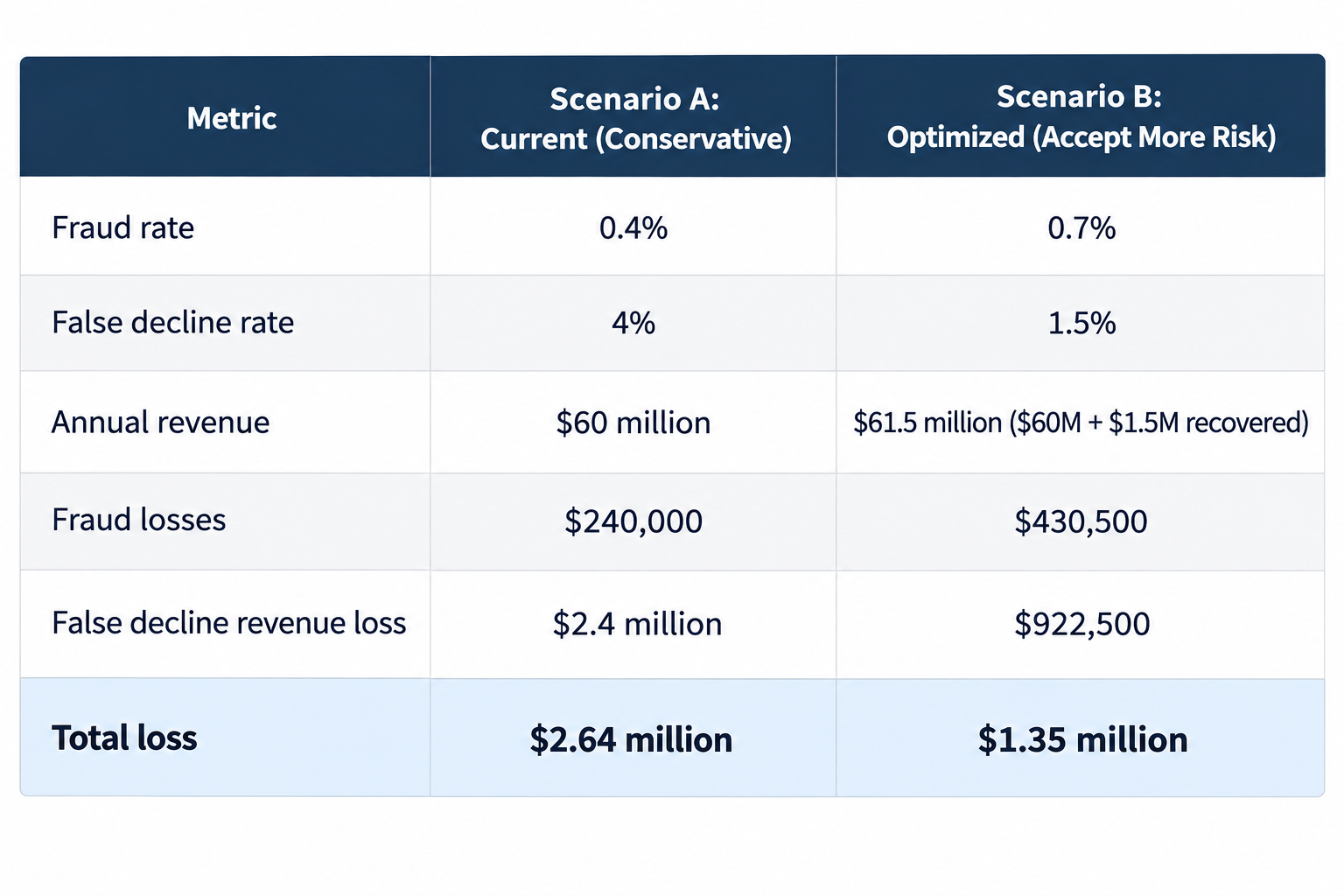
By accepting 0.3 percentage points more fraud, you save $1.29 million annually while growing revenue $1.5 million. The ROI is overwhelmingly positive, but most businesses never run this calculation.
The fear of fraud—chargebacks, account termination, monitoring programs—creates systematic over-declining that costs far more than the fraud it prevents.
What Actually Reduces False Declines
Reducing false declines without increasing fraud requires moving from rigid rules to intelligent risk assessment:
1. Machine Learning Fraud Detection
Replace static rules with ML models that learn your specific customer patterns:
- Identify legitimate behavior that looks suspicious
- Recognize fraudulent behavior even when it appears normal
- Continuously adapt as fraud patterns evolve
Businesses implementing ML fraud detection see 30-50% reduction in false positives while maintaining or improving fraud catch rates.
2. Behavioral Analytics
Analyze how customers interact with your site, not just transaction data:
- Time spent browsing before purchase
- Navigation patterns through product pages
- Mouse movement and interaction patterns
- Device fingerprinting and session analysis
Fraudsters behave differently from legitimate customers even when transaction data looks similar. Behavioral signals provide context that dramatically improves accuracy.
3. Real-Time Authorization Monitoring
Most businesses discover false decline problems months later in aggregate reports. Real-time payment analytics enables immediate response:
- Alert when authorization rates drop for specific segments
- Identify which fraud rules are generating highest false positive rates
- Track decline reasons to understand systematic issues
- Calculate true cost including lost LTV, not just transaction value
Visibility alone doesn't prevent false declines, but it enables rapid intervention before problems compound.
4. Selective Manual Review
Not all high-risk transactions deserve automatic decline. For borderline cases:
- Queue for rapid manual review (target 2-minute review time)
- Provide reviewers with comprehensive context (order history, behavioral data, device info)
- Contact customer proactively for verification rather than silently declining
Manual review costs $2-5 per transaction but recovers orders worth $200-500+. The ROI is overwhelmingly positive for borderline cases.
5. Step-Up Authentication
Instead of declining suspicious transactions, add verification:
- 3D Secure authentication for first-time high-value orders
- SMS or email verification for address mismatches
- Additional identity verification for international transactions
Friction is better than decline. 70-80% of customers complete additional verification when prompted, recovering revenue that would otherwise be lost.
6. Segment-Specific Thresholds
Fraud risk isn't uniform. Apply different tolerances based on:
- New customers: Higher risk tolerance for modest orders, stricter for high-value
- Repeat customers: Very high tolerance based on established behavior
- High-value orders: Manual review rather than automatic decline
- International: Don't automatically decline—use additional verification
One-size-fits-all fraud thresholds generate massive false positive rates because they can't account for context.
Measuring What Actually Matters
Stop tracking fraud rate as the primary success metric. Start tracking:
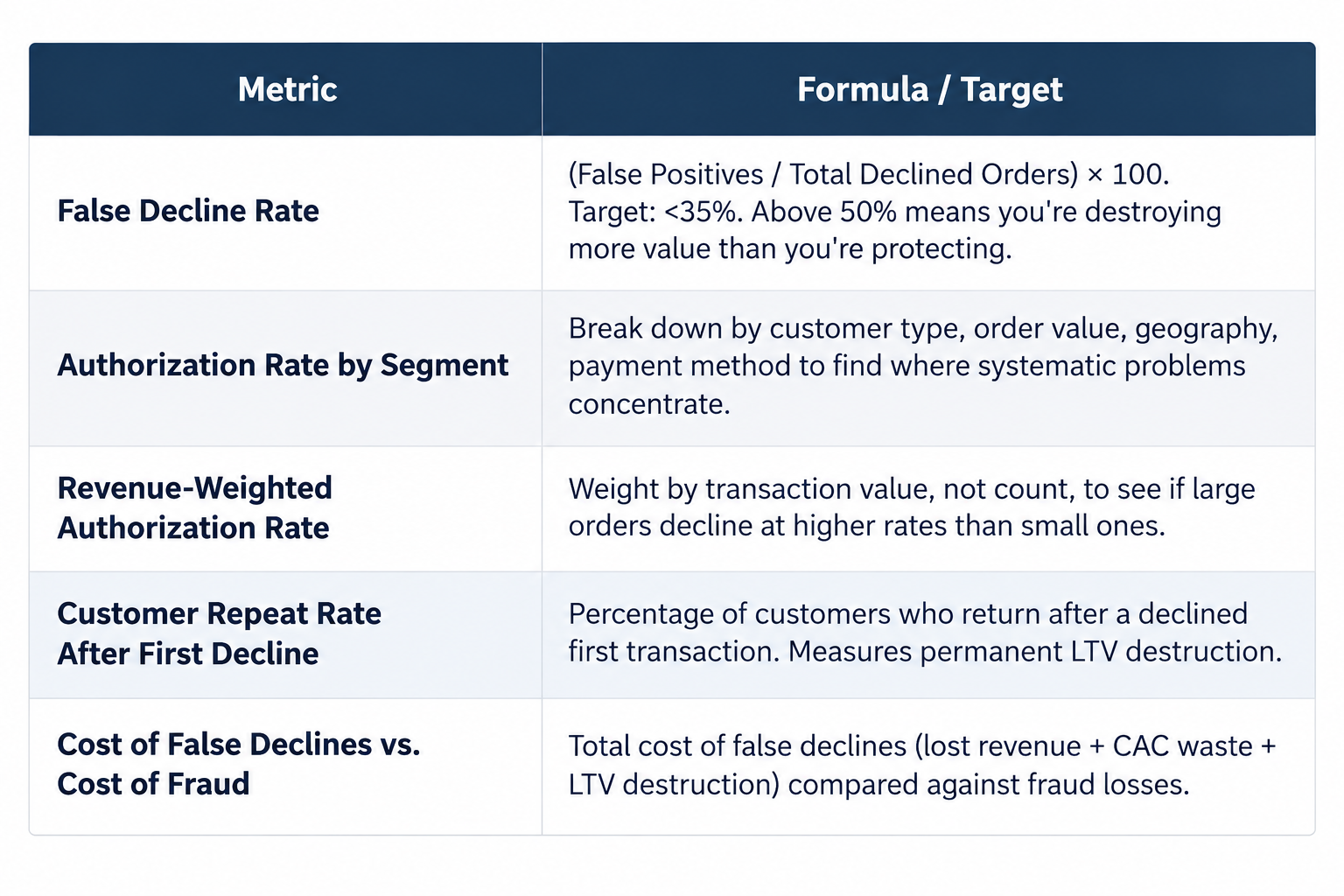
Most businesses discover that false declines cost 5-10x more than fraud—yet receive 1/10th the attention and optimization effort. Comprehensive payment reconciliation platforms provide the transaction-level visibility needed to calculate these metrics accurately.
The Bottom Line
False declines represent the largest hidden cost in payment operations—larger than processing fees, larger than fraud, larger than chargebacks for most businesses.
The average e-commerce business declines 6% of orders, with 65% being false positives. That means 4% of attempted revenue is systematically rejected—legitimate customers turned away by overly aggressive fraud prevention that's optimizing for the wrong outcome.
When you account for lost sales, wasted acquisition costs, destroyed lifetime value, and competitive advantage transfer, false declines cost $3-5 for every $1 spent on processing fees. Yet most businesses track processing fees religiously while barely measuring false decline impact.
The businesses winning in payments don't just minimize processing costs—they maximize revenue capture by optimizing authorization rates without proportionally increasing fraud. This requires sophisticated fraud prevention that distinguishes legitimate from fraudulent behavior based on hundreds of signals, not a handful of rigid rules.
Every false decline costs you far more than the transaction value. It costs you the customer's lifetime value, the acquisition investment already made, and potentially hands a customer to your competitor. That makes authorization optimization one of the highest-ROI initiatives available to e-commerce businesses.
The question isn't whether false declines are costing you money. It's whether you're measuring the impact accurately enough to prioritize solutions appropriately—and whether you're willing to accept slightly more fraud to capture significantly more revenue.
Ready to understand your false decline impact? Optimus provides real-time authorization monitoring, segment-specific decline analysis, and automated detection of systematic authorization problems—helping businesses improve authorization rates by 2-5 percentage points while maintaining fraud controls.
Schedule an authorization analysis to see exactly where legitimate customers are being declined and how much revenue you could recover through intelligent fraud optimization.
Frequently Asked Questions
What percentage of declined transactions are actually fraud?
Industry research indicates 60-65% of declined transactions come from legitimate customers, not fraudsters. In a typical 6% decline rate, roughly 4 percentage points are false declines and only about 2 percentage points are actual fraud.
How much do false declines cost compared to processing fees?
When lost revenue, wasted customer acquisition spend, and destroyed lifetime value are all accounted for, false declines typically cost businesses $3 to $5 for every $1 they spend on processing fees.
What is a good false decline rate target?
A reasonable target is a false decline rate below 35% of total declined orders. If false declines make up more than 50% of your declines, you're likely destroying more revenue than the fraud prevention is protecting.
Should businesses accept more fraud to reduce false declines?
In many cases, yes. Modeling shows that accepting a modest increase in fraud rate (for example, 0.4% to 0.7%) while cutting false declines can substantially reduce total losses and grow revenue, since false declines typically cost far more than the fraud they're meant to prevent.
What reduces false declines without increasing fraud risk?
The most effective approaches include machine learning fraud detection that learns customer-specific patterns, behavioral analytics, real-time authorization monitoring, selective manual review for borderline cases, step-up authentication instead of outright declines, and segment-specific risk thresholds rather than one-size-fits-all rules.