

If you have ever watched a talented finance professional spend their entire day matching transaction numbers across multiple spreadsheets, you know something is fundamentally wrong. These teams are meant to analyze business strategy, forecast growth, and solve complex problems. Instead, they are spending time on work that machines can perform more accurately in seconds.
This isn't about cutting costs or replacing people. It's about recognizing that manual payment reconciliation is stealing potential from your organization and from the people doing the work. The good news? The solution exists, and companies are already seeing transformative results.
The Hidden Cost of Staying Manual
What Your Team Actually Spends Their Time On
Talk to any finance manager, and you will hear a familiar frustration. According to Forwardly's research, businesses spend up to 15 hours per week on payment reconciliation, depending on transaction volume. For growing PSPs and fintechs, that number balloons quickly.
Here's what really stings: nearly 30% of finance professionals' time is spent on manual reconciliation work that's repetitive, error-prone, and completely disconnected from strategy. If you are paying a finance analyst $80,000 a year, roughly $24,000 of that salary goes toward manual spreadsheet data entry. Multiply that across a five-person team, and you are effectively spending $120,000 annually on low-value work.
And the real cost isn’t just the money.
It's watching smart people get trapped doing work that doesn't challenge them, while your organization leaves strategic opportunities on the table.
The Accuracy Problem Nobody Wants to Admit
Here's the uncomfortable truth: humans can't reconcile at scale without mistakes. Transposed numbers, duplicate entries, timing mismatches between platforms; these errors are inevitable when you're manually processing thousands of transactions. Organizations typically lose about 5% of annual revenue to fraud and financial irregularities, and because these errors hide in spreadsheets, they often go unnoticed for weeks.
That's not your finance team's fault. It's a design problem. Humans weren't built to catch needles in data haystacks.
What Automation Actually Delivers
Automation reduces reconciliation time by 70-90%, meaning a team spending 40 hours weekly could reduce to 4-8 hours, freeing up 1,664-1,872 hours annually. At $35 per hour, that's nearly $65,000 in recovered capacity.
But the real win is what happens to those freed-up hours. Instead of living inside transaction logs and reconciliations, finance teams regain time to analyze performance, forecast cash flow, identify risks earlier, and make better decisions. That transition from repetitive work to strategic thinking is where lasting value is created.
Machine Learning: The Game Changer
Why Machines Beat Rules
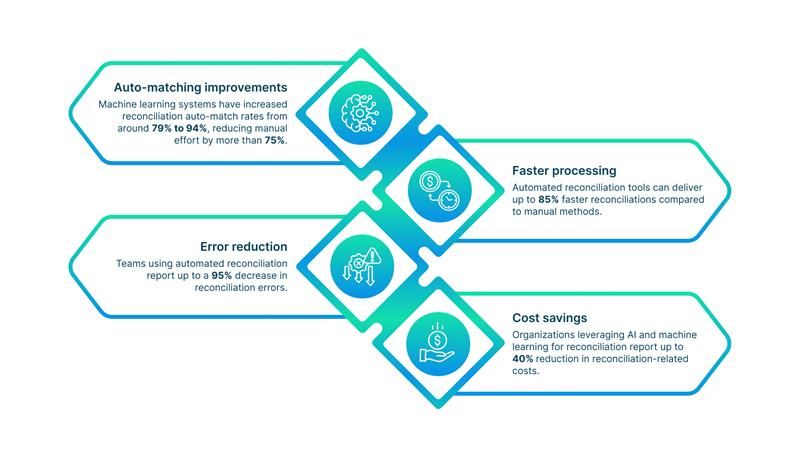
Traditional reconciliation systems use static rules: "If column A equals column B, match the transaction." These rules shatter the moment reality gets complicated. Automation platform uses machine learning to analyze spending patterns, automatically categorize transactions, and flag anomalies in real time, improving continuously as it processes more data.
The difference is profound. Machine learning systems learn from your specific business context. They recognize which vendor payment variations are legitimate, which timing gaps are normal, which transactions actually signal fraud. The accuracy improves constantly because the system is learning from your real data.
61% of AP systems now have AI-powered fraud detection built in, up from 55% just a year ago. Organizations using these systems report a 37% reduction in financial losses due to fraud, not just catching more fraud, but preventing it before money leaves the system.
What Your Team Becomes
When the grind work disappears, your finance team transforms. Instead of auditing transactions, they analyze insights. Instead of reacting to errors after discovery, they prevent them before they occur. They become strategists instead of data entry clerks.
According to KPMG's 2024 survey, 92% of firms view generative AI as critical for audits, with staff finally able to focus on interpreting results rather than manual data processing. Your auditors spend less time extracting data and more time asking meaningful questions about your business.
The Financial Case
Numbers That Justify the Investment
The AP automation market reached $1.47 billion in 2025, up from $1.29 billion in 2024, companies are voting with their wallets because the returns are real.
Businesses typically save 5-10x their annual software cost in the first year. Invest $15,000 and realize $75,000-$150,000 in benefits. ADU increased productivity by 88% and now processes 1,500 invoices monthly up from 800 without hiring additional staff.
The specific improvements matter: automated reconciliation reduces errors by 95%, saving approximately $14,250 annually in error remediation. It also improves Days Sales Outstanding (DSO) by 15-30%, freeing up $280,000 in working capital for a $10 million revenue business.
Compliance Gets Easier
AI generates comprehensive audit trails automatically, so when auditors request documentation, you have complete records ready. No scrambling. No gaps. The SEC's 2025 priorities specifically address AI systems, requiring complete audit trails for all AI-driven decisions.
Progressive organizations have realized something important: automation doesn't help you pass audits. It makes compliance automatic.
The Movement is Already Happening
Over 70% of finance leaders actively use AI in operations as of 2024. These aren't tech companies. They're traditional finance teams who recognized that the cost of staying manual is now higher than the cost of automating.
The real question isn't whether to automate, it's how fast you can move. The winners won't just save money. They will unleash their finance teams to do what they were actually hired to do: think, analyze, and drive business value.
Your people deserve better than spreadsheets. Your business deserves better than hidden errors. The technology is ready. The only question is: are you?
Here's what really stings: nearly 30% of finance professionals' time is spent on manual reconciliation, work that's repetitive, error-prone, and completely disconnected from strategy. If you're paying someone $80,000 annually to be your finance analyst, roughly $24,000 of that salary is being spent on spreadsheet data entry.