
Blog
Financial Reconciliation Software: Fixing Common Reconciliation Errors
Fix reconciliation errors with financial reconciliation software. Improve accuracy, reduce manual work, and scale financ...
Learn how enterprise platforms handle payout reconciliation at scale, from data unification and automated matching to exception handling and audit trails.

Nov 20, 2026

It’s the third business day of the month. Your bank shows one deposit from a payment processor, but behind it sit 40,000 orders, a few hundred refunds, a stack of chargebacks, processing fees and a rolling reserve. Your ledger expects gross sales. The bank shows a net figure. Somewhere in between, money is either missing or simply hasn’t been explained yet, and your team has to find out which before the books can close.
That gap is what payout reconciliation is about. At low volumes, a careful analyst with a spreadsheet can close it. At enterprise scale, across multiple payment providers, currencies, marketplaces and bank accounts, manual matching stops working. That’s why enterprises move to enterprise reconciliation software: to turn lump-sum payouts into verified, line-by-line records automatically.
This guide covers how enterprise platforms handle payout reconciliation at scale, how the main approaches compare, how AI recon agents are moving teams from automated to autonomous reconciliation, and what finance teams can do now to reduce friction in high-volume payouts.
Payout reconciliation is the process of matching each payout received from a payment service provider (PSP), marketplace or acquirer against the individual transactions, fees, refunds and adjustments that make it up, then confirming the net amount landed in the bank.
At scale, the same process runs across millions of transactions, several providers and multiple entities, usually every day rather than once a month. Enterprise reconciliation software automates this by ingesting data from every source, matching it at the transaction level and flagging only the items that need a human decision.
A single payout can combine gross sales, processing fees, refunds, chargebacks, reserves and FX conversions. Unless the payout is broken back into its parts, the finance team can see that the totals differ but not why.
Order data lives in the commerce platform, settlement reports sit in PSP portals, deposits appear in bank statements, and the ledger lives in the ERP. Each uses different formats, IDs and timing. Research by SSON found that 86% of organizations still reconcile in spreadsheets, even with close management platforms in place, and 69% name reconciliations as a major source of manual effort in the close.
Settlement windows differ by provider, card network and region. A sale recorded on the 31st may settle on the 2nd, which shows up as a “discrepancy” even when nothing is wrong. Multiply that by thousands of transactions and the exception queue fills up with noise.
The result is a slower, more error-prone month-end. In a 2024 Gartner survey of 497 controllership professionals, 18% of accountants said they make financial errors at least daily, and 59% make several errors a month. Effort isn’t the issue either. Unit4 research reported by IT Brief found that 84% of finance teams spend excessive time on tasks that could be automated.
Most mature platforms follow the same basic flow, whatever tools they use.
The first step is pulling order data, PSP settlement files, marketplace reports, bank statements and ledger entries into one place, through APIs or scheduled file imports. The data is then standardized so dates, currencies, transaction IDs and fee labels mean the same thing across sources.
Each payout is broken into its components: gross sales, fees, refunds, chargebacks, reserves, taxes and FX. Once a payout is itemized, every part of the gap between ledger and bank has a clear explanation.
Instead of comparing two files, enterprise platforms match three or more sources at once: order to PSP transaction, PSP transaction to payout, payout to bank deposit, and deposit to ledger. This is often called N-way payment reconciliation, and it’s what makes high volumes manageable. Good matching engines also handle one-to-many and many-to-many relationships, such as one deposit covering several days of settlements.
This is where automated reconciliation becomes autonomous. In older setups, rules clear the routine matches and everything else lands in a queue for people to investigate. In autonomous payout reconciliation, AI recon agents work through that queue: they find the likely cause of each break (missing settlement, fee variance, duplicate refund, unmatched deposit), gather the evidence and resolve it within approval limits you set.
Anything above those limits, or anything the agent isn’t sure about, goes to the right owner with full context. Your team reviews and approves decisions instead of investigating every break.
Matched results generate journal entries automatically, including fee, refund and clearing-account postings. Many enterprises run this daily or nightly instead of at month-end, so issues surface within a day and the close becomes a confirmation step rather than an investigation.
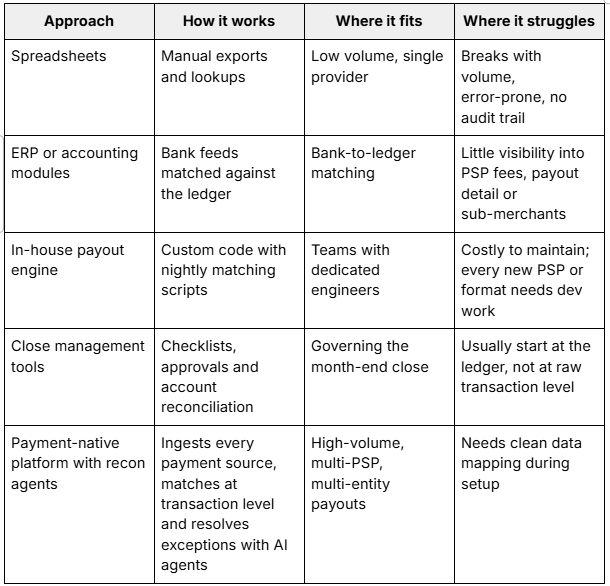
Many enterprises combine two of these, for example a close management tool for governance and a payment-native platform for payout and transaction-level matching.
Teams that automate successfully rarely switch everything on at once. A phased rollout lowers risk and builds trust in the numbers.
The appetite for this is clear. In a Gartner survey of 155 finance executives, 55% said they were aiming for a touchless financial close. A touchless close isn’t possible while people still investigate every payout break by hand.
If you only change a few things this quarter, use this checklist:
Unresolved breaks are expensive. An IDC InfoBrief shared by Amazon Business found that 35% of survey respondents spend more than five hours resolving a single reconciliation issue. Reducing payment reconciliation friction in high-volume payouts is mostly about stopping exceptions from building up in the first place.
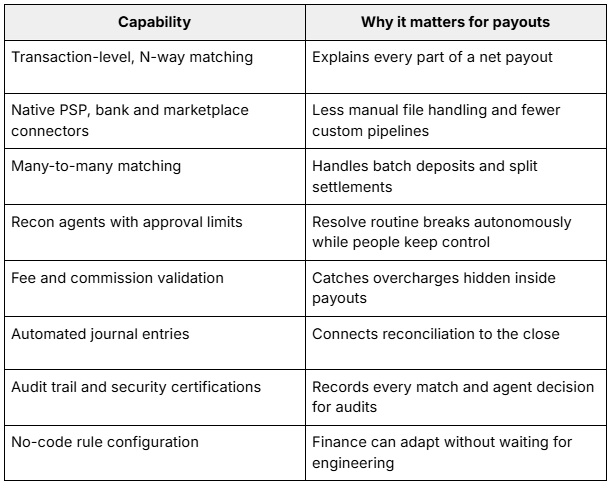
Choosing well also prepares you for where the market is heading. Gartner predicts that finance organizations using cloud ERP applications with embedded AI assistants will see a 30% faster financial close by 2028. Autonomous payout reconciliation feeds directly into that faster close.
Optimus is built for high-volume payment and payout operations. Rather than reconciling each provider separately, it brings payout, payment, bank and ledger data into one place and uses AI agents to reconcile across all of them.
Here’s how it addresses the challenges above:
For marketplaces, this also covers seller payout reconciliation, where seller payouts, commissions, refunds and fees all need to tie together.
When you send thousands of payouts a day, manual reconciliation turns every failure into a fire drill. A single failed, delayed or duplicated payout can mean an unhappy partner, a support ticket and a gap in your books.
Enterprise reconciliation software centralizes your data, tracks every payout through its lifecycle and, with recon agents, resolves problems before they reach your partners or your books. Optimus brings payout, bank and ERP data into one view, so your team can spot a break early and close it fast. Book a demo and walk through your current payout reconciliation flow with the Optimus team.
Ans. Enterprise reconciliation software automatically matches financial data across payment providers, banks, marketplaces and ledgers at high volumes. It flags or resolves exceptions, posts journal entries and keeps an audit trail, so finance teams review only what needs attention.
Ans. They break each payout into its components (sales, fees, refunds, chargebacks, reserves and FX), match each part to the source transactions, and then match the net amount to the bank deposit and the ledger.
Ans. Most start by mapping every payout source, automating the highest-volume provider first, setting matching rules, tolerances and agent approval limits, running in parallel with the manual process, and then expanding provider by provider.
Ans. Autonomous payout reconciliation uses AI recon agents to investigate and resolve exceptions, not just match transactions. Agents work within approval limits set by the finance team and route anything outside those limits to the right person with evidence.
Ans. Bank reconciliation confirms the ledger matches the bank statement. Payout reconciliation goes one level deeper and verifies that each provider payout correctly reflects the underlying transactions, fees and adjustments before it reaches the bank.
More perspectives from our Payment Reconciliation topic collection.
Fix reconciliation errors with financial reconciliation software. Improve accuracy, reduce manual work, and scale financ...

Critical considerations for selecting the right reconciliation product to future-proof accounting and finance operations...

Uncover how to enhance efficiency and eliminate reconciliation delays through streamlined operations, ensuring smooth fi...

1700 Montgomery St, San Francisco, California 94111
6470 E Johns Crossing Suite 160, Johns Creek, GA 30097
Copyright © 2026 Optimus. All Rights Reserved.


