
Blog
Financial Reconciliation Software: Fixing Common Reconciliation Errors
Fix reconciliation errors with financial reconciliation software. Improve accuracy, reduce manual work, and scale financ...
Learn how automated payment reconciliation works step by step, from data ingestion and AI matching to recon agents, audit trails and a faster close.

Nov 23, 2026
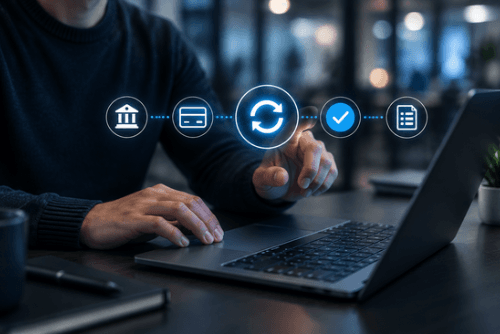
It’s 9 p.m. on the second day of closing. Three people on your finance team have spreadsheets open side by side: a PSP settlement export with 28,000 rows, a bank statement with a few hundred deposits, and an ERP extract that uses completely different reference numbers. Someone is running VLOOKUPs. Someone else is filtering by amount and hoping two numbers line up. How many of those 28,000 rows will they actually verify before the deadline?
That’s the job automated payment reconciliation takes over. Instead of people comparing files line by line, software connects to every source, matches records automatically and shows only the items that need a human decision. The newest platforms go one step further, with AI recon agents that also investigate and resolve those items.
This guide explains how automated payment reconciliation works step by step, how rules, AI and recon agents differ, what it can reconcile, and why it scales where spreadsheets fail.
Automated payment reconciliation is the process of matching payment records from different systems without manual work. Software compares data from banks, payment service providers (PSPs), acquirers, card networks and ERPs, confirms the records agree and flags any differences. For a broader definition, see our guide to automated reconciliation.
The goal is to replace manual matching with a repeatable, auditable process that runs daily instead of only at month-end.
Automation solves matching. Exceptions still land in a queue for people to investigate. Autonomous payment reconciliation adds AI recon agents: agents that carry out specific reconciliation tasks, such as resolving a fee variance or tracing a missing settlement, within limits your team sets. People move from doing the work to approving it.
Here’s what happens inside the engine, from raw data to closed books.
The software first connects to every system that holds a piece of the transaction story:
Data arrives through APIs, secure file transfers or scheduled imports. The goal is simple: no source is left in a separate spreadsheet. Optimus calls this payment data aggregation, handled by its Data Fusion Agent.
Every source speaks its own language. One PSP labels a field “txn_id”, the bank calls it “reference”, and the ERP stores it as a document number. Dates, currencies, time zones and fee labels all differ.
Normalization converts everything into one standard format, so a “transaction amount” means the same thing in every source.
Example: a $1,000.00 USD card sale recorded at 23:58 UTC in the PSP file might appear as $1,000 on the next calendar day in a local-time bank file. Normalization aligns the date, time zone and currency so the two can match.
Next, the engine applies matching rules. A rule defines what makes two records a match, for example:
Rules also cover different match types:
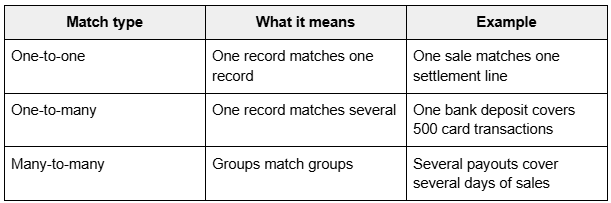
Tolerances matter. Set them too tight and you create false exceptions. Set them too loose and you risk wrong matches.
Rules handle the predictable majority. AI handles what rules can’t. Machine learning models learn from past matches and resolved exceptions, so over time they can:
This is how teams automate payment reconciliation with AI. Optimus uses AI agents for payment reconciliation, including a Recon Agent that applies N-way fuzzy matching alongside configurable rules.
Anything that doesn’t match becomes an exception. In basic automation, exceptions are simply listed for people to work through. In autonomous payment reconciliation, recon agents:
Record how each break was resolved, so the system improves
This is where finance teams spend most of their time, so it’s where autonomy saves the most hours.
Once records are matched and exceptions resolved, the software creates journal entries for fees, adjustments and clearing accounts. Every match, edit, override and agent decision is logged with who or what made it and when. Optimus ledgers reconciliation models money movement with double-entry accounting, so matched payment data turns into accurate ledger records.
Because matching runs daily or continuously, the books stay up to date all month. Dashboards show match rates, open exceptions, fee variances and cash positions as they change. That turns month-end into a review rather than a rebuild.
The three approaches build on each other. Most enterprise teams use all three together.
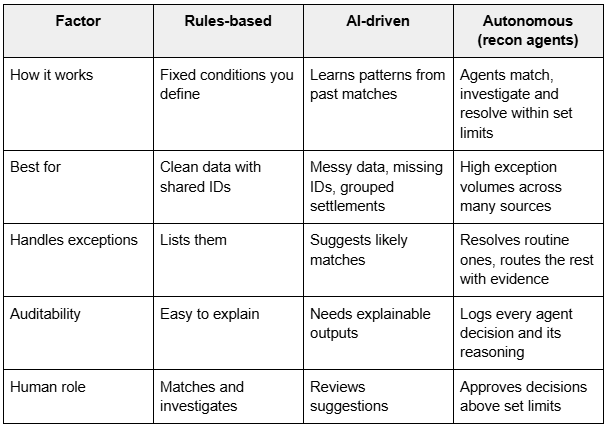
In practice, rules clear the straightforward bulk, AI handles the messy matches, and recon agents work the exceptions, so people only review what truly needs judgment.
Automated payment reconciliation works across the payment flows high-volume finance teams deal with most.
This matches transactions processed through gateways and PSPs to their settlements and payouts, then to bank deposits. The Merchant Risk Council’s 2025 Global Fraud and Payments Report found that merchants typically use 3 to 4 payment gateways and acquiring banks, and each one has its own data format.
This matches bank statements and card settlements against internal records and the ledger, so every deposit, withdrawal and card settlement is accounted for.
Processors deduct fees before paying out. Fee and commission reconciliation checks every fee against contracted rates, turning hidden processing costs into visible, recoverable amounts.
For marketplaces, platforms and fintechs, this confirms that every payout to sellers, partners or customers went out correctly and ties back to the transactions, fees and refunds behind it.
This confirms internal ledgers and balances agree with payment data, and for groups with several legal entities, matches transactions between entities across currencies so balances eliminate cleanly at consolidation.
Manual close is slow because reconciliation is pushed to the end of the month. Every problem from 30 days shows up at once. Payment reconciliation automation speeds this up in four ways:
Finance leaders want this shift. In a Gartner survey of 155 finance executives, 86% said they were aiming for a faster, real-time close, and 55% were aiming for a touchless close. Most teams are still far from that. SSON research found that 97% of organizations still rely on people to complete the close, and only 2% report full end-to-end automation.
Auditors want to know three things: what was matched, who approved it and why. Manual spreadsheets rarely answer all three. Automated payment reconciliation supports audits and compliance by:
Security matters too, because reconciliation platforms hold sensitive payment data. Optimus describes itself as a PCI- and SOC-compliant data platform.
Spreadsheets work for a few hundred rows and one data source. They break when volume, sources and currencies grow.
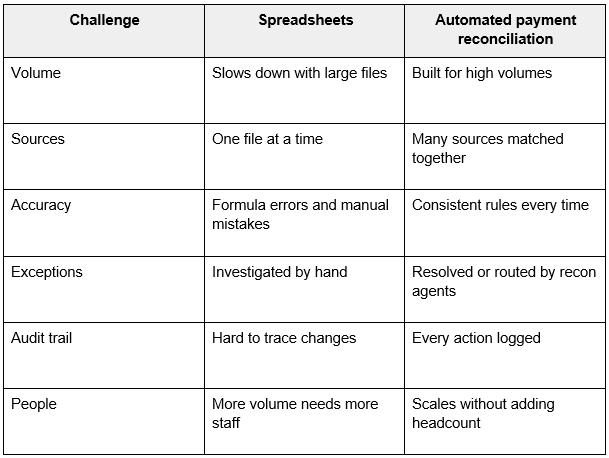
Yet spreadsheets are still everywhere. SSON research found that 86% of organizations still reconcile in spreadsheets, and that has a cost. A Gartner survey of 497 controllership professionals found that 18% of accountants make financial errors at least daily, and 59% make several errors each month.
The right tools reduce that risk. The same Gartner research found that companies with high technology acceptance (tools that are easy to use, easy to learn and customizable) see a 75% reduction in financial errors. That’s one reason no-code configuration matters. Optimus is built so finance teams can set up sources, rules and workflows without relying on engineering.
Understanding how the engine works is the first step. Seeing it run on your own data is the next. A walkthrough shows how matching, recon agents and reporting behave with your real PSP, bank and ERP files, not a clean sample set.
Optimus brings data aggregation, AI matching, autonomous exception resolution, fee and commission validation, ledgers and analytics together in one no-code platform built for high-volume finance teams. Book a demo and walk through your current reconciliation flow with the Optimus team.
Ans. Automated payment reconciliation uses rules and AI to match payment records from different systems, such as banks, PSPs and ERPs, without manual work. It confirms the records agree, flags differences and reduces manual work.
Ans. Connect every data source, normalize the data into one format, apply matching rules with tolerances, and let AI match records without shared IDs or with fee-adjusted amounts. Recon agents can then investigate and resolve exceptions within limits you set.
Ans. Automated payment reconciliation matches transactions and lists exceptions for people to investigate. Autonomous payment reconciliation uses AI recon agents that also investigate and resolve exceptions, routing only the rest to your team.
Ans. It becomes an exception. A recon agent identifies the likely cause, gathers evidence and either resolves it within approved limits or routes it to the right owner, and the resolution is recorded so similar cases are handled faster next time.
Ans. No. It clears routine matches and exceptions automatically, but people still set the rules, approve decisions above set limits and handle unusual cases. The goal is to move people from matching to reviewing and analysis.
More perspectives from our Payment Reconciliation topic collection.
Fix reconciliation errors with financial reconciliation software. Improve accuracy, reduce manual work, and scale financ...

Critical considerations for selecting the right reconciliation product to future-proof accounting and finance operations...

Uncover how to enhance efficiency and eliminate reconciliation delays through streamlined operations, ensuring smooth fi...

1700 Montgomery St, San Francisco, California 94111
6470 E Johns Crossing Suite 160, Johns Creek, GA 30097
Copyright © 2026 Optimus. All Rights Reserved.


