
Blog
Financial Reconciliation Software: Fixing Common Reconciliation Errors
Fix reconciliation errors with financial reconciliation software. Improve accuracy, reduce manual work, and scale financ...
See the real cost of manual payment reconciliation, the benefits of automating it, and a simple ROI example to judge whether it pays off for your business.

Nov 24, 2026
Yes, for most high-volume and enterprise businesses, automating payment reconciliation is worth the cost. It pays off when the time your team spends matching records by hand, the fee errors that go unnoticed and the days lost at month-end cost more than the software and setup. That usually happens once you process thousands of transactions a month, use more than one payment provider or operate across several entities. For a business with a few hundred transactions and a single PSP, a manual process may still be enough for now.
Picture yourself as a finance leader looking at a quote for reconciliation software. The number looks big. Then you look at your own team: three analysts spending the first week of every month matching PSP reports, bank statements and ERP entries, plus the fee errors nobody has time to chase. Which number is actually bigger? Manual work feels free because it’s already in the payroll, but it rarely is.
This guide shows what manual reconciliation really costs, the benefits of automating payment reconciliation, how AI recon agents change the return, and a simple way to estimate whether automation pays off for your business.
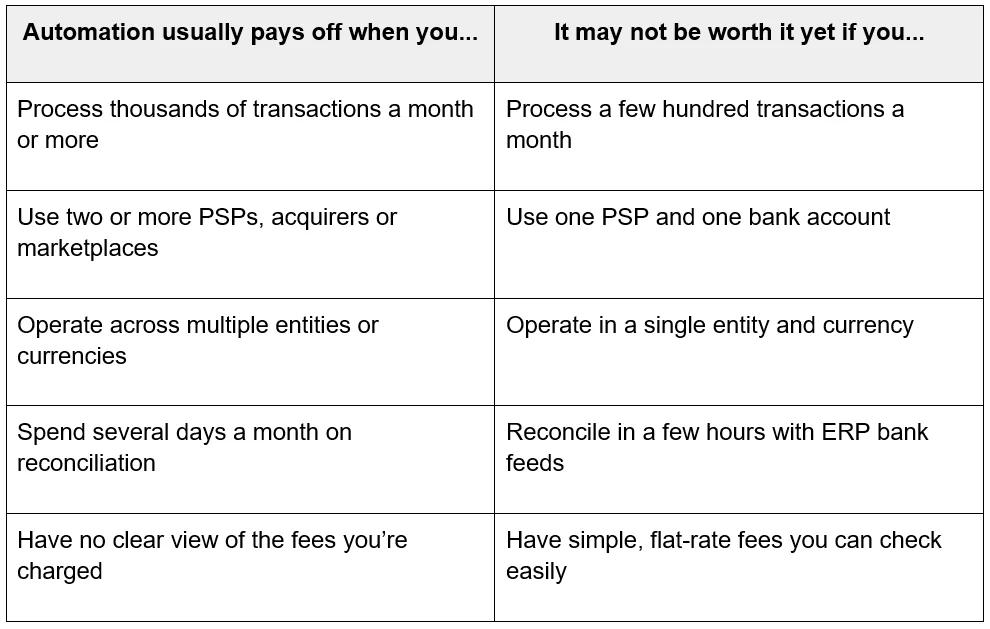
Use this quick comparison to see which side your business falls on.
Before you can put a value on automation, it helps to name the payment reconciliation challenges businesses face every month.
Orders sit in one platform, settlements in PSP portals, deposits in bank statements and entries in the ERP. Research by SSON found that 86% of organizations still reconcile in spreadsheets, even with close management platforms in place, and 69% name reconciliations as a major source of manual effort in the close.
Sales, settlements and deposits land on different days. Every gap looks like a mismatch until someone confirms it isn’t.
PSPs deposit net amounts. Without breaking payouts into their parts, overcharges and missing refunds are almost impossible to see.
Weak reconciliation leaves blind spots. According to the AFP 2026 Payments Fraud and Control Survey, 76% of organizations in the United States experienced attempted or actual payments fraud in 2025. Timely reconciliation helps finance teams identify unusual payment activity, unexplained transactions and discrepancies that may otherwise go unnoticed. It should complement, not replace, dedicated payment fraud controls.
Manual reconciliation has four costs, and only the first shows up on a budget line.
Hours go into exporting, matching and investigating, and that volume of manual work leads to mistakes. In a 2024 Gartner survey of 497 controllership professionals, 18% of accountants said they make financial errors at least daily, and 59% make several errors a month.
Investigating breaks takes far longer than matching clean records. An IDC InfoBrief shared by Amazon Business found that 35% of survey respondents spend more than five hours resolving a single reconciliation issue.
Fee overcharges, missed refunds and unrecovered chargebacks go unnoticed when nobody checks at the transaction level. This is often the largest cost, because it’s invisible.
When reconciliation is pushed to month-end, every problem from 30 days shows up at once. SSON research found that 97% of organizations still rely on people to complete the close, and only 2% report full end-to-end automation. Every extra day delays the numbers leadership needs.
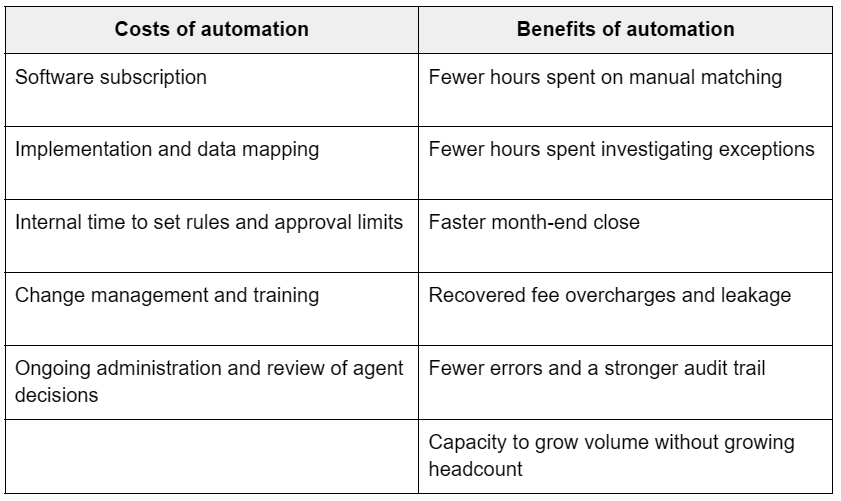
The benefits of automating payment reconciliation fall into five groups:
Traditional automation saves time on matching, but exceptions still land in a queue for people to investigate. Since exception handling is one of the most expensive parts of reconciliation, that limits the return.
Autonomous payment reconciliation goes further. AI recon agents investigate each break, gather the evidence from every source and resolve routine exceptions within approval limits your team sets. Only the cases that need judgment reach people. That moves the savings from matching alone to matching and exception handling, which is where most of the hours go.
Merchants that sell through cards, wallets and local payment methods across several PSPs face their own costs. The Merchant Risk Council’s 2025 Global Fraud and Payments Report found that merchants typically use 3 to 4 payment gateways and acquiring banks, and accept 4 to 5 payment methods on average.
The benefits of automated reconciliation for merchants include:
Use this simple formula:
ROI = (Annual labor savings + Annual recovered leakage − Annual cost of automation) ÷ Annual cost of automation
A high-volume merchant with these assumptions:
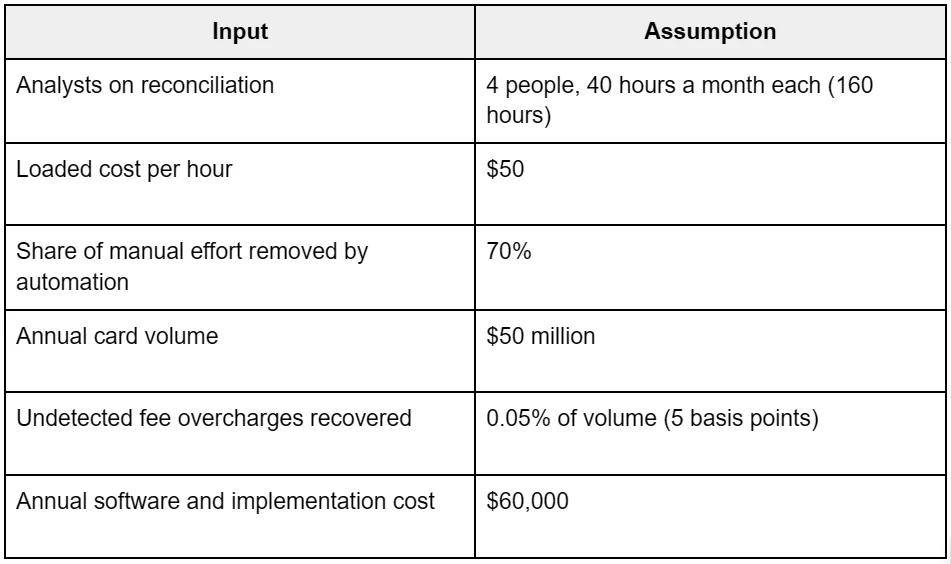
Step 1: Labor savings. 160 hours × $50 × 12 months = $96,000 a year in manual work. At 70% removed, savings are $67,200.
Step 2: Recovered leakage. $50,000,000 × 0.05% = $25,000.
Step 3: Total benefit. $67,200 + $25,000 = $92,200 a year.
Step 4: ROI. ($92,200 − $60,000) ÷ $60,000 = about 54% in year one, with payback in roughly 7.8 months.
Change the assumptions to match your own business. If your volume is higher or you use more PSPs, the leakage figure usually grows fastest. If recon agents also take on routine exceptions, the share of manual effort removed goes up too.
The return on automation depends on where the platform does its work. Most of the hidden cost sits at the payment level, in fees, refunds, chargebacks and settlement gaps, so the biggest savings come from payment reconciliation software built to reconcile there.
Less manual effort. Optimus combines AI agents for payment reconciliation, 150+ reported integrations and a PCI-DSS certified data mart in one no-code platform. Finance teams set and adjust matching rules themselves, and recon agents autonomously resolve and route exceptions instead of leaving them in spreadsheets.
Revenue you can recover. Fee errors are easy to miss when payouts arrive as net amounts. With fee and commission reconciliation, every fee is checked against the transaction it belongs to, so overcharges are flagged instead of absorbed.
A faster close. Optimus GL and Financial Close agents turn reconciled data into close-ready records, and connect payment reconciliation to financial close management, so teams get an up-to-date view of cash instead of waiting for month-end.
Tick each statement that applies:
If you ticked three or more, automation is very likely to pay for itself. If you ticked one or none, your current process may be enough for now. Revisit the decision as volume grows.
The fastest way to know whether automation is worth it is to see it run on your own PSP settlements, bank deposits and ledger entries.
Book a demo to see where time and revenue are slipping through your current process, and how much of it automated payment reconciliation can recover.
Ans. For most businesses with high transaction volumes, multiple PSPs or multiple entities, yes. The savings in labor, exception handling, recovered fee overcharges and a faster close usually exceed the software cost. Very low-volume businesses may not need it yet.
Ans. The main benefits are less manual work, fewer errors, recovered revenue from fee overcharges and missed refunds, a faster month-end close, and a stronger audit trail.
Ans. Add annual labor savings and recovered leakage, subtract the annual cost of automation, then divide by that cost. Use your own hours, hourly rates, transaction volume and fee data for an accurate estimate.
Ans. Data spread across many systems, settlement timing gaps, fees and refunds hidden in net payouts, slow exception handling, and weak visibility that increases fraud risk.
Ans. It depends on volume, complexity and cost. Businesses with high volumes and multiple payment providers often see payback within the first year, since fee recovery and labor savings start as soon as matching is automated.
More perspectives from our Payment Reconciliation topic collection.
Fix reconciliation errors with financial reconciliation software. Improve accuracy, reduce manual work, and scale financ...

Critical considerations for selecting the right reconciliation product to future-proof accounting and finance operations...

Uncover how to enhance efficiency and eliminate reconciliation delays through streamlined operations, ensuring smooth fi...

1700 Montgomery St, San Francisco, California 94111
6470 E Johns Crossing Suite 160, Johns Creek, GA 30097
Copyright © 2026 Optimus. All Rights Reserved.


