

Payment Analytics for Fees and Payouts: What Every Business Should Know
Every transaction that flows through your payment stack carries a fee. The question is whether you know what you're paying, and whether those charges match what you agreed to.
For high-volume businesses managing multiple PSPs, acquirers, and currencies, the answer is often no. This guide covers how payment analytics for fees and payouts works and the metrics that matter most. It also shows how to turn fragmented settlement data into actionable visibility.
What is payment analytics for fees and payouts
Payment analytics for fees and payouts tracks processing costs, net revenue, and cash flow timing across every transaction. In practical terms, it means collecting data from your payment service providers, acquirers, and banks. It then normalizes that data so you can see exactly what you paid in fees and what landed in your account.
This is different from general payment analytics, which typically focuses on sales volume or conversion rates. Fee and payout analytics zeroes in on the cost side: interchange fees set by card networks like Visa and Mastercard, scheme fees, and processor markups. It also tracks net settlement amounts that reach your bank after all deductions.
- Payment fees: Costs deducted by processors, acquirers, and card networks before funds settle
- Payouts: The net amount deposited into your bank account after all deductions and adjustments
- Payment analytics: The process of tracking, validating, and reporting on fee and payout figures at the transaction level
Why fee and payout visibility matters for high volume businesses
When you process thousands of transactions daily across multiple payment providers, complexity compounds quickly. Each PSP reports fees differently. Settlement timing varies.
Currency conversions add another layer of opacity. Without visibility, you're essentially trusting that every deduction is accurate, and that trust often proves misplaced.
The consequences of operating blind show up in several ways:
- Margin erosion: Hidden fees compound across thousands of transactions, spread across thousands of transactions that nobody checks individually
- Cash flow uncertainty: Unpredictable payout timing disrupts treasury planning and working capital management
- Audit exposure: Inability to trace fees back to source transactions creates compliance risk during financial reviews
- Vendor accountability gaps: Without granular data, disputing incorrect charges becomes nearly impossible
For a business processing $50 million annually, even a 0.3% discrepancy in fees represents $150,000 in potential leakage. For scale, McKinsey's Global Payments Report puts annual global payments revenue at $2.5 trillion across 3.6 trillion transactions, so small pricing errors at the transaction level add up quickly.
Core data sources behind fee and payout analytics
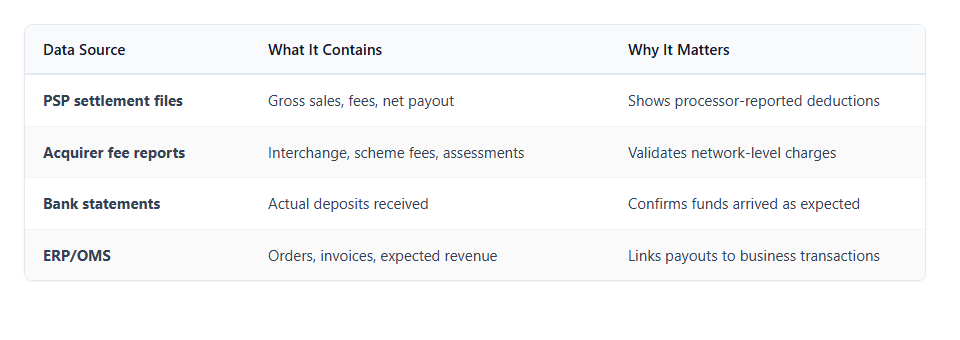
Understanding where fee and payout data originates helps explain why consolidation is so challenging. The data lives in multiple systems, each with its own format and delivery schedule.
PSP and processor settlement files
Your payment service providers generate settlement files showing gross volume, fees deducted, and net payout amounts. These files typically arrive daily or weekly, depending on your agreement.
Every provider uses a different format, field naming convention, and level of detail. What one PSP calls "processing_fee" another might label "txn_cost" or bundle into a single line item.
Acquirer and card scheme fee reports
Interchange fees (set by Visa, Mastercard, and other networks) and scheme fees appear in separate reporting from your acquiring bank. For a breakdown of how interchange fees work, see our guide to interchange fee reconciliation. These reports break down costs by card type, region, and transaction category.
Matching them to individual transactions requires careful alignment of timestamps, amounts, and identifiers. For a deeper look at this process, see Optimizing Fee Reconciliation for Faster Payment Settlement.
Bank statements and payout confirmations
Your bank statements show what actually arrived in your account. This is the ground truth for confirming whether expected payouts matched reality. Discrepancies here signal either timing differences or genuine settlement errors that warrant investigation.
ERP, billing, and order management systems
Internal systems hold the order-level and invoice-level data you need to connect settlements back to the original sale. Without this linkage, you can see what was deducted but cannot validate whether it was correct.
Key metrics to track for fees and payouts
Knowing which numbers to watch transforms raw data into actionable intelligence. The following metrics help finance teams spot problems early and benchmark performance over time.
Effective fee rate by processor and channel
Effective fee rate is your total fees divided by gross volume, expressed as a percentage. Tracking this by processor and sales channel (ecommerce versus in-store versus mobile) reveals where costs run highest.
You might find one PSP charges 2.4% while another charges 2.1% for similar transaction profiles. That difference adds up fast at scale.
Interchange and scheme fee variance
Interchange rates vary by card type, region, and how the transaction was processed. When transactions get "downgraded" to higher-cost categories (often due to missing data fields like Level 2 or Level 3 data), your costs increase. Tracking variance helps identify patterns worth addressing.
Payout accuracy and reconciliation match rate
Match rate measures the percentage of transactions successfully reconciled between processor reports and bank deposits. A falling match rate usually signals data quality issues or billing discrepancies worth investigating.
Payout latency and settlement timing
Payout latency is the number of days between transaction capture and bank deposit. Delays affect working capital and cash forecasting.
Some processors settle in one day; others take three to five. Knowing your actual timing, not just the contractual terms, matters for treasury planning.
Fee leakage and overbilling exposure
Fee leakage is the gap between your contracted rates and actual charges. This metric quantifies recoverable overcharges. Learn how to identify fee discrepancies with the Hidden Stripe Fees checklist.
Common use cases for fee and payout analytics
Analytics becomes valuable when it drives specific actions. Here are the scenarios where finance teams see the most impact.
Validating fees against contracted rates
Your processor contract specifies pricing tiers and rate structures. Analytics compares actual fees charged against those terms to detect billing errors. Even small discrepancies, when multiplied across millions of transactions, add up to meaningful amounts.
Detecting overcharges and hidden processor markups
Some processors bundle fees in ways that obscure their markup. Analytics unbundles charges to reveal true costs. You might discover that a "blended rate" actually includes a 0.15% markup above interchange that wasn't clearly disclosed in your agreement.
Reconciling multi-PSP and multi-currency payouts
Operating across multiple processors and currencies creates reconciliation complexity. Analytics normalizes data into a single view, converting currencies and aligning settlement periods so you can compare like for like across your entire payment ecosystem. For more on managing multi-gateway complexity, see Payment Analytics for Multi-Gateway Businesses.
Monitoring payout health in real time
Real-time alerting for missed, delayed, or short payouts catches problems before they become month-end surprises. Treasury teams can act immediately rather than discovering issues during close when it's too late to investigate efficiently.
Risks of operating without fee and payout analytics
Relying on manual processes or ignoring fee data entirely creates both operational and financial exposure. The risks compound over time.
- Unrecovered overcharges: Without transaction-level validation, billing errors go undetected indefinitely
- Reconciliation backlogs: Manual matching creates month-end bottlenecks and delays financial close by days
- Forecast inaccuracy: Unpredictable fee deductions and payout timing undermine cash projections
- Audit failures: Inability to produce transaction-level audit trails exposes the business to compliance findings
- Vendor lock-in: Lack of comparative cost data weakens your negotiating position with processors
Features to look for in payment analytics software
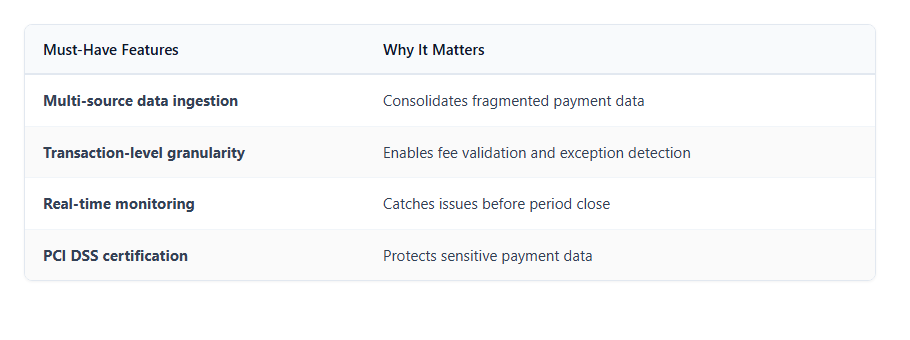
Not all analytics tools address the specific challenges of fee and payout visibility. These features matter most when evaluating options.
Unified multi-source dashboard
Consolidating PSP, acquirer, bank, and ERP data into a single interface eliminates the need to toggle between portals and spreadsheets. You see all payment channels in one place, which makes pattern recognition possible.
Transaction-level fee validation
The ability to compare each transaction's actual fees against expected fees based on contract terms is essential. Aggregate reporting hides the exceptions that matter most.
Real-time payout monitoring and alerts
Alerting for payout exceptions (missed deposits, short settlements, delays) catches issues before they become reconciliation problems at month-end.
Prebuilt integrations with PSPs, acquirers, and banks
Integration speed determines time-to-value. Platforms with extensive connector libraries reduce implementation effort from months to weeks.
No-code workflow and rule configuration
Finance teams benefit from configuring validation rules, thresholds, and exception handling without engineering support. This reduces dependency on IT for ongoing changes.
How payment analytics connects to reconciliation and the general ledger
Fee and payout analytics doesn't exist in isolation. It feeds directly into reconciliation workflows and ultimately into your general ledger.
Validated fee and payout data enables correct journal entries and balance sheet accuracy. When analytics confirms that a $100,000 gross settlement resulted in $97,200 net after $2,800 in fees, those figures flow into revenue recognition and expense accounts. See also: Accurate & Automated Payouts Reporting.
The process typically follows this sequence:
- Payment analytics normalizes and validates fee and payout data from all sources
- Reconciliation workflows match validated data to bank deposits and internal records
- Confirmed, reconciled figures feed into GL entries for revenue, fees, and receivables
Automating fee and payout analytics with Optimus
At Optimus, we built our platform to address exactly the challenges outlined above. Our Insights Agent and Cost Intelligence Agent provide fee and payout visibility across all your payment channels. The Data Fusion Agent consolidates multi-source data without coding.
- Data Fusion Agent: Collects and normalizes settlement files, fee reports, and bank data from 150+ sources
- Cost Intelligence Agent: Validates fees against contracted rates and detects overcharges across processors
- Insights Agent: Delivers unified dashboards for fee tracking, payout monitoring, and cost benchmarking
- No-code workflows: Finance teams configure rules and alerts without engineering involvement
- PCI DSS certified cloud: Secures sensitive transaction data in a compliant environment
Request a demo to see how Optimus automates payment analytics for high-volume finance teams.
Frequently asked questions about payment analytics for fees and payouts
How is payment analytics different from payment reconciliation?
Payment analytics focuses on understanding and validating fee structures and payout patterns. Reconciliation is the process of matching transactions across systems to confirm accuracy. Analytics provides the insights; reconciliation confirms the data.
Can payment analytics software work across multiple PSPs and acquirers?
Modern payment analytics platforms are designed to ingest and normalize data from multiple payment service providers, acquirers, and banks into a unified view. This multi-source capability is essential for businesses operating across channels or regions.
How often should fee and payout data be refreshed for accurate analytics?
For operational accuracy, fee and payout data is typically refreshed daily or in real time, depending on transaction volume and business needs. Less frequent updates increase the risk of delayed exception detection.
What compliance standards apply to storing and analyzing payment data?
Payment data containing cardholder or transaction details falls under PCI DSS requirements. Analytics platforms provide PCI DSS certified storage and access controls to maintain compliance.
Does implementing payment analytics require engineering or data warehouse resources?
No-code payment analytics platforms allow finance and operations teams to configure integrations, workflows, and reports without engineering support. This reduces implementation time and eliminates dependency on IT for ongoing changes.


