

Payment Reconciliation Controls: How to Build an Audit-Ready Framework Across Processors, Banks and ERP Systems
Most teams treat payment reconciliation as a matching exercise.
A payment shows up in the processor, the settlement lands in the bank and the entry gets posted in the ERP. If all three line up, the job is done.
For a modern finance team, that view is too narrow.
Payment reconciliation is also a financial control. It is how you show that transactions are complete, amounts are right, settlements are accounted for, discrepancies get investigated and every adjustment is backed by evidence.
That gets harder once payment data moves through several systems. A single transaction can pass through a payment gateway, a processor, a bank account and the ERP before it reaches the books. Each system creates its own records. Each handoff is another chance for a missing record, a timing difference, a duplicate or a wrong posting.
So an audit-ready payment reconciliation process has to do more than find matches. It has to show what was reconciled and how. It has to show which exceptions came up, who reviewed them and what adjustments were made, and the whole thing has to be rebuildable months later.
What Are Payment Reconciliation Controls?
Payment reconciliation controls are the policies, procedures, system rules and reviews that keep payment transactions, processor records, bank settlements and ERP entries complete, accurate and properly accounted for. An audit-ready framework covers:
- data completeness
- matching
- exception management
- adjustments and approvals
- segregation of duties
- evidence retention
- ongoing monitoring
Why Payment Reconciliation Is a Financial Control
Take a simple transaction flow:
Customer → Payment Gateway → Processor → Bank → ERP
Along the way, the transaction creates several records:
- The payment gateway records the transaction.
- The processor authorizes and processes it.
- The processor later produces a settlement record.
- The bank shows the movement of funds.
- The ERP records the accounting impact.
Reconciliation compares these records. But the real goal goes beyond matching. Finance needs to be confident that:
- No transactions are missing.
- No transactions are duplicated.
- Amounts are accurate.
- Fees are accounted for correctly.
- Settlements are complete.
- Refunds and chargebacks are reflected.
- Exceptions are investigated.
- Adjustments are authorized.
- Reconciliation work is documented.
- Evidence exists to support the conclusion.
That is why payment reconciliation belongs inside your wider financial control environment, not off to the side as an ops task.
The Five Control Objectives of Payment Reconciliation
A practical framework rests on five objectives.
1. Completeness
The first question: did every relevant transaction actually enter the reconciliation process?
Teams often skip this. A reconciliation can look highly accurate and still be missing transactions that never made it into the data set.
Say a processor reports 1,000 transactions, but your reconciliation data holds only 980. If all 980 match, the match rate looks great. The control has still failed.
Completeness controls should confirm that:
- All expected source files arrived.
- All expected records were loaded.
- Record counts make sense.
- No files are duplicated.
- Data ingestion didn’t fail silently.
- Missing periods are flagged.
- Source totals tie to downstream totals.
A basic control compares:
● Processor transaction count → Reconciliation transaction count
● Processor transaction value → Reconciliation transaction value
Any material difference should trigger an investigation.
2. Accuracy
Complete data isn’t necessarily accurate data. The next question: are the records and amounts correct?
Accuracy controls can include:
- Transaction amount validation
- Currency validation
- Settlement amount checks
- Fee calculations
- Reference and date validation
- Account mapping
- General ledger posting checks
For example, if a processor reports $1 million in gross transactions and $25,000 in fees, you should be able to explain the net settlement. A good process doesn’t just compare final settlement values. It explains the movement:
Gross transaction value → Fees → Refunds/adjustments → Net settlement
That gives you a much stronger control trail.
3. Validity
A transaction can be complete and accurate and still need checking. The question: does it represent a legitimate financial event?
Validity controls may cover:
- Approved payment sources
- Valid transaction identifiers
- Authorized adjustments
- Expected processor activity
- Appropriate account mappings
- Approved refunds
- Valid chargeback records
This is where reconciliation overlaps with your other financial controls. It won’t catch every kind of fraud or unauthorized activity, but it should raise a flag when records don’t behave as expected.
4. Timeliness
A reconciliation finished three months after a discrepancy appeared may tick a reporting box, but it does little for day-to-day operations.
Unresolved discrepancies affect:
- Cash visibility
- Month-end close
- Customer balances
- Revenue reporting
- Settlement forecasting
- Management reporting
Your controls should define when reconciliation happens: intraday, daily, weekly or monthly. Set the frequency by transaction volume and by the financial and operational risk of the process.
5. Accountability
A control nobody owns is hard to defend. Every payment reconciliation process should spell out:
- Who performs the reconciliation?
- Who reviews it?
- Who investigates exceptions?
- Who approves adjustments?
- Who owns unresolved discrepancies?
- Who is responsible for the underlying system?
This matters most when several teams are involved:
- Payment operations may own processor data.
- The Treasury may own bank activity.
- Accounting may own ERP postings.
- Finance operations may have their own reconciliation.
Without clear ownership, exceptions bounce between teams and never get resolved.
Building Reconciliation Controls Across the Transaction Chain
The strongest frameworks don’t treat the processor, bank and ERP as separate reconciliation points. They connect them:
Processor → Settlement → Bank → ERP
Each handoff needs its own controls.
Processor Reconciliation Controls
At the processor level, finance teams should set controls around:
- Transaction completeness and status
- Refunds and chargebacks
- Processing fees
- Settlement files
- Processor adjustments
- Duplicate records
One useful control is a daily completeness check. It compares the transactions the processor reports against the records your reconciliation environment received.
Bank Reconciliation Controls
Bank reconciliation adds another layer. Finance should be able to answer:
- Which settlements were expected?
- Which settlements arrived?
- What amounts were received, and when?
- Which processor or settlement batch did each one come from?
A settlement showing up in the bank doesn’t prove that every processor record behind it is accounted for. The link between the two has to be traceable.
ERP Reconciliation Controls
The final stage is accounting. You need confidence that payment activity is correctly reflected in the ERP. Controls may include:
- Account mapping
- Journal validation
- Settlement, fee and refund posting
- Adjustment approval
- Period-end reconciliation
This is where operational payment data meets the general ledger.
The Payment Reconciliation Control Matrix
A control matrix is one of the simplest ways to formalize the framework.
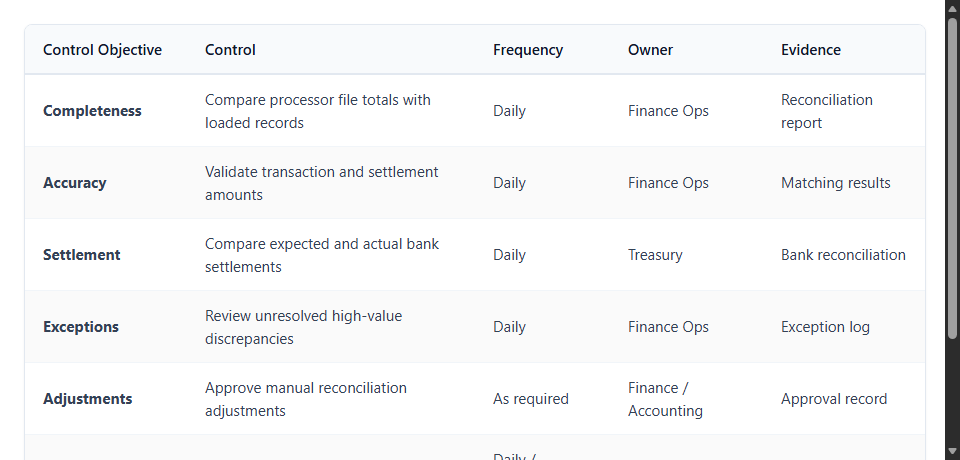
The exact controls will differ from one organization to the next. What matters is that each control has a clear objective, action, frequency, owner and evidence trail.
Exception Management Is Part of the Control
A report showing 98% matched transactions doesn’t prove the control works. The other 2% matter.
Say your reconciliation covers 20,000 transactions: 19,600 matched and 400 exceptions. The next questions are:
- What are the 400 exceptions?
- What’s their total value?
- How old are they?
- Who owns them?
- How many are expected timing differences?
- How many are real discrepancies?
- How many are resolved?
- How many will still be open at period-end?
This is where exception management becomes part of the control framework. A mature process classifies exceptions and sets escalation rules, for example:
- Low-value timing difference → Monitor
- High-value settlement discrepancy → Investigate immediately
- Duplicate transaction → Finance and payments review
- Missing transaction → Source-system investigation
The goal isn’t just a lower exception count. It’s making sure material exceptions get the attention they deserve.
Let Financial Exposure Set Control Priority
Not every discrepancy carries the same risk. Compare two exceptions:
- Exception A: a $20 timing difference, open for one day.
- Exception B: a $250,000 settlement discrepancy, open for 12 days.
Both are unresolved. They shouldn’t get the same priority.
Useful ways to rank risk include:
- Financial value
- Age
- Transaction type
- Customer impact
- Processor
- Settlement status
- Root cause
- Potential accounting impact
This lets finance teams put their control effort where the risk is highest.
Manual Adjustments Need Their Own Controls
Manual adjustments are sometimes necessary, but each one is a new control point.
When a discrepancy can’t be fixed from source data, an accounting adjustment may be needed. That adjustment should be:
- Justified
- Supported by evidence
- Approved
- Properly recorded
- Traceable to the original exception
A weak process lets an analyst edit a reconciliation file and mark the item resolved. An audit-ready process keeps the original data and records why the adjustment was made.
The test is simple: could someone reviewing this transaction months later understand exactly what changed and why? If not, the process needs a stronger audit trail.
Segregation of Duties in Payment Reconciliation
Reconciliation controls should also consider who does what. Where it makes sense, separate:
- Preparation: the person or team performing the reconciliation.
- Investigation: the team resolving discrepancies.
- Approval: the person authorized to approve adjustments.
- Review: the person confirming the reconciliation was done properly.
The right structure depends on your size and risk. A small finance team may not be able to separate every activity, and compensating controls can fill that gap. What matters is that the framework names the risk openly, instead of assuming a system-generated reconciliation is independent by default.
Audit Evidence: Proving the Control Worked
An audit-ready payment reconciliation process needs evidence that shows:
- What data was reconciled, and when
- What rules were applied
- What exceptions came up
- What actions were taken
- Who did the work, and who reviewed it
- What adjustments were made
- When exceptions were closed
Together, these form your reconciliation audit trail.
A dashboard screenshot may show the final result, but it rarely gives enough evidence to rebuild the process. A stronger system keeps the underlying reconciliation records, exception history and review activity.
How Payment Reconciliation Software Strengthens Controls
Payment reconciliation software can support much of the control framework. Automated payment reconciliation can handle:
- Data ingestion and completeness checks
- Transaction matching
- Settlement reconciliation
- Exception classification and routing
- Aging analysis
- Approval workflows
- Audit trails
- Reconciliation reporting and performance analytics
Automation also cuts the risk that comes with repetitive manual work.
But automation doesn’t replace controls. A system can run the wrong matching rule perfectly. A data feed can be incomplete without anyone noticing. A misconfigured account mapping can produce wrong postings every single time.
Technology has to work inside a defined control framework, not stand in for one.
Monitoring Whether Your Reconciliation Controls Work
Controls need monitoring too. Finance leaders should track:
- Reconciliation completion rate: are reconciliations finished on schedule?
- Exception rate: is the share of unmatched transactions rising?
- Exception aging: are discrepancies staying open longer?
- High-value exposure: how much unresolved value is outstanding?
- Repeat exceptions: do the same issues keep coming back?
- Manual adjustment rate: how often do teams work around the standard process?
- Control failures: how often do data feeds, matching rules or reconciliation processes break?
These measures show problems early, before they grow into a bigger financial control issue.
Common Weaknesses in Payment Reconciliation Controls
The same weaknesses show up again and again:
- Looking only at the match rate. A 99% match rate sounds strong. But if the remaining 1% is $20 million in exposure, the percentage tells half the story.
- Treating exceptions as an ops issue, not a financial one. Exceptions affect cash, accounting, customer balances and the close, so assess them that way.
- Using spreadsheets as the system of record. Spreadsheets can support reconciliation, but they get hard to govern as volumes and complexity grow.
- Weak adjustment controls. Manual changes without evidence create avoidable audit risk.
- Unclear exception ownership. An exception with no owner can stay open indefinitely.
- No historical audit trail. If you can’t reconstruct what happened, you can’t prove the control worked.
- Measuring activity instead of effectiveness. Finishing a reconciliation is not the same as running an effective reconciliation control.
What an Audit-Ready Payment Reconciliation Framework Looks Like
An audit-ready framework creates an unbroken chain of evidence:
Source Data → Validation → Matching → Exceptions → Investigation → Adjustment → Review → Closure
Every stage has its own controls.
The point isn’t to add bureaucracy. It’s to make payment reconciliation consistent, explainable and defensible. A strong framework lets your finance team answer an auditor’s questions without piecing the process back together months later:
- Where did the transaction come from?
- How did it enter the reconciliation process?
- Which rule was used?
- Why did it match, or not?
- What happened to the exception?
- Was an adjustment made, and who approved it?
- When was the issue resolved?
That level of traceability is what turns reconciliation into an audit-ready financial control.
From Reconciliation Activity to Financial Control
Payment reconciliation sits where payments, banking and accounting meet, which makes it more than an operational task. It’s one of the main ways finance teams build confidence that data has moved correctly from transaction systems into the books.
A strong framework connects:
Processors → Banks → ERP → Reconciliation → Exceptions → Controls → Evidence
The goal isn’t just a high match rate. It’s proving that transactions are complete, accurate, valid, timely, properly reviewed and backed by evidence.
Technology makes that faster and easier to scale, but the control framework is still the foundation.
When you design payment reconciliation as a financial control instead of a monthly matching exercise, you get more than a cleaner report. You get a process that holds up to scrutiny, surfaces material discrepancies earlier and leaves a defensible record of how money moved from the payment transaction to the accounting records.
If you’re ready to build that kind of process, Optimus can help. It brings processor, bank and ERP data together, automates matching and exception routing, and keeps a full audit trail behind every review and adjustment. Book a demo to see how it fits your reconciliation workflow.
FAQs
1. What is payment reconciliation?
Ans. Payment reconciliation is the process of comparing payment records from gateways, processors, banks and the ERP to confirm that transactions, fees, refunds and settlements are complete, accurate and correctly recorded in the books.
2. What are payment reconciliation controls?
Ans. Payment reconciliation controls are the policies, procedures, system rules and reviews that make sure payment transactions, processor records, bank settlements and ERP entries are complete, accurate and properly accounted for, with evidence to support every conclusion.
3. What makes a payment reconciliation process audit-ready?
Ans. An audit-ready payment reconciliation process can show what data was reconciled, which rules were applied, what exceptions were found, who reviewed them, what adjustments were made and who approved them. Every step leaves an audit trail that can be reconstructed later.
4. Is a high match rate enough to prove reconciliation controls work?
Ans. No. A high match rate can hide missing transactions that never entered the reconciliation, as well as high-value exceptions sitting in the unmatched share. Completeness checks, exception management and financial exposure tracking show whether the controls actually work.
5. Does payment reconciliation software replace financial controls?
Ans. No. Payment reconciliation software automates data ingestion, matching, exception routing, approvals and audit trails, but it has to run inside a defined control framework. A system can apply the wrong matching rule perfectly, so ownership, review and monitoring are still needed.


