

The Payment Reconciliation Exception Taxonomy: A Framework for Classifying and Resolving Financial Discrepancies
In payment reconciliation, finding an exception is the easy part, because something simply doesn't match. The hard part is working out why it doesn't match, how serious the discrepancy is, who should investigate it and what needs to happen next.
That challenge grows with every system you add. A single payment can leave records across a payment gateway, processor, settlement file, bank account, billing platform and ERP. Financial discrepancies between those records can come from timing differences, processing fees, refunds, chargebacks, missing or duplicate transactions, data-quality problems or genuine accounting errors. When every one of them is labelled an "unmatched transaction," the exception queue becomes a long to-do list that tells your team nothing about what kind of attention each item needs.
A payment reconciliation exception taxonomy solves this. It's a framework for classifying and resolving financial discrepancies by their root cause, so finance teams can prioritize what matters, route each exception to the right owner and spot the issues that keep coming back. In short, it turns exception management from reactive queue-clearing into a structured financial control.
What Is a Payment Reconciliation Exception Taxonomy?
A payment reconciliation exception taxonomy is a framework for classifying discrepancies found during reconciliation. It groups exceptions by root cause, such as:
- timing differences
- missing transactions
- amount variances
- duplicate records
- fee discrepancies
- refunds
- chargebacks
A good taxonomy helps finance teams prioritize exceptions, assign ownership, resolve discrepancies faster and find recurring process failures.
What Is a Payment Reconciliation Exception?
A payment reconciliation exception happens when records that should agree don't reconcile under your matching rules.
Take a simple payment flow:
Customer payment → Payment processor → Settlement → Bank → ERP
The transaction can exist in all five systems without the records lining up perfectly. For example:
- The processor shows a $500 payment.
- The settlement file shows $495.
- The $5 difference is a processing fee.
- The bank receives $495.
- The ERP records the original $500 receivable.
None of this points to fraud or an accounting error. The records simply reflect different stages of the same financial event.
That's why reconciliation exceptions need context. An exception isn't automatically a problem. It's a signal that something needs explaining, validating or fixing.
Why Classifying Payment Reconciliation Discrepancies Matters
Without classification, your exception queue might show one number:
12,483 unmatched transactions
That tells the team something needs attention. It doesn't tell them:
- Which exceptions are high value
- Which come from timing
- Which are missing transactions
- Which keep recurring
- Which need the processor to investigate
- Which can resolve automatically
- Which need accounting to step in
- Which have been open too long
A taxonomy adds that structure. Instead of one huge queue, you see something like this:
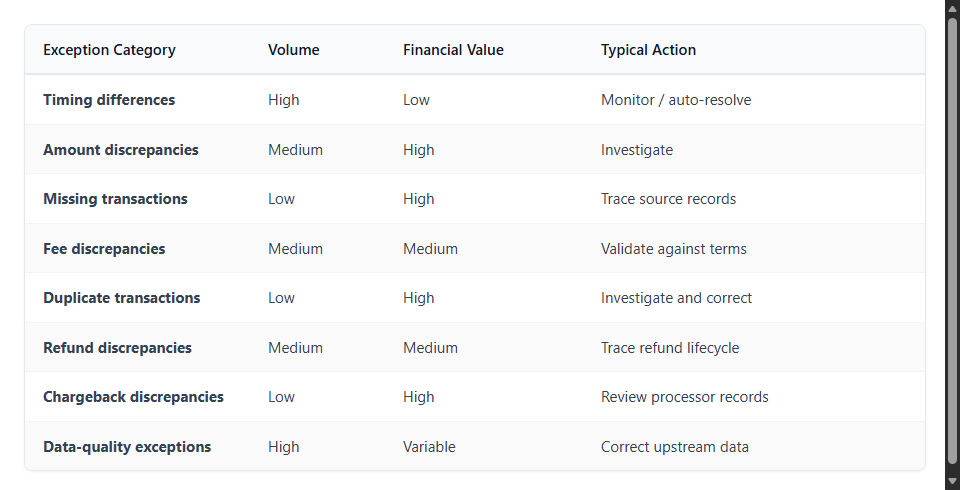
Your exact categories will depend on your business. The principle stays the same: classification should make every exception actionable.
A Practical Taxonomy for Payment Reconciliation Exceptions
No single taxonomy fits every payment environment. But most payment reconciliation discrepancies fall into ten broad categories.
1. Timing Differences
Timing differences happen when the same event shows up in different systems at different times. For example:
- A customer pays on Monday.
- The processor records it on Monday.
- The processor settles the funds on Tuesday.
- The bank statement shows the settlement on Wednesday.
- The ERP may post the entry based on the settlement date.
For a couple of days the records look unmatched, even though nothing is financially wrong.
Common causes:
- settlement cycles
- bank processing delays
- cut-off times
- time-zone differences
- weekend or holiday processing
- batch processing
- posting delays
Timing exceptions shouldn't be treated as financial errors by default. A mature payment reconciliation process separates an expected timing difference from an unresolved discrepancy. Where the rules are predictable, some timing exceptions can resolve automatically after a set window.
2. Amount Discrepancies
An amount discrepancy is when matching records show different values. For example:
- Transaction amount: $1,000
- Settlement amount: $970
The $30 gap may be perfectly legitimate. It could come from:
- processing or interchange fees
- taxes
- discounts
- refunds
- currency conversion
- adjustments
- partial settlement
It could also be a real financial problem. That's why amount discrepancies shouldn't just be labelled "variance." The process should work out:
Expected amount − actual amount = variance
Then it should explain that variance. Classification matters most here, because two discrepancies of the same size can have very different financial consequences.
3. Missing Transactions
A missing transaction is a record expected in one source that can't be found in another.
Say the processor reports a successful $2,500 transaction, but it doesn't appear in the ERP. Or the ERP holds a receivable that isn't in the processor data.
Possible causes:
- failed data ingestion
- integration issues
- wrong filters
- transaction rejection
- delayed posting
- data corruption
- incorrect identifiers
- a genuine processing failure
Missing records deserve extra attention, because an absent record is harder to investigate than a visible mismatch. Start with one question: is the transaction missing from the source, or only from the reconciliation dataset? The answer can change the whole investigation.
4. Duplicate Transactions
A duplicate exception is when one financial event shows up more than once. For example, a processor file contains two records with the same transaction reference and amount.
Typical causes:
- duplicate file ingestion
- repeated API events
- retry mechanisms
- integration errors
- duplicate payment submissions
- faulty batch processing
Duplicates carry real financial and accounting risk. They can cause:
- inflated revenue
- wrong receivables
- wrong cash expectations
- duplicate settlement records
- customer balance issues
So treat duplicate detection as a financial control, not just data cleanup.
5. Fee and Commission Discrepancies
Processors usually deduct fees before settlement. A transaction might show:
- Gross transaction: $10,000
- Processing fees: $250 (2.5%)
- Net settlement: $9,750
If your contract terms say fees should be 2%, finance expects $9,800. The $50 gap needs investigating. Across 1,000 such batches a month, that's $50,000 in fees nobody agreed to pay.
Fee discrepancies can come from:
- wrong fee rates
- processor pricing changes
- interchange differences
- currency-related charges
- extra service fees
- misconfigured fee settings
- contract changes
A strong process reconciles more than transaction amounts. It checks the full relationship between gross value, fees and net settlement.
6. Refund Exceptions
Refunds add complexity because the original payment and the refund are separate events. A refund moves through several stages, each of which can happen at a different time:
1. Initiated
2. Approved
3. Processed
4. Settled
5. Posted to the customer's account
An exception can come up when:
- The refund is in the payment system but not the ERP.
- The refund amount differs.
- The refund is processed twice.
- The refund is recorded but never settled.
- The refund can't be linked to the original transaction.
A good taxonomy links each refund to its original transaction wherever possible. Without that link, refund investigations get much harder.
7. Chargeback Exceptions
Chargebacks run their own lifecycle across the customer, merchant, processor and financial records. A chargeback can affect:
- the original transaction value
- the merchant balance
- the processor settlement
- fees
- accounting entries
- customer balances
Exceptions appear when chargeback records are missing, duplicated, wrongly valued or posted at different stages across systems. Chargeback exceptions often need a different owner from standard payment exceptions, which is one more reason classification matters.
8. Currency and FX Discrepancies
International payments add currency conversion to the payment reconciliation process. A transaction may be recorded in one currency and settled in another. For example:
- Customer transaction: €10,000
- Settlement currency: USD
The settled value depends on the exchange rate, when the conversion happens and any FX charges. A rate move of just 0.5% on €10,000 shifts the settlement by about $50 (at roughly 1.08 USD per EUR, €10,000 is about $10,800, and 0.5% of that is $54).
Differences can come from:
- exchange rates
- conversion timing
- FX fees
- rounding
- multi-currency settlement
These shouldn't be treated as errors by default. You need rules that separate expected FX movement from unexplained variance.
9. Data-Quality Exceptions
Sometimes the financial event is correct, but the data describing it isn't. Examples:
- missing transaction IDs
- invalid references
- wrong dates
- missing currency codes
- inconsistent customer IDs
- wrong account mappings
- truncated fields
Data-quality exceptions matter because they can trigger huge numbers of downstream failures. If 5,000 transactions fail matching because a processor changed the format of one reference field, resolving all 5,000 by hand only treats the symptom. Fixing the upstream mapping fixes the cause. This is where clean data preparation and exception analytics pay off.
10. Settlement Exceptions
Settlement exceptions occur when a settlement's amount or make-up doesn't match what you expected. For example:
- Expected settlement: $1.2M
- Actual settlement: $1.16M
- Gap: $40,000 (3.3%)
The gap could come from:
- fees
- refunds
- chargebacks
- timing
- currency conversion
- missing transactions
- processor adjustments
Settlement exceptions often deserve higher priority, because they directly affect cash visibility and the financial close. They also connect straight to bank reconciliation.
From Taxonomy to Payment Reconciliation Exception Management
Classification only adds value if it changes what happens next. Good exception management links classification to action:
Severity → Ownership → Action → SLA → Resolution → Root cause
For example:
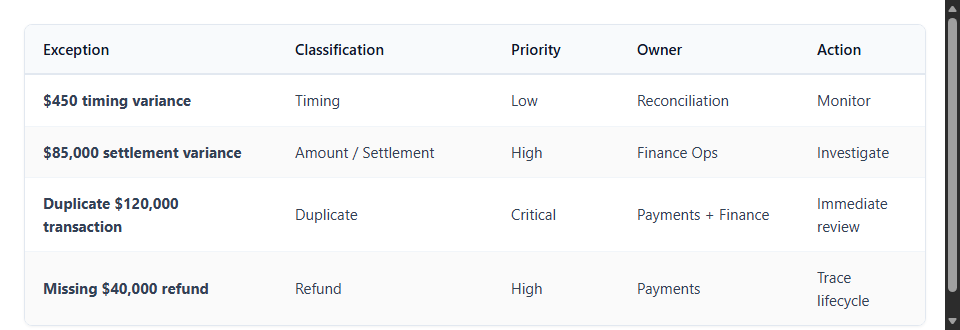
This is where payment reconciliation exception management becomes an operating discipline, not just a queue.
Not Every Exception Deserves the Same SLA
A mature process weighs at least three factors:
- Value: how much money is involved?
- Age: how long has it been open?
- Risk: what happens if it stays unresolved?
A simple prioritization model:
Priority = Financial exposure + Age + Operational risk
Your exact formula will differ. The principle is what counts: priority should reflect business impact, not the order items landed in the queue. A $250,000 settlement gap open for 12 days should never sit behind a $20 timing difference opened yesterday.
The Exception Lifecycle
Once exceptions are classified, you need a consistent lifecycle:
Detect → Classify → Prioritize → Assign → Investigate → Resolve → Validate → Close → Learn
1. Detect: spot a failed match.
2. Classify: decide what type of discrepancy it is.
3. Prioritize: weigh value, age and risk.
4. Assign: route it to the right owner.
5. Investigate: trace the underlying financial event.
6. Resolve: fix the discrepancy, or document why it's valid.
7. Validate: confirm the records now reconcile.
8. Close: keep an auditable record of the resolution.
9. Learn: check whether the same exception is likely to come back.
The last step is the one most teams skip. A reconciliation process shouldn't just resolve exceptions. It should learn from them.
The Most Valuable Exception Is the Recurring One
Picture a finance team that resolves 2,000 exceptions a month. On paper, that looks productive. Then the analysis shows that 1,200 of them, 60%, come from the same data-formatting issue in one upstream system. The team is efficiently fixing the same problem over and over. That’s not operational maturity.
Exception analytics should answer:
- Which exception categories are growing?
- Which keeps recurring?
- Which systems generate the most exceptions?
- Which processors have the highest exception rates?
- Which exceptions carry the most financial value?
- Which categories take the longest to resolve?
- Which exceptions come back after being closed?
This is how you move from resolving exceptions to preventing them.
What a Mature Exception Taxonomy Looks Like
A useful taxonomy is:
- Clear: different teams read the categories the same way.
- Meaningful: each category points to a different cause or action.
- Actionable: the classification tells you what happens next.
- Measurable: you can track volume, value and aging by category.
- Flexible: it changes as your payment processes change.
- Linked to ownership: each exception type routes to the right team.
- Linked to root cause: it helps expose upstream process problems.
It should never become a 100-category spreadsheet that nobody maintains. The aim is useful classification, not complexity.
How Payment Reconciliation Software Supports Exception Classification
Payment reconciliation software makes exception management far more scalable. Technology can:
- apply matching rules
- detect exceptions
- classify known exception patterns
- calculate financial exposure
- assign priorities
- route exceptions
- track aging and resolution SLAs
- spot recurring patterns
- deliver reconciliation analytics
- keep audit trails
But technology should support your taxonomy, not replace the thinking behind it. A system can't decide that every discrepancy is a particular type of exception just because a rule exists. The classification model has to reflect how your financial workflows actually run.
What Finance Teams Should Measure
Once your taxonomy is in place, exception analytics become far more useful. Track:
- Exception volume: how many exceptions are created?
- Exception value: how much financial exposure do they carry?
- Exception rate: what share of transactions create exceptions? (If 400 of 20,000 transactions fail, that’s 2%.)
- Exception aging: how long do they stay open?
- Resolution time: how fast is each category closed?
- Root cause: what’s generating them?
- Recurrence: do the same problems keep coming back?
- Owner performance: which teams or workflows resolve exceptions efficiently?
- Financial impact: which categories hit cash, revenue or the close hardest?
These metrics help finance leaders tell a large, low-risk queue apart from a small queue hiding serious exposure.
The Goal Isn’t Zero Exceptions
“Zero exceptions” is a tempting target, but in real payment environments it’s rarely realistic. Timing differences, refunds, chargebacks and settlement adjustments will always happen, and systems will sometimes send late or incomplete data.
The real goal is controlled exceptions. A controlled exception has:
- a known category
- a known owner
- a known financial value
- a defined priority
- a documented resolution path
- an appropriate SLA
- an auditable outcome
That's a far more meaningful measure of reconciliation maturity.
Turning Financial Reconciliation Discrepancies Into Operational Intelligence
The biggest payoff from an exception taxonomy isn't a tidier queue. It's better insight across the business. Over time, the data can show patterns like:
- Processor X generates three times more settlement exceptions than Processor Y.
- Refund exceptions spike after a particular system release.
- High-value exceptions stay open far longer than low-value ones.
- Most unmatched transactions trace back to missing identifiers.
- One payment method keeps producing fee discrepancies.
These insights can drive changes well beyond the reconciliation team:
- a processor review
- an integration change
- a data-quality fix
- a contract review
- a payment configuration change
- a revised accounting rule
- a new matching rule
Reconciliation becomes a source of operational intelligence, whether you run multi-location retail or an iGaming operation.
From Exception Queue to Financial Control
Payment reconciliation exceptions are unavoidable in complex financial environments. Unstructured exception management is not. The difference is classification.
A well-designed payment reconciliation exception taxonomy gives finance teams a shared language for discrepancies. It links every exception to its financial exposure, likely cause, owner and resolution path.
More importantly, it lays the foundation for analytics. Once exceptions are classified consistently, you can see:
- what failed to reconcile, and why
- what it costs
- how fast it's being resolved
- whether the same problem keeps coming back
That's the real purpose of payment reconciliation exception management. The goal isn't a bigger exception queue. It's a process where exceptions are visible, explainable, prioritized, resolved and, over time, reduced at the source.
Ready to see that in practice? Book a demo and see how your team can move from clearing exceptions to preventing them.
FAQs
What is a payment reconciliation exception?
A payment reconciliation exception is a record that fails to match its corresponding record under your matching rules, such as a processor transaction missing from the ERP or a settlement that differs from the expected amount. It signals something that needs explaining, validating or fixing.
What causes payment reconciliation discrepancies?
Payment reconciliation discrepancies are usually caused by timing differences, processing fees, refunds, chargebacks, currency conversion, missing or duplicate transactions, settlement adjustments and data-quality issues such as missing transaction IDs or wrong account mappings.
What is payment reconciliation exception management?
Payment reconciliation exception management is the process of detecting, classifying, prioritizing, assigning, investigating and resolving reconciliation exceptions, while keeping an audit trail and using root-cause analysis to stop the same exceptions from recurring.
How should finance teams prioritize reconciliation exceptions?
Finance teams should prioritize reconciliation exceptions by financial exposure, age and operational risk rather than by the order they entered the queue. A high-value settlement discrepancy that has been open for days should always come before a small timing difference.
How does Optimus help resolve financial reconciliation discrepancies?
Optimus connects processor, bank, PSP and ERP data, uses configurable rules and AI-powered matching to detect real exceptions, routes each one to the right owner and keeps a complete audit trail. Its analytics show which systems and categories generate the most financial reconciliation discrepancies.


