
The month-end close has a shelf life. For decades, finance teams accepted a five-to-ten-day blackout period every month when books were frozen and treasury flew blind on cash position until the numbers finally settled. Continuous ledger accounting software is what's ending that pattern. Instead of batching transactions and reconciling them after the fact, it posts, matches, and settles entries the moment they happen, turning the close from a monthly project into a byproduct of the day's work.
That's the idea behind the "zero-day close": not a single switch, but the outcome of running continuous accounting, a model where the books stay audit-ready every hour, and settlement visibility is a live dashboard instead of a report assembled on the 5th of the month. This guide covers what continuous ledger accounting software does, why the zero-day close is becoming an enterprise expectation, and what to evaluate before you switch.
Key Takeaways
• Continuous ledger accounting software matches, posts, and reconciles transactions in real time, replacing the batch cycle that forces a month-end scramble.
• A zero-day close is the outcome of continuous accounting: the close period shrinks toward zero because exceptions are resolved daily, not discovered the following month.
• Half of finance teams take more than five business days to close the books, and 27% take more than a week, largely due to Excel-dependent, disconnected workflows.
• Manual reconciliation can consume 72 business days a year in analyst time and let 1 to 5% of EBITDA leak out through missed fees and chargebacks.
• AI-assisted matching is now standard in continuous ledger platforms: 71% of finance functions have deployed AI, and close cycles are shrinking by an average of 7.5 days among adopters.
What Is Continuous Ledger Accounting Software?
Continuous ledger accounting software ingests transactions from banks, payment service providers (PSPs), and ERPs, then matches and posts them to a double-entry ledger in real time, rather than waiting for a nightly batch or a month-end cycle. It replaces the "collect, download, compare" rhythm of traditional close with a live feed: every transaction is validated and reconciled close to the moment it occurs.
• Continuous matching: Rules-based and AI-assisted logic compares transactions against ledger entries as they flow in, not on a schedule.
• Immutable, real-time posting: Matched entries record to the ledger immediately, maintaining a live double-entry system rather than a batch-updated one.
• Instant exception surfacing: Unmatched items and variances trigger alerts within minutes, not at the next close cycle.
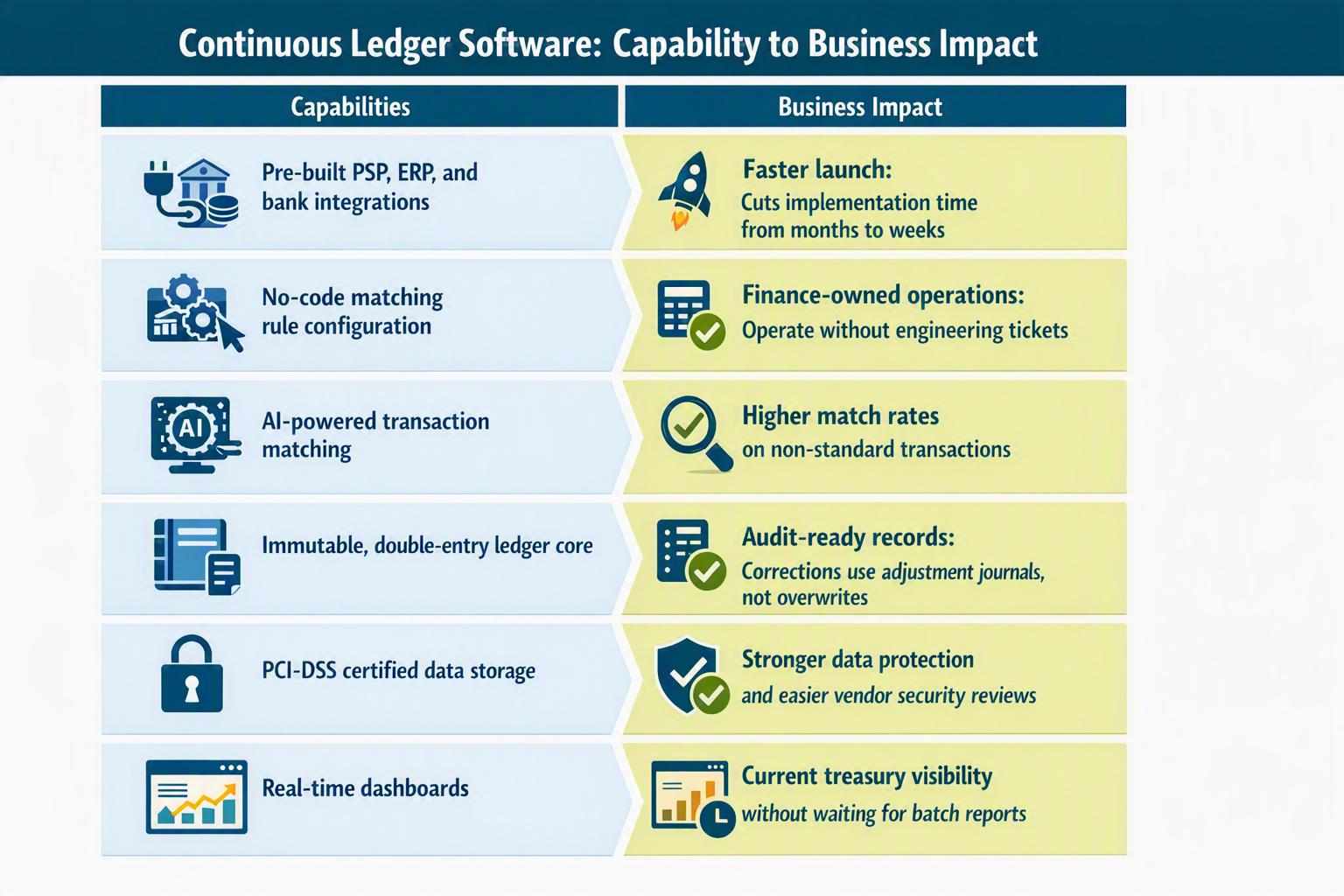
Zero-Day Close vs. Traditional Month-End Close
A zero-day close doesn't mean the close "disappears." It means the heavy lifting already happened during the month, because reconciliation and settlement visibility were continuous. Traditional close concentrates that same work into one high-pressure window
Why Continuous Settlement Visibility Matters for Enterprise Teams
For fintechs, PSPs, marketplaces, and enterprises running high transaction volumes, a delayed close is a structural risk, not an inconvenience. Treasury can't forecast liquidity on data that's a week old, and regulators expect current, traceable records rather than trails reconstructed under deadline pressure.
• Cash position uncertainty: Treasury can't make confident funding decisions without real-time balance visibility.
• Revenue leakage risk: Undetected fee discrepancies and missed chargebacks erode 1 to 5% of EBITDA silently over time.
• Audit and compliance pressure:SOX and PCI-DSS expect current, traceable records, not month-end reconstructions.
• Operational drag: Manual reconciliation consumes up to 72 business days annually in analyst time, and 56% of financial institutions still lean on spreadsheets to do it.
How Continuous Ledger Accounting Software Works
Continuous ledger platforms follow a consistent sequence from ingestion through reporting, keeping the ledger, and settlement visibility, current at all times.
• Ingest transactions from PSPs, banks, and ERPs via automated data ingestion, continuously rather than on a schedule.
• Normalize and validate raw data at the source, catching errors before they propagate downstream.
• Match continuously using rules-based and AI-powered logic that compares amounts, timestamps, and reference keys as transactions arrive.
• Post in real time to an immutable double-entry ledger the moment transactions clear.
• Flag exceptions automatically, routing them through exception management with maker-checker controls before any adjustment posts.
• Generate audit trails continuously, so documentation already exists when someone asks for it instead of being assembled after the fact.
Core Components and Where It Applies
Modern platforms combine a data integration layer, an AI-assisted matching engine, an immutable double-entry ledger, exception workflows, and real-time dashboards. The same logic extends across every transaction category an enterprise touches:
• Bank and cash reconciliation: see the Complete Guide to Bank Reconciliation.
• Payment and PSP settlement: see the guide to multi-channel payment reconciliation.
• Card network and interchange reconciliation: see the Credit Card Reconciliation Software guide.
• Intercompany reconciliation across subsidiaries and business units.
• Fee and commission reconciliation: see the guide to fee and commission validation.
Benefits of Moving to a Zero-Day Close
Shifting from batch to continuous accounting delivers measurable gains across finance, treasury, and audit, not just a faster close.
• A close that stops disrupting the business: With financial close management running continuously, teams enter period-end with exceptions already resolved.
• Real-time treasury visibility: Liquidity forecasting runs on actual balances, not week-old estimates.
• Zero revenue leakage: Continuous matching catches missed payments and chargebacks before they become buried write-offs.
• Continuous audit readiness: Always-current documentation means audit requests get answered immediately.
• Lower operational cost: Less time on spreadsheet wrangling frees analysts for forecasting and variance analysis.
Why Batch and Manual Reconciliation Break Down at Scale
• Delayed detection: Errors surface days or weeks later, once the context, and often the person who handled it, has moved on.
• Spreadsheet dependency: Manual handling invites copy-paste errors, broken formulas, and version-control chaos.
• Summary-level matching hides variances: A $50,000 variance can hide dozens of discrepancies that only surface during an audit.
• Compounding backlogs:Legacy batch processes leave teams catching up on last month's work instead of analyzing this month's results.
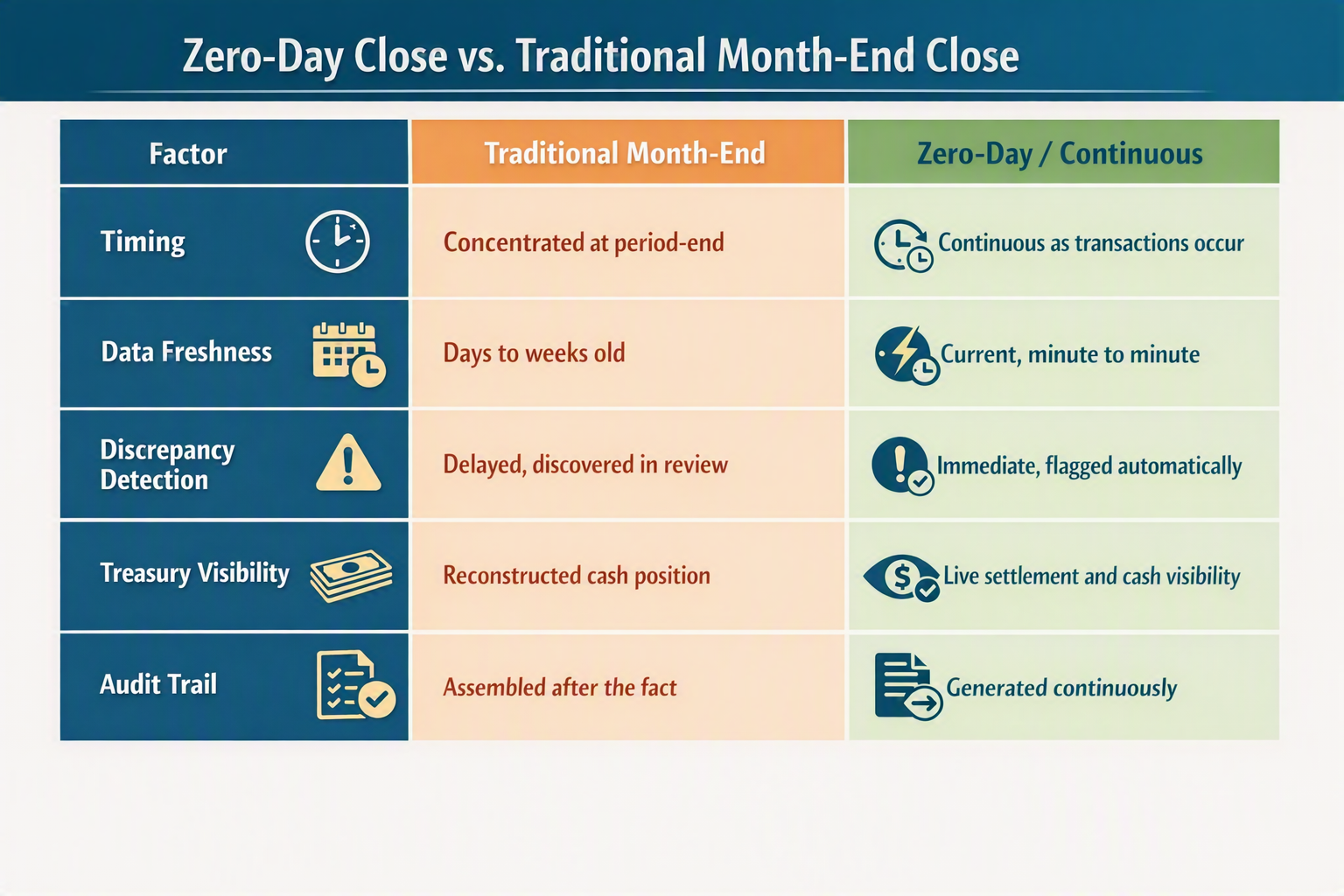
Key Features to Look for in Continuous Ledger Accounting Software
Not every "real-time" reconciliation tool supports continuous accounting end to end. Compare vendors against this checklist:
The Role of AI in Continuous Settlement Visibility
AI is what makes continuous ledger accounting practical at enterprise scale, since rules alone can't keep pace with the volume and variety of modern transaction data. Intelligent matching learns patterns from historical data to reconcile transactions that don't follow standard formats, while anomaly detection flags unusual fee variations and duplicate transactions that rules-based systems miss entirely.
Adoption backs this up: industry research shows 71% of finance functions have already deployed AI, with adopters seeing close cycles shrink by an average of 7.5 days, a gap that lands most companies far closer to zero-day territory than a spreadsheet-driven process ever could.
Achieve Continuous Settlement Visibility With Optimus
Optimus delivers continuous ledger accounting through a no-code platform with 150+ pre-built integrations and PCI-DSS certified data storage, built for high-volume businesses that need transaction-level accuracy and audit readiness every day. Explore the Ledger Reconciliation on Auto-Pilot product page for full details.
• Data Fusion Agent: Collects and normalizes data from PSPs, ERPs, and banks without custom integration work.
• Continuous transaction matching: AI-powered reconciliation runs at scale as transactions occur.
• Immutable ledger: Double-entry records with full audit trails, by design.
• Real-time exception management: Automated alerts surface discrepancies immediately.
Frequently Asked Questions About Continuous Ledger Accounting
What is a zero-day close?
A zero-day close is the outcome of continuous accounting: transactions are matched, posted, and reconciled throughout the month so that by period-end, little to no dedicated close work remains.
What is continuous ledger accounting software?
Continuous ledger accounting software ingests, normalizes, and matches transactions from banks, PSPs, and ERPs, then posts them to an immutable double-entry ledger in real time, rather than in scheduled batches or at month-end.
How is continuous accounting different from continuous close?
The terms are often used interchangeably. Continuous accounting describes the always-on process of matching and posting transactions; continuous close (or zero-day close) describes the resulting outcome, a close period that requires minimal additional work.
Can enterprises actually achieve a zero-day close?
Yes, though it's more achievable for standardized, high-volume transaction flows than for complex, multi-entity consolidations. A close that shrinks from ten days to two or three is still a major operational and treasury win.
Is continuous ledger accounting software compliant with SOX and PCI-DSS?
Leading platforms are built with PCI-DSS certified data storage, immutable audit trails, and maker-checker controls to support SOX and PCI-DSS requirements. Actual compliance still depends on how the organization configures approvals and access controls.