

A finance leader at a large quick commerce operator once described her cash position reporting process as "a rearview mirror bolted to a moving car." By the time her team consolidated data across hundreds of dark stores, multiple payment gateways, and cash-on-delivery settlements spanning several markets, the numbers reflected where the business had been three days earlier. That gap between real-time reality and reported reality is the single biggest liability in enterprise treasury today, and most finance leaders at large-scale operations, whether running a quick commerce network or a global retail brand with stores across countries, have simply learned to live with it.
They shouldn't have to. Enterprises adopting autonomous financial operations are discovering that enterprise cash visibility isn't just a reporting problem; it's a structural one, rooted in how financial operations have traditionally been built.
Why Enterprise Cash Visibility Breaks Down at Scale
Cash visibility sounds simple: know how much money you have, where it sits, and what's committed against it. In practice, it's one of the hardest things for a large enterprise to get right, for reasons rooted in architecture rather than effort.
Most finance teams pull cash data from a patchwork of sources. Payment gateways settle on their own schedules. Delivery partners and marketplace payouts arrive net of fees that aren't always itemized the same way twice. Stores and dark stores across markets maintain their own books, often with their own definitions of "reconciled." Layer in manual adjustments and spreadsheet-based consolidation, and you end up with a cash position that's technically accurate but practically stale.
This isn't a new problem, but the cost of tolerating it has changed. Idle cash is more expensive to hold, short-term borrowing is more expensive to use, boards want intraday answers, and as enterprises expand into more markets, the moving parts needing reconciliation grow faster than headcount ever could.
The Limits of Traditional Cash Reconciliation Automation
Many finance organizations already run rules-based automation, matching transactions against predefined criteria and flagging exceptions for human review. This was a genuine improvement over manual reconciliation, and it remains useful for high-volume, low-complexity matching.
But rules-based automation has a ceiling. It performs well when patterns are predictable and falls apart when they aren't, which in enterprise finance is more often than teams admit. A partial payment, a rounding difference, a vendor splitting an invoice across two remittances: these exceptions get routed to a human queue that never empties, and analysts spend their days investigating exceptions rather than analyzing cash trends.
Autonomous financial operations take a different approach, applying pattern recognition and contextual reasoning to determine how a transaction should be handled, improving over time as more data flows through. It's the difference between a system that executes instructions and one that makes decisions within defined boundaries.
The table below compares how traditional cash reconciliation typically operates day to day against an autonomous approach.
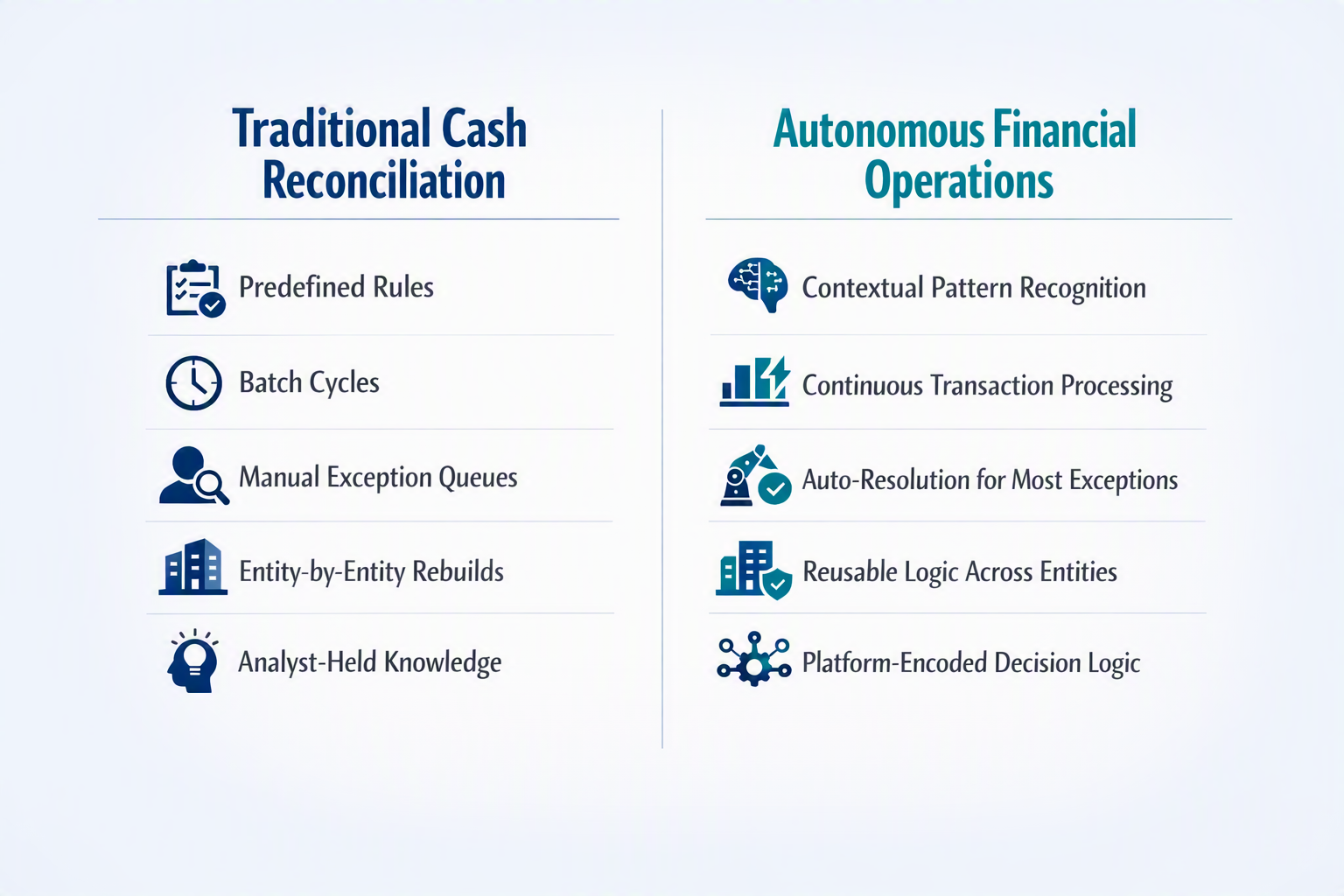
Traditional reconciliation is built around periodic catch-up, while autonomous operations are built around continuous state. That architectural difference ultimately determines whether a CFO's cash position report reflects reality or a snapshot of where reality used to be.
How Autonomous Operations Improve Real-Time Cash Visibility
The immediate effect of autonomy is speed. Transactions get matched and posted closer to real time, so the cash position in dashboards is closer to the one that actually exists. The more interesting effects show up further downstream.
Fewer exceptions reaching human queues. Resolving ambiguous matches with historical context shifts analyst attention from investigation toward forecasting and strategic analysis.
Consolidated visibility across entities. Enterprises no longer have to trade granular local control for consolidated global visibility, since reconciliation logic doesn't need manual rebuilding for every new market.
Earlier detection of anomalies. A cash position updating continuously surfaces problems while they're still small, which matters when a break signals something larger like a fraud pattern.
Reduced dependency on tribal knowledge. Manual reconciliation accumulates institutional memory in people's heads; autonomous systems encode that logic into the platform itself, making the process more resilient to turnover.
Choosing a Cash Visibility Platform: Where the Approach Diverges Across the Market
Not every platform marketed as "autonomous" delivers the same depth of capability. Some cash forecasting and treasury platforms, HighRadius among them, have built strong predictive models based on historical patterns. That's genuinely useful, but forecasting quality is only as good as the transactional data feeding it, and prediction is a different problem than reconciliation.
The gap tends to show up in how a platform handles reconciliation itself, the matching that determines whether the "current" cash position is trustworthy in the first place. A forecasting engine built on reconciliation data that's a day or two stale is still forecasting from a rearview mirror, just a slightly clearer one. Optimus’s Platform treats reconciliation and cash visibility as one continuous process rather than sequential stages, so forecasting always works from data reflecting the current state of the books.
The table below breaks down three common approaches across the factors that matter most during vendor evaluation.
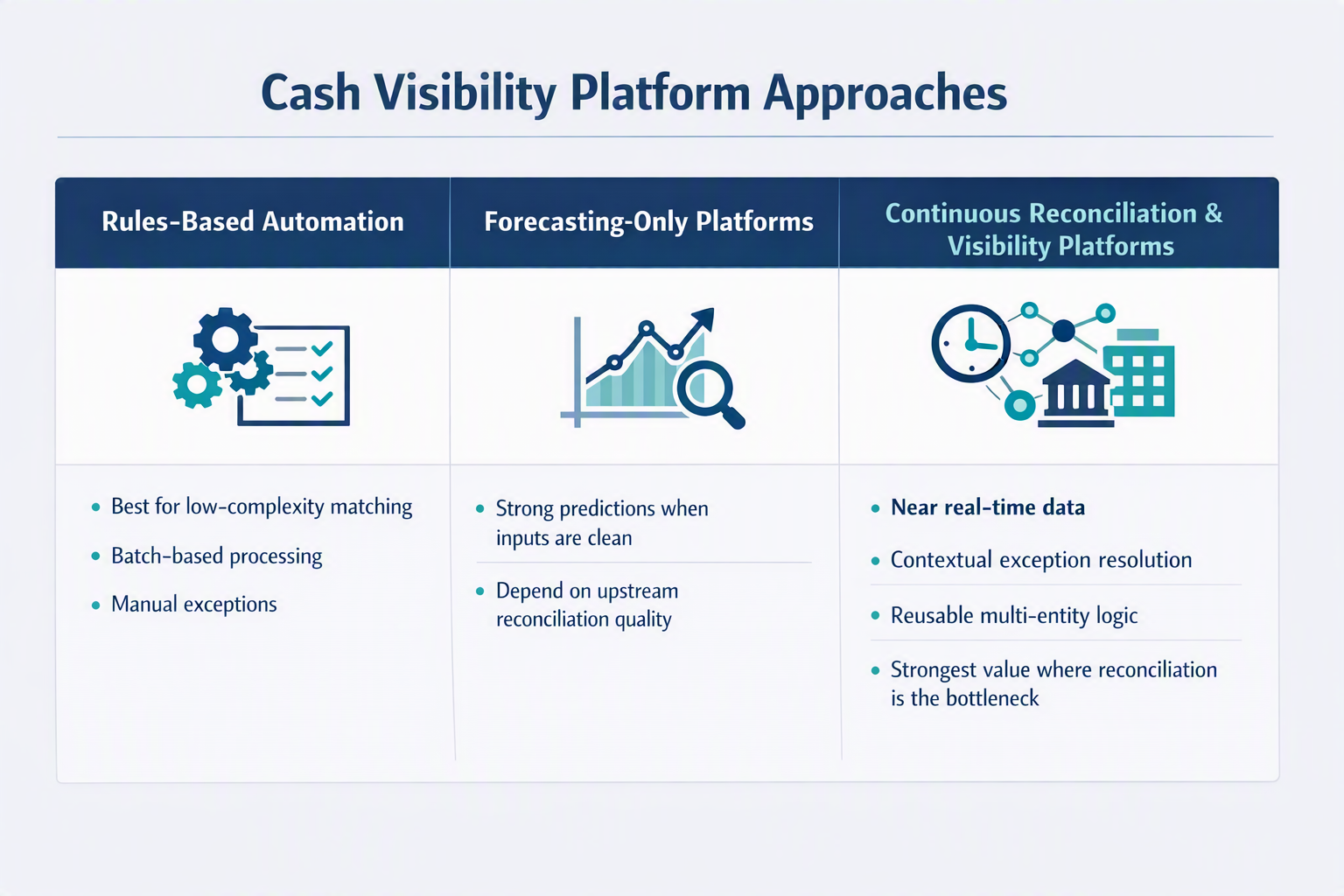
An enterprise with a single ERP and a handful of domestic bank accounts may get by on rules-based automation. The calculus changes once multiple entities and currencies enter the picture, which is exactly when the gap between "automated" and "autonomous" shows up in the numbers.
Implementation Considerations for Enterprise Finance Teams
Adopting autonomous financial operations isn't a plug-and-play exercise. A few considerations separate successful rollouts from stalled ones:
- Data quality comes first. Autonomous systems learn from historical transaction data, so inconsistent or poorly labeled records get inherited as errors.
- Integration depth determines value. A system connected to one ERP and a handful of bank feeds delivers only partial visibility.
- Change management matters. Teams built around manual reconciliation sometimes see automation as a threat; successful rollouts are explicit early about how roles shift toward higher-value analysis.
- Governance can't be an afterthought. Autonomous decisions still need to be explainable, particularly under SOX controls or strict regulatory oversight.
Scaling Autonomous Financial Operations Across the Enterprise
For enterprises operating across multiple business units or geographies, scalability isn't just about transaction volume; it's about whether the underlying logic generalizes. A reconciliation process built around one entity's quirks doesn't transfer cleanly to a newly acquired subsidiary with different banking relationships. Platforms built on flexible, learnable matching logic scale more gracefully into new entities than those built on a fixed rule set requiring reconfiguration each time, a difference that compounds for enterprises growing through acquisition.
Looking Ahead
Cash visibility will keep mattering more, not less, as capital costs remain elevated and enterprises operate across more currencies, banking partners, and regulatory jurisdictions. Finance organizations that treat autonomous financial operations as core infrastructure, not a point solution bolted onto existing processes, will be the ones that can answer the CFO's question about cash position with confidence rather than caveats.
Frequently Asked Questions
1. What's the difference between automated and autonomous financial operations?
Automated systems follow predefined rules and route anything outside those rules to a human for review. Autonomous systems use pattern recognition to handle a broader range of scenarios independently, reducing exceptions that need manual intervention.
2. How does autonomous reconciliation improve cash visibility, not just processing speed?
Faster reconciliation means the reported cash position is closer to the actual one. Since forecasting and planning sit on top of that reported position, improving its accuracy compounds across every downstream decision.
3. Is this technology suitable for enterprises with complex multi-entity structures?
Yes, though the value depends on integration depth and how well the matching logic generalizes across banking relationships. Enterprises should evaluate this specifically during vendor selection.
4. What's the biggest implementation risk finance teams should plan for?
Poor historical data quality is the most common cause of underwhelming results, since autonomous systems learn from past transactions.
5. Does adopting autonomous financial operations reduce the need for finance staff?
Not typically. Most organizations see a shift in what teams do, with analysts spending less time on exception investigation and more on forecasting and strategic decision support.