

Every transaction that flows through a payment gateway creates a paper trail across multiple systems: your internal records, the gateway's settlement reports, and your bank statements. When those records don't match, revenue slips through the cracks.
Payment reconciliation for a payment gateway is the process of matching internal sales and order records with payout and transaction reports from providers like Stripe, PayPal, or Adyen to verify that gross sales, fees, refunds, and net payouts align with actual bank deposits. This guide covers how the process works, why it breaks down at scale, and what modern automation looks like in practice.
What Is Payment Reconciliation for Payment Gateways?
Payment reconciliation for a payment gateway is the process of matching internal sales and order records with payout and transaction reports from providers like Stripe, PayPal, or Adyen. The goal is to verify that gross sales, gateway processing fees, refunds, chargebacks, and net payouts all line up correctly with actual bank deposits.
Picture it as a three-way conversation between your internal systems, your payment service provider, and your bank. When all three tell the same story, every dollar is accounted for. When they don't, you've found something worth investigating.
For businesses processing thousands of transactions daily, this verification spans three stages:
- Authorization: The gateway approves or declines the transaction
- Settlement: Funds batch and move to the acquiring bank
- Payout: Money lands in your account, minus fees
Each stage introduces potential discrepancies. Reconciliation catches them before they become bigger problems.
How Payment Gateway Reconciliation Differs From Bank and Ledger Reconciliation
Gateway reconciliation sits upstream in your cash flow cycle. It validates PSP and acquirer data before funds ever reach your bank account, which means you catch discrepancies days earlier than you would with bank statement reviews alone.
Bank reconciliation, on the other hand, compares bank statements against internal cash records to confirm deposits and withdrawals actually occurred. Ledger reconciliation ensures general ledger entries balance against subledgers for accounting accuracy.
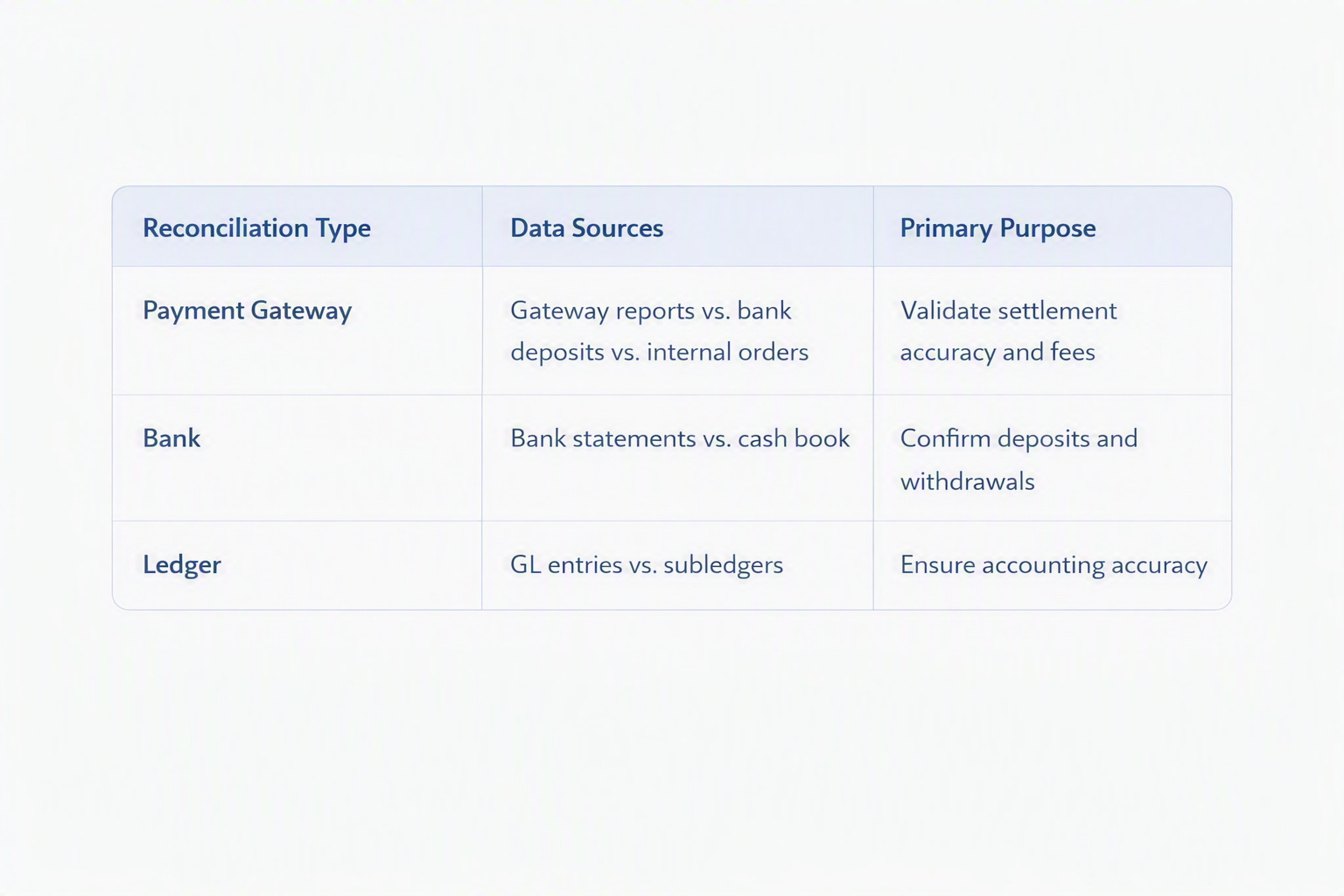
Why does the distinction matter? A fee overcharge caught at the gateway level never flows through to your bank reconciliation, your ledger, or your financial statements. Earlier detection means less cleanup.
How the Payment Gateway Reconciliation Process Works
The workflow breaks into five steps. Each addresses specific data sources and validation requirements that, together, transform raw transaction data into verified accounting entries.
Capture Transaction Data From the Gateway
Finance teams pull authorization, capture, and settlement files from payment service providers through API connections, SFTP transfers, or CSV downloads. This data includes transaction IDs, amounts, timestamps, payment methods, and customer identifiers.
Transaction IDs become your matching keys: the thread connecting a customer's purchase to the money in your bank account.
Ingest Settlement and Payout Reports
Settlement reports from acquirers and payout confirmations from banks show actual funds movement. Timing gets tricky here: settlement typically occurs 1-3 days after authorization, so transactions may appear "missing" from bank statements even though they processed successfully.
Match Transactions Across Gateway, Bank, and Ledger
N-way matching compares transaction records across all sources. Each transaction ID, amount, currency, and date aligns across gateway reports, bank deposits, and ERP entries.
Straightforward cases match automatically. Exceptions require investigation.
Investigate and Resolve Exceptions
Exceptions include missing transactions, amount mismatches, duplicate entries, and timing discrepancies. Root-cause analysis determines whether exceptions stem from processing delays, fee calculation errors, chargebacks, or data quality issues.
Post Reconciled Entries to the General Ledger
Once verified, transactions post to the general ledger with proper revenue recognition, fee allocation, and tax treatment. Complete audit trails document the entire process: critical for compliance and financial audits.
Types of Payment Gateway Reconciliation
Different reconciliation categories address specific aspects of payment processing. Comprehensive programs cover all four.
Settlement reconciliation matches gateway settlement reports against bank deposits. Did the funds you expected actually arrive?
Fee and commission reconciliation validates that gateway fees, interchange fees, and processor commissions match contractual rates. This process flags overcharges that silently erode margins.
Chargeback and refund reconciliation tracks disputed transactions and customer returns, projected to reach 324 million chargebacks annually by 2028, according to Datos Insights and Mastercard's chargeback research Without it, you risk duplicate processing or missed deductions that distort accounts receivable.
Multi-gateway and multi-currency reconciliation handles businesses using multiple PSPs or processing international transactions. This includes validating FX conversion rates, timing differences across time zones, and cross-border fee structures that vary by provider and currency pair.
Why Payment Gateway Reconciliation Is Operationally Complex
Finance teams face multiple challenges when reconciling gateway transactions. Understanding complexity drivers helps organizations design more effective processes or recognize when automation becomes essential.
Fragmented data across PSPs and acquirers. Each payment gateway uses different report formats, field names, column orders, and delivery schedules. A single transaction may appear in gateway reports, acquirer statements, bank deposits, and internal order systems, each with slightly different identifiers.
Timing gaps between authorization, capture, and settlement. Authorizations may occur days before settlement, creating windows where transactions appear "missing." Gateways batch transactions at different times, making individual transaction-to-deposit matching difficult without detailed reports.
Opaque fee structures and FX conversions. Tiered fees, interchange-plus pricing, and blended rates make cost validation difficult. Merchant statements often lack the transaction-level detail needed for accurate reconciliation. Cross-border transactions add FX conversion fees and rate markups that vary by provider.
High transaction volume and exception load. At scale, even a 1% exception rate generates thousands of items requiring manual review. Spreadsheet-based reconciliation breaks down when processing millions of transactions across multiple gateways, currencies, and entities.
Risks and Business Impact of Poor Payment Gateway Reconciliation
Inadequate reconciliation creates financial, operational, and compliance risks that directly impact business performance:
- Revenue leakage: Undetected fee overcharges, missed settlements, and duplicate charges drain margin - companies typically lose 3-9% of revenue to leakage
- Cash flow blind spots: Inaccurate cash position data leads to poor treasury decisions and unnecessary borrowing costs
- Audit failures: Missing documentation and unexplained variances trigger audit findings and regulatory penalties
- Operational drag: Finance teams spend significant hours each month on manual spreadsheet reconciliation
- Delayed financial close: Reconciliation bottlenecks push back month-end reporting
- Customer disputes: Unreconciled chargebacks create service issues and damage brand reputation
The silent nature of reconciliation failures, hidden in spreadsheet averages and summary reports, makes them particularly dangerous. By the time patterns emerge, the damage has already accumulated.
Manual vs Automated Payment Gateway Reconciliation
Traditional spreadsheet-based reconciliation fails at scale. The reasons are structural: data fragmentation, manual matching limitations, and lack of audit controls compound as transaction volume grows.
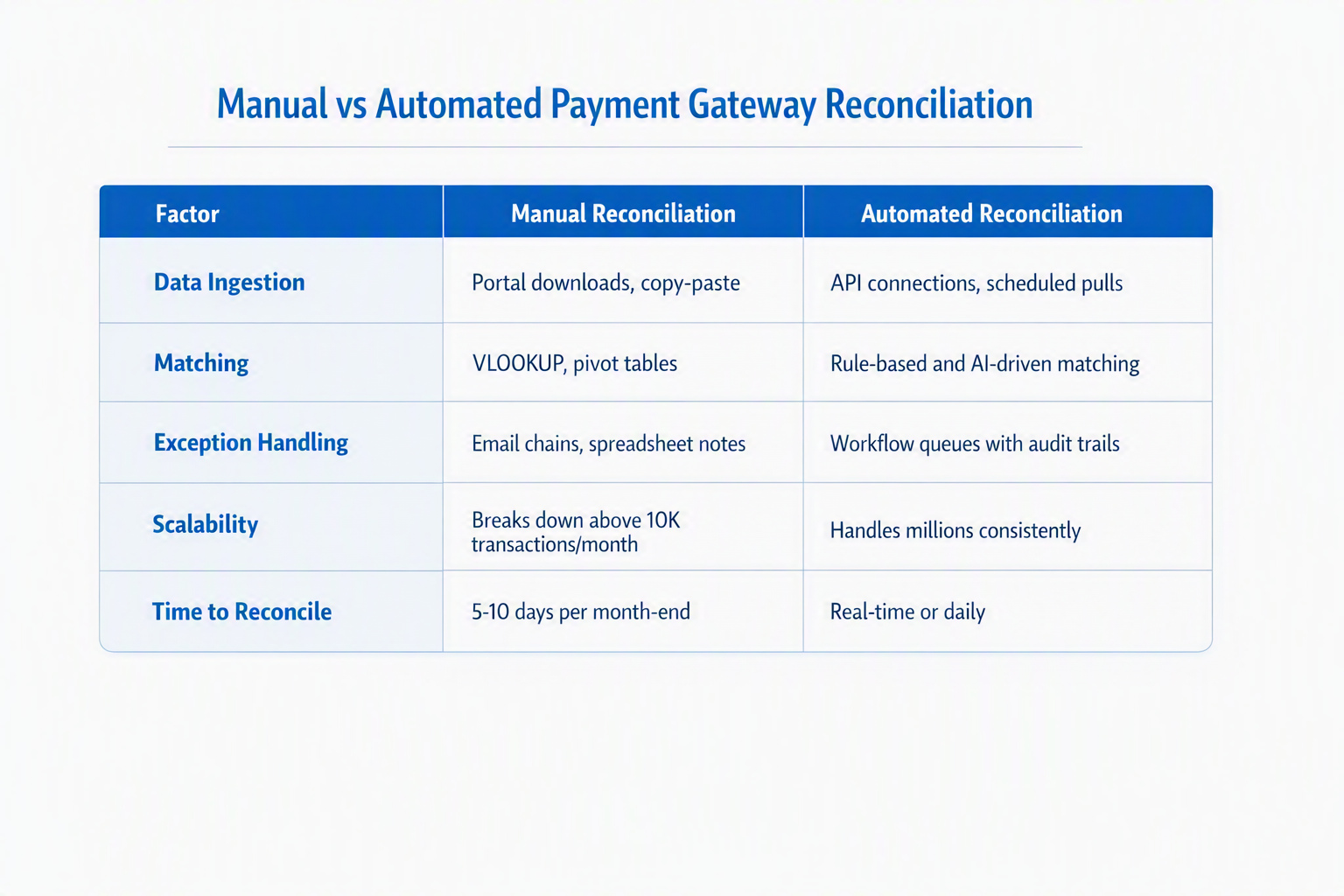
The tipping point typically arrives around 10,000-50,000 monthly transactions. Beyond that threshold, manual processes consume disproportionate resources while accuracy declines.
Best Practices for Reconciling Payment Gateways
Five practices consistently reduce reconciliation time, improve accuracy, and strengthen financial controls.
Reconcile daily at the transaction level. Daily reconciliation catches discrepancies within 24-48 hours, before they compound. It also distributes workload evenly, eliminating the month-end crunch that delays financial close - Gartner predicts AI-embedded finance tools will drive a 30% faster financial close by 2028.
Validate every fee, refund, and chargeback. Don't assume PSP invoices are accurate. Cross-check gateway fees and interchange against contractual rate cards.
Centralize data from all PSPs and banks. Consolidate transaction data, settlement reports, and bank statements into a single source of truth. Eliminate portal-hopping and spreadsheet fragmentation.
Automate exception handling and alerts. Configure real-time alerts for mismatches above defined thresholds. Route exceptions to responsible owners based on transaction type or gateway.
Maintain audit-ready records. Store reconciliation results with full audit trails documenting matching logic, exception resolution, and approval workflows.
Core Capabilities of a Modern Payment Gateway Reconciliation Platform
When evaluating reconciliation software, look for platforms combining connectivity, automation, and intelligence.
Pre-built PSP and bank integrations eliminate custom development. Optimus offers 150+ pre-built connectors covering major gateways, acquirers, banks, and ERP systems, accelerating deployment from months to days.
No-code matching rules and workflows let finance teams configure N-way matching logic and exception thresholds through drag-and-drop interfaces, without IT dependency.
Real-time transaction monitoring surfaces exceptions as they occur, not days later during month-end close. Continuous visibility enables proactive resolution.
PCI-DSS compliant data storage meets security requirements for handling sensitive payment data, reducing audit burden.
AI-driven matching and exception resolution learns from historical patterns, handles fuzzy matches, and suggests resolution actions for common exception types.
Automate Payment Gateway Reconciliation With Optimus
Optimus eliminates the manual work, data fragmentation, and compliance risks associated with payment gateway reconciliation:
- No-code automation: Configure matching rules and workflows without IT dependency
- 150+ pre-built integrations: Connect to payment gateways, banks, ERPs, and accounting systems in minutes
- Real-time monitoring: Surface exceptions as they occur with automated alerts
- PCI-DSS compliance: Secure, certified data storage meeting regulatory requirements
- AI-powered matching: Achieve high straight-through processing rates with intelligent transaction matching
Finance teams using Optimus eliminate transaction leakage, accelerate financial close, and reduce reconciliation effort significantly.
Request a Demo to see how Optimus transforms payment reconciliation.
Frequently Asked Questions
How do I reconcile my payment gateway?
Export transaction and settlement reports from your gateway, match them against bank deposits and internal order records, investigate exceptions, and post verified entries to your general ledger with proper fee allocation.
What is the difference between payment settlement and payment reconciliation?
Settlement is the actual transfer of funds from gateway to merchant bank account. Reconciliation is the verification process confirming settled amounts match expected transactions minus fees, chargebacks, and refunds.
How often should businesses reconcile payment gateway transactions?
High-volume businesses benefit from daily reconciliation to catch discrepancies early. Lower-volume merchants may reconcile weekly, though daily cadence reduces risk and prevents errors from compounding.
What causes discrepancies in payment gateway reconciliation?
Common causes include timing differences between authorization and settlement, processing fees, chargebacks, refunds, failed transactions, currency conversion adjustments, and data synchronization errors across systems.