

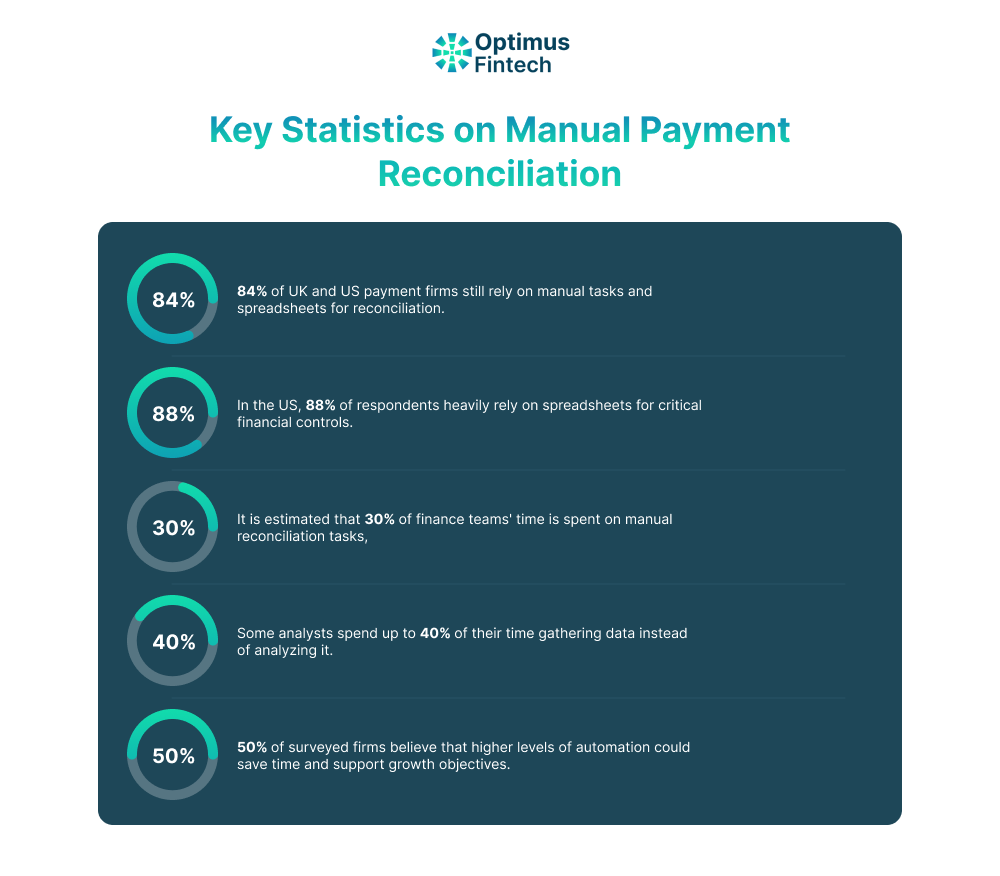
In 2026, the landscape of payment reconciliation is evolving rapidly, driven by the increasing interconnectedness of the global economy, surging transaction volumes, and the demand for greater accuracy in financial reporting. Yet, many businesses continue to cling to outdated manual methods, exposing themselves to significant risks. In fact, 84% of companies still depend heavily on manual tasks and spreadsheets for reconciliation.
As the digital economy accelerates, manual reconciliation has become not only inefficient but also perilous, failing to keep pace with the complexities of modern financial transactions. This reliance on outdated processes poses serious challenges, from errors and delays to potential compliance issues.
The Complexity of Manual Payment Reconciliation
Manual payment reconciliation involves several labor-intensive steps, including gathering transaction data from various sources, matching records, and resolving discrepancies. While this may seem straightforward, the reality is that it requires considerable time and effort, especially for businesses handling high volumes of transactions. According to a recent survey, 42% of finance professionals identified manual reconciliation as a major pain point, contributing to errors and inefficiencies in financial reporting.
The payment reconciliation process can be broken down into several key stages: record retrieval, where all relevant documents are collected; matching, which involves comparing internal records against bank statements; and reconciliation, where discrepancies are investigated and resolved. Each of these steps can be time-consuming, especially when performed manually, leading to potential delays in financial reporting and increased risk of human error. For companies processing over 500 payments monthly, the manual approach can become a significant source of stress, exacerbated by challenges such as varying reporting formats from different payment partners and the need for timely cash flow management.
Moreover, the reliance on manual processes can hinder timely financial visibility, complicate month-end closures, and ultimately affect a company's cash management capabilities. Delays in payment processing not only inconvenience stakeholders but can also strain vendor relationships. As businesses grow and transaction volumes increase, the inefficiencies associated with manual payment reconciliation underscore the urgent need for automation solutions to streamline this critical financial function and improve accuracy across financial operations.
In an era where global transactions are projected to reach $25 trillion by 2025, the demand for swift and accurate reconciliation has never been more urgent. Yet, many organizations continue to rely on outdated manual methods, leaving them vulnerable to significant risks.
The Risks Involved
1. Human Error
The most glaring risk associated with manual reconciliation is human error. A study revealed that 69% of U.S. firms noted that their operational costs rise directly with increased payment processing volumes. This correlation underscores how errors in manual processes can lead to significant financial discrepancies.
2. Operational Inefficiencies
Manual processes are slow and inefficient, with up to 30% of business time wasted on them, according to BDO. These delays disrupt cash flow, hinder operations, and reduce focus on strategic growth. Moreover, inefficiencies increase the risk of errors, complicating financial management further.
3. Compliance Risks
As regulations continue to evolve, maintaining compliance becomes increasingly challenging when relying on manual methods. Financial institutions face heightened scrutiny over their reconciliation processes, and inaccuracies can lead to severe penalties and reputational damage. In fact, nearly 55% of companies engaged in cross-border trade reported difficulties in reconciling transactions due to varying regulatory requirements.
4. Fraud Vulnerability
Manual reconciliation lacks the speed and accuracy to detect fraud or errors promptly. Automated systems flag discrepancies in real time, enabling swift action and risk mitigation. The ACFE reports that organizations lose an estimated 7% of annual revenue to fraud, highlighting the need for robust detection mechanisms.
The Case for Automation
Given the various risks associated with manual reconciliation, organizations are increasingly adopting automation to enhance accuracy and efficiency. Here are some compelling data points highlighting the advantages of automated reconciliation tools:
- Error Reduction: Over 90% of Excel spreadsheets contain errors, which can lead to inaccurate financial records. Automated solutions significantly reduce these data entry errors.
- Time Efficiency: Manual reconciliation can take up to 8 days to complete, while automated systems can reduce this time to as little as 3 hours, depending on the complexity of the transactions.
- Fraud Detection: Automated payment reconciliation tools can quickly detect and flag suspicious transactions, enhancing fraud prevention measures. This capability allows businesses to identify discrepancies in real time, reducing the risk of financial fraud.
- Scalability: As transaction volumes grow, manual processes become unsustainable and labor-intensive. In contrast, automated systems can handle increased workloads without the need for additional manpower, making them more scalable.
- Operational Efficiency: According to a study on AR/AP automation, 93% of participants believe that automation will deliver more accurate and efficient processes compared to manual methods.
Conclusion
As we move further into 2025, the risks associated with manual payment reconciliation will only increase. With transaction volumes soaring and regulatory demands intensifying, businesses must adapt or face significant operational challenges. Embracing automation not only mitigates these risks but also positions organizations for greater efficiency and accuracy in their financial operations.
In this fast-paced digital landscape, companies that cling to outdated manual processes may find themselves at a competitive disadvantage. The future of payment reconciliation lies in leveraging technology to streamline operations, enhance accuracy, and ensure compliance; a crucial step for any organization aiming to thrive in today's complex financial environment.
FAQs
What is payment reconciliation?
Payment reconciliation is when payments coming in from everywhere are matched and checked. This includes bank records, gateway data and internal books. The goal of payment reconciliation is to make sure all these payments make sense.
What is the difference between manual and automated payment reconciliation?
Manual payment reconciliation is when someone uses spreadsheets to check each payment one by one. This method is slow. Automated payment reconciliation is different. It happens in the background and matches data away. This helps cut down on errors and saves a lot of time.
Why is manual payment reconciliation risky in 2025?
Scale has changed the game. More transactions, more complexity. Relying on manual work now means higher chances of errors, delays, and blind spots where discrepancies—or worse—can slip through unnoticed.
How can businesses automate payment reconciliation?
Businesses can start by connecting their systems. This means linking up their banks, gateways and other systems. Then they can use software to match transactions and flag anything that looks unusual. The software will also keep records up to date without needing someone to do it all the time.
What are the main types of payment reconciliation?
There’s no single way to do it. Some still rely on manual checks, others use ERP systems or predefined rules. Then there are fully automated setups—built for speed, accuracy, and handling scale without breaking.