

An agentic financial operations platform uses AI agents that autonomously reconcile transactions, validate fees, and prepare the close, not just flag exceptions for a human to fix. BlackLine pioneered financial close automation, but its architecture is rules-based: it tells you what broke, rarely why, and rarely fixes it without a human in the loop. In 2026, a growing list of finance teams are evaluating alternatives built agent-first, including Optimus, FloQast, Trintech, OneStream, and Vena.
Finance leaders are under more pressure than ever: faster closes, multi-entity accuracy, and rising compliance demands, all while managing fragmented payment and ERP data. BlackLine helped define the close-automation category, but many teams now find it slow to implement, expensive to scale, and built for a rules-based era that AI has already moved past.
This guide breaks down why teams are evaluating BlackLine alternatives, what to look for in an agentic platform, and how the leading options compare, including where Optimus fits into that picture.
Key Takeaways
- Agentic financial operations means AI agents autonomously execute reconciliation, fee validation, and close tasks, not just flag exceptions for manual review.
- BlackLine enterprise deployments typically cost $150,000 to $500,000+ annually, with 3 to 9 month implementations, a slow and expensive path for teams that need results this quarter.
- The strongest BlackLine alternatives are differentiated by agentic depth, not by adding an AI label to a rules-based engine.
- Optimus runs on named, purpose-built agents (Data Fusion, Recon, GL, Cost Intelligence, Insights, Financial Close, and an AI Copilot) with 1,500+ pre-integrated ERP and payment partners.
- Implementation speed is one of the clearest differentiators in this category: BlackLine measures rollout in months, agentic platforms increasingly measure it in weeks or days.
What Is Agentic Financial Operations?
Agentic financial operations is the use of autonomous AI agents, not static rules or macros, to execute the finance back office: matching transactions, validating fees, posting journal entries, flagging anomalies, and preparing a continuous close.
The distinction from traditional automation matters. Rules-based systems, including BlackLine's core engine, execute pre-configured logic: if a transaction matches a defined pattern, it clears; if not, it's routed to a human queue. Agentic systems go further. They interpret unstructured or fragmented data, learn from correction patterns, resolve exceptions autonomously, and explain why a discrepancy occurred, not just that one exists.
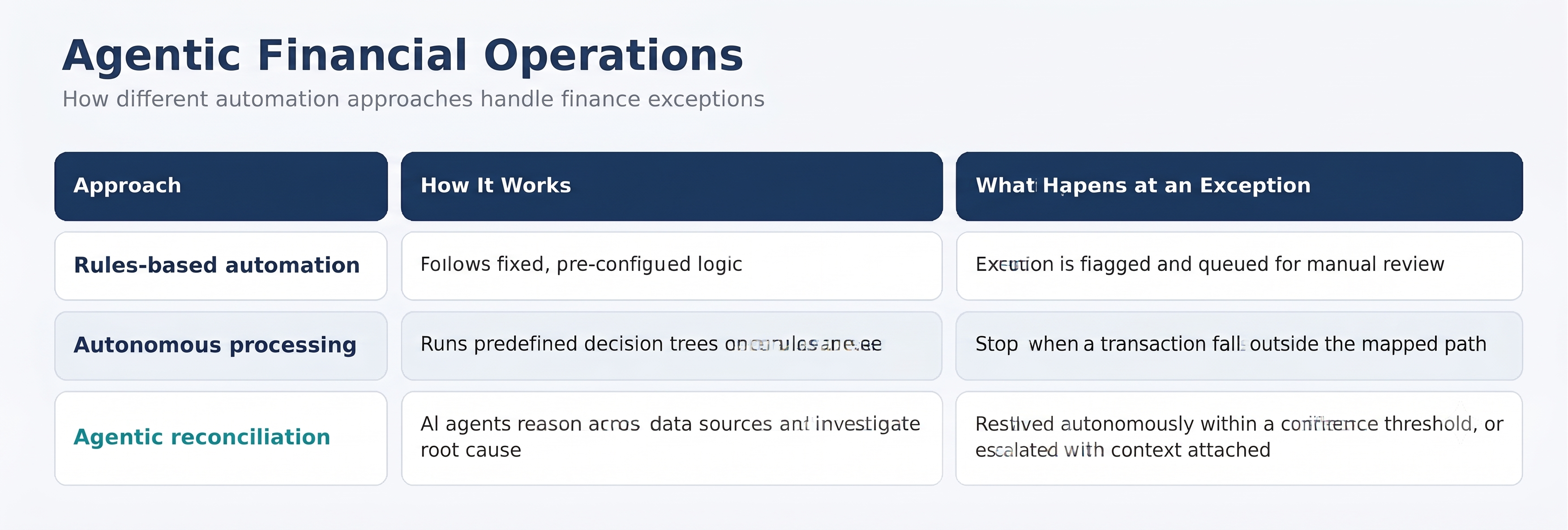
For finance teams, the practical difference shows up as fewer manual touches per close cycle and a shift from monthly close sprints toward continuous, always-reconciled books.
Why Finance Teams Are Moving Off BlackLine
- Cost and total cost of ownership at scale: Enterprise BlackLine deployments commonly run $150,000 to $500,000+ annually once reconciliation, task management, and compliance modules are added, with implementation consulting adding another $50,000 to $100,000 in year one.
- Rules-based automation, not adaptive automation: BlackLine's reconciliation engine is powerful at high-volume matching, but it operates on configured rules. When formats change or exception patterns shift, someone has to update the logic.
- Implementation timelines and complexity: BlackLine implementations commonly run 3 to 9 months, involving detailed process documentation, chart-of-accounts mapping, and IT resourcing.
- Utilization gaps: Mid-market teams often pay for enterprise-tier functionality they use at a fraction of its depth, a mismatch between platform scope and actual team size or transaction complexity.
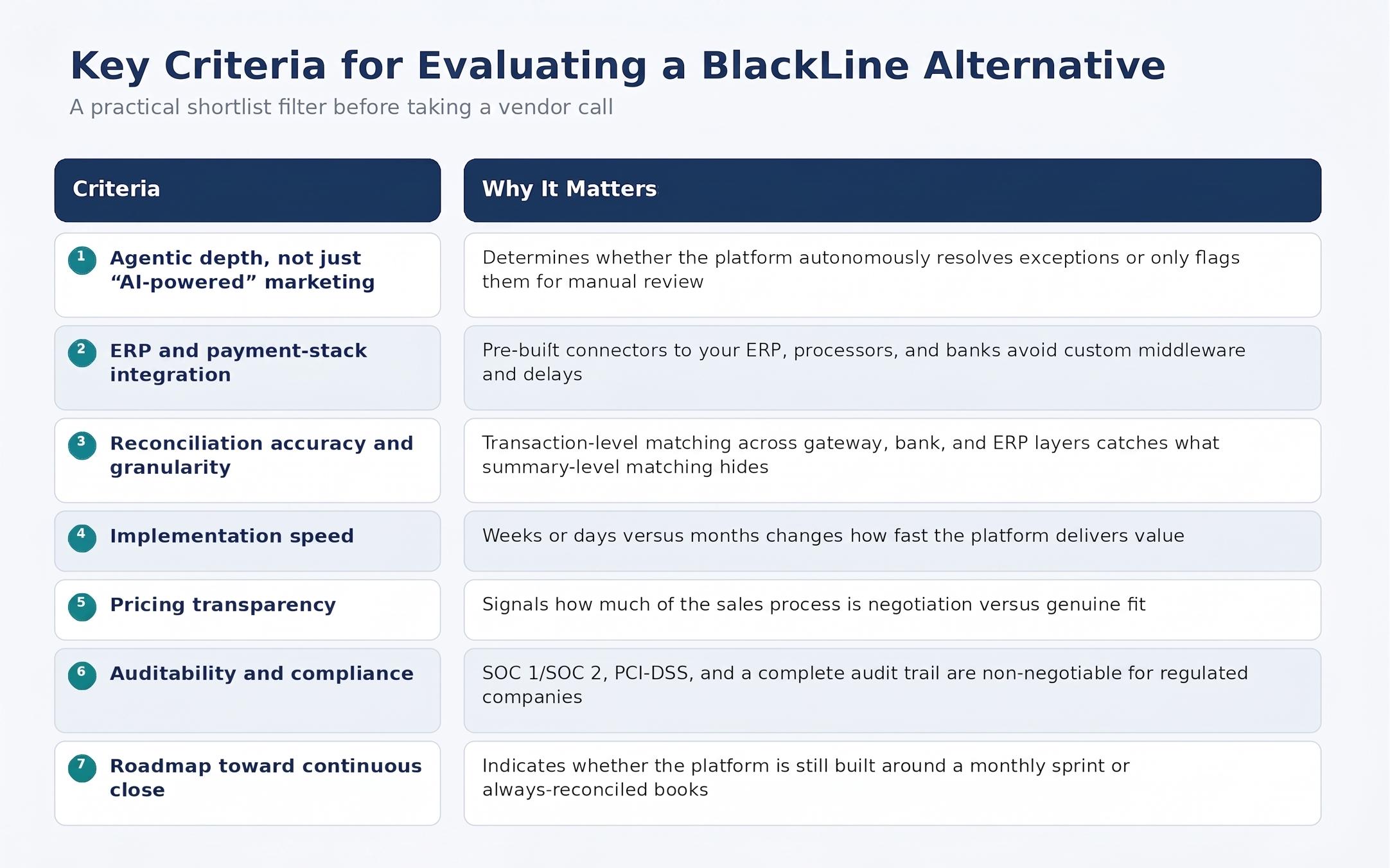
Key Criteria for Evaluating a BlackLine Alternative
Use this checklist as your shortlist filter before taking a vendor call.
Questions to Ask Before Switching
- What does your AI actually do autonomously, versus what does it flag for a human to fix?
- How long does implementation realistically take for a team our size and transaction volume?
- Which ERPs and payment processors do you have native, pre-built integrations with, not custom development?
- What does your pricing model look like at our transaction volume, even directionally?
- Can you show a reference customer with similar transaction complexity and geography?
- What's your SOC 2 / PCI-DSS compliance posture, and can we see the audit trail in a demo?
If a vendor can't answer the first and third questions with specifics, that's worth noting.
BlackLine Alternatives Compared (2026)
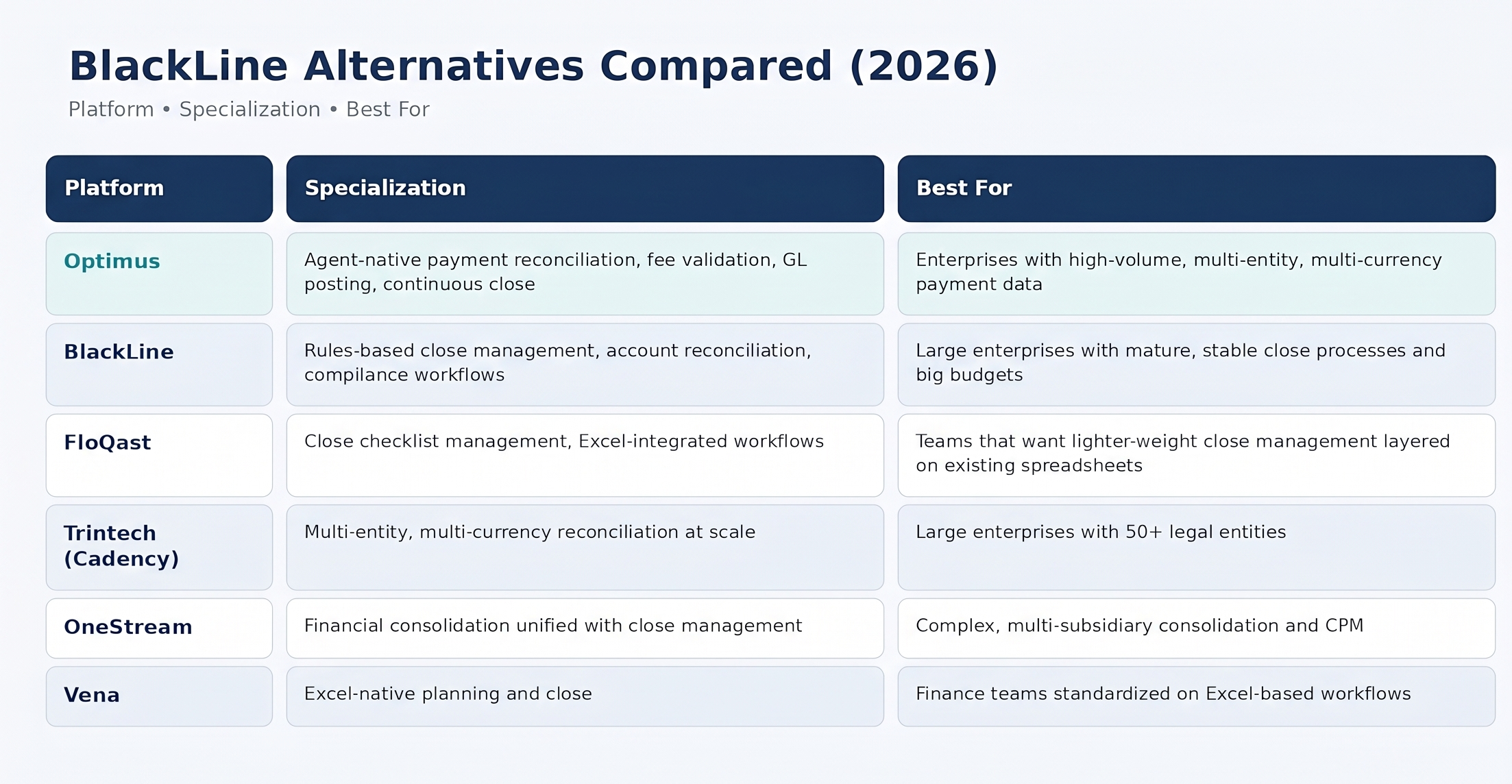
Top BlackLine Alternatives for Agentic Financial Operations, Reviewed
Optimus
Optimus is an autonomous financial operations platform built specifically for agentic reconciliation, fee validation, and continuous close, not a rules engine with AI features added on. The platform runs on named, purpose-built agents:
- Data Fusion Agent: Unifies fragmented payment data across systems into one financial model.
- Recon Agent: Matches transactions across payment gateway, bank, and ERP layers and autonomously resolves exceptions.
- GL Agent: Classifies and maps transactions to the general ledger before posting.
- Cost Intelligence Agent: Validates fees and commissions and flags overcharges.
- Insights Agent: Detects anomalies and prioritizes issues by financial impact.
- Financial Close Agent: Supports continuous, rolling close.
- AI Copilot: Lets finance teams query reconciled data conversationally, without dashboards or SQL.
Optimus ships with 1,500+ pre-integrated payment ecosystem partners spanning ERPs (including NetSuite), billing systems, payment facilitators, and banks, with a "go live in days, not months" implementation model, a direct contrast to BlackLine's multi-month rollout. The platform is PCI-DSS certified and built toward SOC 1/SOC 2 compliance, and is used by enterprises including Tillo and T-Mobile to manage high-volume, multi-country payment reconciliation. Pricing isn't publicly listed (consistent with most platforms in this category, BlackLine included); it's quote-based via demo request.
BlackLine
BlackLine is the category-defining platform for financial close automation, serving 4,300+ customers with a comprehensive suite spanning reconciliation, task management, journal entry automation, and compliance workflows. Its reconciliation engine is strong for high-volume matching, and its Studio360 platform layers in AI through "Verity AI" for predictive intercompany-error prevention and cash forecasting. The trade-off is cost and implementation complexity: enterprise deployments typically run $150,000 to $500,000+ annually with 3 to 9 month implementations.
FloQast
FloQast focuses on close checklist management layered on top of existing spreadsheet workflows, a comfortable fit for accounting teams that don't want to abandon Excel. Its close visibility and task tracking are strong, and implementation is notably faster than BlackLine's. It's less built for deep, transaction-level reconciliation across complex, high-volume payment stacks.
Trintech (Cadency)
Trintech's Cadency platform is built for multi-entity, multi-currency reconciliation at enterprise scale, serving 3,800+ organizations, and is a strong fit for companies with 50+ legal entities needing intercompany matching. Pricing is comparable to BlackLine's enterprise tier. For a deeper side-by-side, see the dedicated Optimus vs. Trintech comparison.
OneStream
OneStream unifies financial consolidation with close management, a strong option for organizations that need CPM (corporate performance management) and close automation in a single platform rather than stitching two tools together. It's a heavier, more consolidation-first platform than a payment-reconciliation specialist.
Vena
Vena is built around Excel-native planning and close workflows, appealing to finance teams that want AI-assisted automation without leaving the spreadsheet interface they already know. It trades some reconciliation depth for that familiarity.
Why Optimus Stands Out
- Built agent-first, not retrofitted with AI: The platform architecture is agents from the ground up, so it autonomously resolves exceptions, validates fees, and classifies GL entries rather than merely flagging them for a human.
- Transaction-level accuracy at high volume: Optimus is purpose-built to operate at transaction-level granularity, even in environments with millions of daily transactions across multiple payment service providers and complex fee structures.
- Implementation measured in days, not months: Against BlackLine's typical 3 to 9 month rollout, Optimus's pre-integrated partner network across ERPs, billing systems, and payment processors is built for fast go-live.
- A genuinely payments-native platform: Built specifically around the complexity of modern payment ecosystems (gateways, processors, banks, and fee structures), which shows up in how it handles fee and commission validation and ledger-level reconciliation.
- Compliance built in, not bolted on: PCI-DSS certified with a complete audit trail, built toward SOC 1/SOC 2.
Move to Agentic Financial Operations With Optimus
Optimus builds agentic payment reconciliation and close software for finance teams that need transaction-level accuracy at high volume, without a multi-quarter implementation. Explore the Security & Compliance overview for full details on certifications and controls.
- Coordinated agent architecture: A Data Fusion Agent, Recon Agent, GL Agent, Cost Intelligence Agent, Insights Agent, and Financial Close Agent each handle a distinct part of the workflow.
- Fast, pre-integrated go-live: 1,500+ partners across ERPs, billing systems, and payment processors. See the full list on the Optimus integrations hub.
- Audit-ready by design: PCI-DSS certified storage, built toward SOC 1/SOC 2, with a complete audit trail.
- Transaction-level accuracy at scale: Purpose-built for high-volume, multi-entity, multi-currency payment data.
Frequently Asked Questions About BlackLine Alternatives
What is a good BlackLine alternative for agentic finance teams?
Optimus is built specifically for agentic financial operations: AI agents that autonomously reconcile transactions, validate fees, and prepare journal entries rather than just flagging exceptions for manual review. FloQast suits teams wanting lighter checklist-based close management on top of Excel; Trintech and OneStream suit large multi-entity consolidation needs.
What does “agentic” mean in financial operations software?
Agentic means the software uses autonomous AI agents to execute tasks (matching transactions, resolving exceptions, posting journal entries) rather than only applying static, pre-configured rules and routing exceptions to a human. The agent interprets data, adapts to pattern changes, and completes the task rather than just detecting a problem.
How much does BlackLine cost compared to alternatives?
BlackLine enterprise deployments typically run $150,000 to $500,000+ annually, plus $50,000 to $100,000 in first-year implementation costs. Most alternatives, including Optimus, price on a quote basis tailored to transaction volume and don't publish list pricing, but implementation timelines are typically measured in weeks rather than BlackLine's 3 to 9 months.
Is Optimus a full replacement for BlackLine or a complement?
For payment reconciliation, fee validation, and continuous close, Optimus is built as a direct, purpose-built replacement. Organizations with heavy needs in areas like SEC/XBRL compliance reporting may still evaluate specialized tools for that specific function alongside a reconciliation platform.
How long does implementation typically take?
BlackLine implementations commonly take 3 to 9 months for mid-market to enterprise deployments. Optimus is built for go-live measured in days to weeks through its pre-integrated network of ERP, billing, and payment processor connectors.
What ERPs and payment systems does Optimus integrate with?
Optimus has 1,500+ pre-integrated partners across ERPs (including NetSuite), billing systems, payment facilitators, processors, and banks. See the full list on the Optimus integrations hub.