
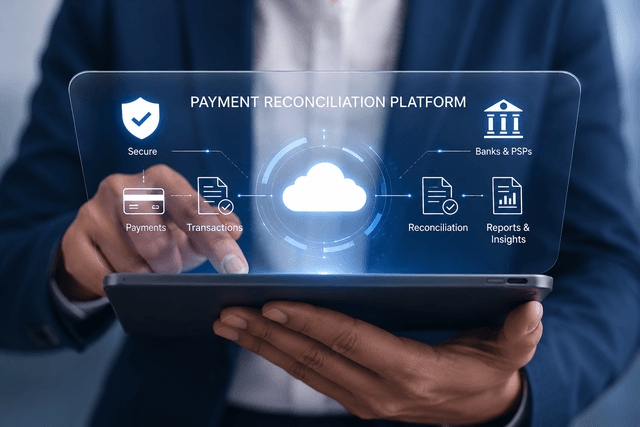
Finance teams evaluating reconciliation platforms often land on the same two names: Optimus and Trintech. But these platforms solve fundamentally different problems, and choosing the wrong one means months of implementation for capabilities that don't match your operational reality.
This guide breaks down where each platform excels, how their architectures differ, and which business scenarios favor one over the other.
Why enterprise payment reconciliation demands a purpose-built modern platform
Optimus and Trintech solve different problems. Optimus targets operational payment management, high transaction volumes, and messy multi-processor settlement data. Trintech focuses on enterprise accounting, financial close cycles, compliance tracking, and standard general ledger reconciliations.
The distinction matters more than it might seem at first. Payment-heavy businesses (fintechs, marketplaces, e-commerce platforms) face reconciliation challenges that accounting-first tools weren't built to handle. When you're processing thousands of transactions daily across multiple payment service providers, the reconciliation problem looks fundamentally different than matching GL accounts at month-end.
Payment reconciliation is the process of matching transaction records across payment systems, bank settlement files, and accounting ledgers. A customer pays through Stripe, and that transaction flows through the payment gateway, the acquiring bank, and eventually into your ERP. Each system records the event differently. Discrepancies between records create revenue leakage, delayed closes, and audit headaches.
For CFOs managing high-volume payment operations, choosing the right reconciliation platform directly impacts cash position, margin, and operational burden. The platform you select shapes how your finance team operates every single day.
Where traditional reconciliation approaches fall short at enterprise scale
Before comparing platforms, it helps to understand why finance teams start searching for alternatives in the first place. The pain points reveal what features actually matter.
Excessive manual data wrangling consuming finance resources
Most finance teams still download settlement files from multiple PSP portals, normalize formats in spreadsheets, and manually match transactions against bank statements. This process consumes 20 to 50 hours every month, time that could go toward analysis and strategic work.
The manual approach also delays month-end closes. When reconciliation depends on spreadsheet manipulation, finance teams can't close books until every file is downloaded, formatted, and matched. A single missing file or format change from a payment provider can stall the entire process.
High error rates and revenue leakage risk
Manual matching introduces errors that compound over time. Missed discrepancies, duplicate payments, unrecovered fees, chargeback errors, and settlement timing mismatches all contribute torevenue leakage, measurable revenue loss from undetected issues.
Even a 3 to 5% manual error rate on millions in monthly transaction volume translates to significant lost revenue. The problem is that losses hide in the noise of high-volume operations, making them difficult to detect without transaction-level visibility.
Limited transaction-level visibility and traceability
Spreadsheet-based reconciliation lacks drill-down capability. When an exception surfaces, finance teams can't easily trace the transaction back to its source to understand root cause.
This visibility gap createsexception handling bottlenecks and slows dispute resolution. Auditors increasingly expect complete traceability from payment initiation through settlement. Without it, organizations face compliance gaps and extended audit cycles.
Poor scalability across PSPs, banks, and payment channels
Adding new payment partners, channels, or markets creates exponential complexity. Each new PSP brings different file formats, settlement schedules, and fee structures.
Without a unified platform, finance teams end up managing dozens of manual processes that don't scale. What works with two payment providers breaks down with five or ten.
How Trintech approaches reconciliation and financial close management
Trintech is a financial close management platform built for the office of the CFO. The core strength lies in GL-centric reconciliation and broad enterprise finance use cases across accounting close cycles.
The platform excels at:
- Account reconciliation: Matching ledger and balance sheet accounts against subledgers and external statements
- Close task management: Workflow orchestration, deadline tracking, and status visibility across close activities
- Journal entry automation: Automating journal workflows, approvals, and documentation
Trintech's design centers on accounting close cycles and balance sheet reconciliation rather than payment-specific operations. For organizations whose primary challenge is managing the financial close process across multiple entities and geographies, Trintech offers robust capabilities.
However, this accounting-first architecture means Trintech wasn't purpose-built for the unique demands of high-volume payment reconciliation: multiple PSPs, real-time transaction matching, and fee validation across complex payment networks.
How Optimus approaches enterprise payment reconciliation differently
Optimus was designed from the ground up for payment operations and transaction reconciliation. Rather than adapting accounting software to handle payments, the platform starts with payment-specific workflows and builds outward.
- Payment-first design: Specializes in transaction-level reconciliation across PSPs, acquiring banks, and payment gateways
- No-code workflow configuration: Drag-and-drop builders let finance teams design reconciliation flows without IT dependency
- Real-time transaction monitoring: Automated visibility and issue detection as transactions settle, not days later
Optimus includes a data preparation layer that collects, standardizes, and enriches payment data from multiple sources. Raw processor files get normalized automatically, eliminating the manual format conversion that consumes so much finance team time.
The platform also embeds AI for predictive matching and automated discrepancy resolution, capabilities that become essential at high transaction volumes where manual review isn't feasible.
Optimus vs Trintech feature comparison for payment reconciliation
Understanding specific capability differences helps clarify which platform fits your operational reality.