

Revenue leakage detection is the process of identifying and stopping the unintentional loss of earned income before it impacts profitability. It works by continuously monitoring transactions, validating fees, and reconciling settlements to catch discrepancies that would otherwise drain revenue silently.
For high-volume businesses, even a 1-2% leakage rate translates into millions in lost margin annually: losses that rarely show up as obvious line items. This guide covers where revenue leakage originates, how to calculate and detect it, and the technologies and practices that finance teams use to close the gaps.
What Is Revenue Leakage Detection?
Revenue leakage detection is the process of finding and stopping the unintentional loss of earned income before it hurts your bottom line. It spots gaps like unbilled usage, missed contract renewals, pricing errors, and broken data links between sales and finance tools. Think of it like checking a pipe for leaks: money that your business has already earned quietly drains away through cracks in billing, payment processing, and reconciliation.
The process works by continuously monitoring transactions, validating fees, and reconciling settlements to catch discrepancies in real time. For finance teams handling thousands or millions of transactions daily, even a small percentage of undetected leakage compounds into serious margin erosion over time.
- Transaction monitoring: Tracking payments to identify missing transactions, failed authorizations, and settlement delays before they become write-offs.
- Fee validation: Verifying that processor fees, network charges, and commissions match contracted rates rather than inflated amounts.
- Settlement reconciliation: Comparing expected deposits against actual bank receipts to surface shortfalls and timing gaps.
Why Revenue Leakage Detection Matters for Finance Teams
Finance teams own the numbers. When revenue leaks go undetected, the consequences ripple through forecasting, reporting, and compliance: areas where accuracy isn't optional.
Cash flow unpredictability is often the first symptom. If you can't trust that collected revenue matches what you've earned, planning for growth, payroll, or vendor payments becomes guesswork. For high-volume businesses processing millions in transactions monthly, even small percentage variances create material gaps between projected and actual cash positions.
Margin erosion happens quietly. A 0.5% leakage rate might sound trivial, but on $100 million in annual revenue, that's $500,000 walking out the door. Losses often hide in fee overcharges, missed rebates, or transactions that simply never settle: none of which show up as obvious line items.
- Audit and compliance exposure: Unresolved discrepancies create control weaknesses that auditors flag. For companies subject to SOX requirements, systematic revenue leakage can escalate from an operational issue to a material misstatement risk.
- Operational burden: Finance staff spend hours, sometimes days, manually investigating exceptions instead of focusing on strategic analysis.
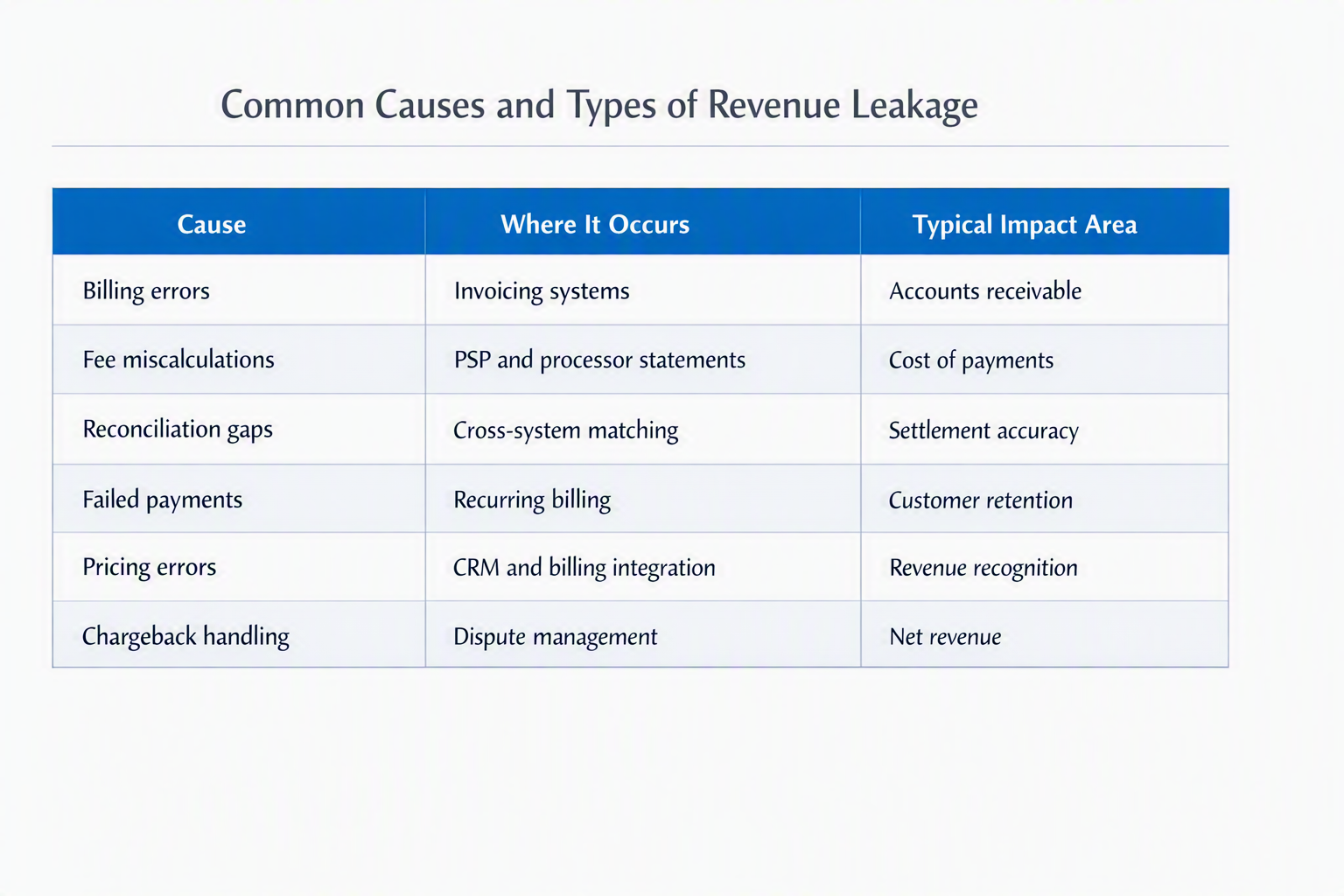
Common Causes and Types of Revenue Leakage
Revenue leakage rarely stems from a single source. It typically emerges across multiple points in the order-to-cash cycle, often in places that don't get regular scrutiny.
Billing and Invoicing Errors
Missed invoices, incorrect amounts, and misapplied pricing tiers create immediate revenue loss. The gap between service delivery and invoice generation is particularly risky: if a transaction isn't billed within the expected window, it often never gets billed at all. Customer disputes frequently surface billing errors, but by then, recovery becomes difficult.
Fee, Commission, and Rebate Miscalculations
Payment processing involves layers of fees: interchange, network assessments, processor markups, and gateway charges. Each layer introduces calculation complexity. When you're working with tiered pricing, volume-based discounts, or interchange-plus models, manual validation becomes nearly impossible. Interchange fees alone typically represent 70-90% of total card processing costs, making fee-layer accuracy one of the highest-leverage places to check for leakage. Overcharges of even a few basis points accumulate quickly across high transaction volumes.
Reconciliation Gaps Across PSPs, Banks, and ERPs
Fragmented data is the enemy of accurate reconciliation. When transaction records live in separate systems (your PSP portal, banking platform, and ERP), matching them requires manual effort that introduces both delays and errors. Transactions that don't match cleanly often get parked in exception queues where they sit unresolved for weeks.
Failed Payments and Involuntary Churn
Not all customer churn is intentional. Declined credit cards, expired payment methods, and failed recurring billing attempts cause what's called involuntary churn: a projected $129 billion problem, according to Recurly's industry analysis, revenue lost not because customers wanted to leave, but because payment mechanics failed. Failed payments often go untracked, making it difficult to understand true customer retention rates.
Contract, Pricing, and Discount Errors
Manual pricing overrides, outdated rate cards, and unenforced minimum commitments create systematic leakage. When sales teams apply discounts that don't match contract terms, or when pricing updates don't propagate across systems, the gap between what you collect and what you're owed widens.
Chargebacks and Refund Handling
Chargebacks and refunds processed without proper validation against original transactions distort net revenue calculations. Without transaction-level tracking, it's difficult to distinguish legitimate customer disputes from processing errors.
How to Calculate Revenue Leakage
The standard formula is straightforward:
(Expected Revenue – Actual Revenue Collected) / Expected Revenue × 100 = Revenue Leakage Percentage
The challenge lies in defining "expected revenue" accurately. Depending on your business model, expected revenue might mean contracted amounts, invoiced totals, or transaction-based revenue before fees and deductions.
- Expected Revenue: The total amount your business is owed based on contracts, invoices, and pricing terms.
- Actual Revenue Collected: Net amount received after accounting for payment failures, fees, chargebacks, and disputes.
- Revenue Leakage Percentage: The percentage of earned revenue that never made it to your accounts: your baseline for tracking improvement.
Most finance teams find that calculating leakage at the aggregate level masks where problems actually occur. Transaction-level analysis reveals patterns that percentages alone can't show.
Warning Signs and Red Flags of Revenue Leakage
Before you can detect leakage systematically, you'll often notice symptoms that signal something's wrong.
- Inconsistent cash flow vs. sales volume: When revenue receipts don't track with transaction growth, something is leaking between sale and settlement.
- Frequent billing disputes: Recurring customer complaints about charges point to invoicing errors or pricing inconsistencies that likely affect other customers too.
- High manual adjustment rates: If your team regularly processes write-offs, credits, or manual corrections, adjustments often mask underlying leakage.
- Persistent reconciliation exceptions: Unresolved mismatches that carry forward month after month suggest systemic problems rather than one-off errors.
How to Detect Revenue Leakage Step by Step
Detection requires a systematic approach. Here's how finance teams typically structure the process.
Step 1: Centralize Payment and Financial Data
You can't find leakage if your data lives in silos. The first step is aggregating transaction records from all PSPs, acquiring banks, ERP systems, and accounting platforms into a single source of truth. Without centralized data, reconciliation becomes a game of chasing information across portals and spreadsheets.
Step 2: Reconcile Transactions at the Source
Once data is centralized, the next step is matching individual transactions across systems: from orders to authorizations to settlements to accounting entries. N-way reconciliation, which validates consistency across multiple sources simultaneously, catches discrepancies that two-way matching misses.
Step 3: Validate Fees, Commissions, and Settlements
Processing fees deserve their own validation layer. Compare charged fees against contracted rate cards, verify commission calculations, and confirm that settlement amounts reconcile to expected net revenue after all deductions. Many businesses discover they've been overcharged for months without realizing it.
Step 4: Flag Anomalies and Exceptions in Real Time
The difference between catching leakage early and discovering it during month-end close often determines whether you can recover the revenue. Real-time exception alerting surfaces issues (fee variances, missing transactions, settlement timing gaps) while they're still actionable.
Step 5: Trace and Resolve Discrepancies With Audit Trails
When you find a discrepancy, you need to understand why it happened. Transaction-level audit trails enable efficient root cause analysis and provide the documentation auditors require to verify financial controls.
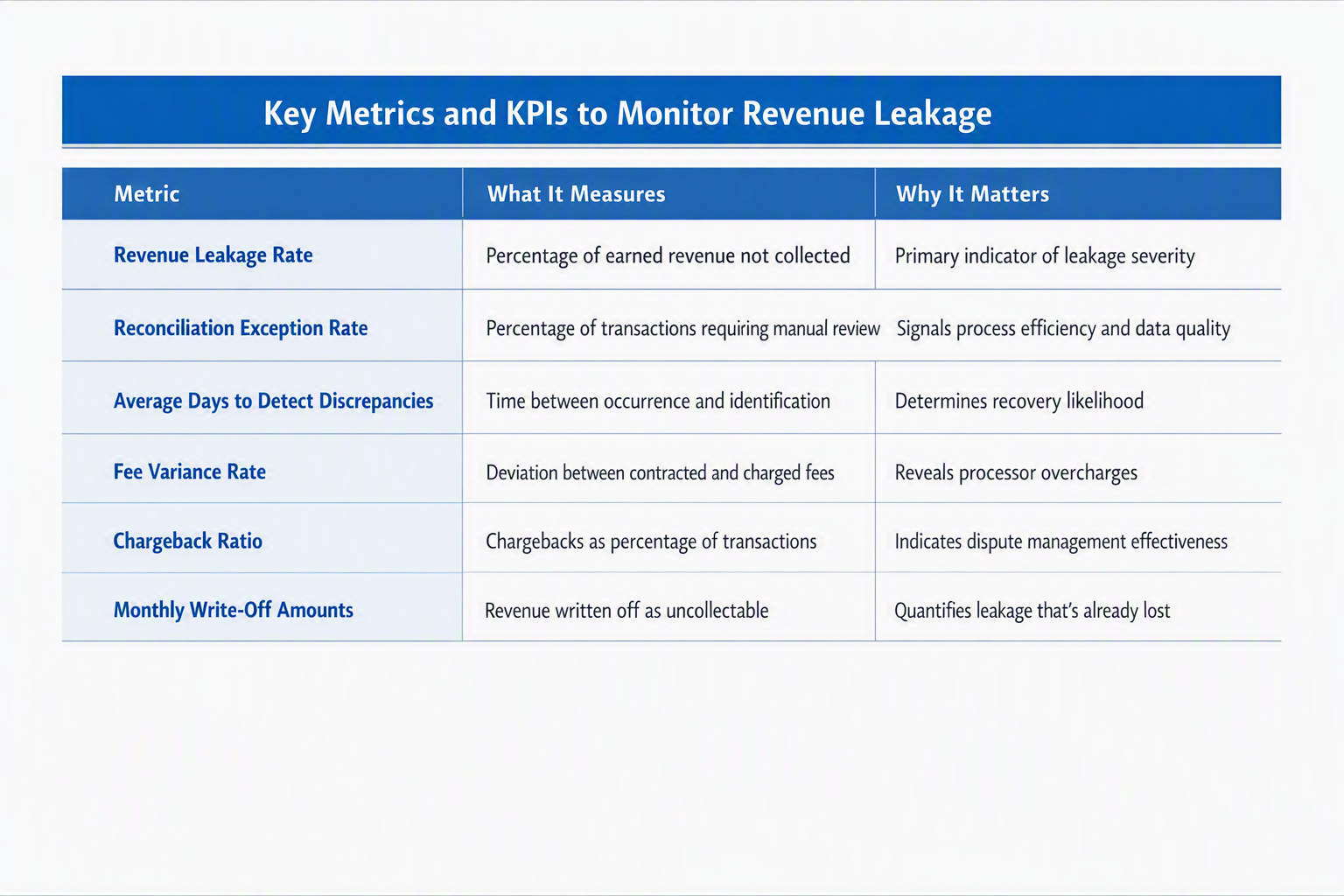
Key Metrics and KPIs to Monitor Revenue Leakage
Tracking the right metrics transforms revenue leakage from an abstract concern into a measurable operational priority.
Why Manual and Legacy Approaches Fail
Spreadsheet-based reconciliation worked when transaction volumes were manageable. For businesses processing thousands of transactions daily across multiple payment providers, manual approaches create more problems than they solve.
Time lag delays detection and resolution. With 50% of finance teams taking 6+ days to close the books, by the time monthly reports surface a discrepancy, the window for recovery has often closed. Customers have moved on, and the operational context needed to investigate has faded.
Human error compounds losses. Manual review introduces calculation mistakes, missed exceptions, and inconsistent application of matching rules. What starts as a small oversight becomes a pattern that persists for months.
- Spreadsheets can't scale: A finance team that can reconcile 1,000 transactions manually will struggle with 10,000 and fail at 100,000. Volume growth exposes the fundamental limitations of manual processes.
- No audit trail for compliance: Fragmented workflows across spreadsheets, emails, and portal downloads make it difficult to demonstrate controls during audits.
Technologies That Power Revenue Leakage Detection
Modern revenue leakage detection relies on several technology categories working together.
Automated Reconciliation Engines
Automated reconciliation systems match transactions across multiple data sources without manual intervention, performing transaction-level matching at scale. Reconciliation engines identify discrepancies that indicate leakage and route exceptions for review based on configurable rules.
No-Code Data Preparation and Integration Platforms
Finance teams increasingly want to connect data sources without waiting for IT projects. No-code platforms with pre-built integrations to PSPs, banks, ERPs, and accounting systems reduce the time from data fragmentation to unified visibility.
AI and Machine Learning for Anomaly Detection
Machine learning algorithms identify patterns in transaction data and flag statistical outliers that rules-based systems miss. AI models improve over time as they learn your business's specific transaction patterns and fee structures.
Real-Time Transaction Monitoring Systems
Continuous monitoring catches issues as they occur rather than during batch processing cycles. For high-volume businesses, the difference between real-time and daily detection can mean the difference between recovering revenue and writing it off.
Best Practices to Prevent and Reduce Revenue Leakage
Detection is essential, but prevention is more efficient.
Automate Reconciliation and Fee Validation Processes
With nearly three-quarters of companies still lacking automated revenue assurance, automation is the single most effective prevention method. Systems that continuously reconcile transactions and validate fees catch discrepancies that manual processes miss, and they do it without adding headcount.
Standardize Data Formats Across Systems
Data normalization makes accurate matching possible. When transaction records from different sources use consistent formats, identifiers, and structures, reconciliation becomes reliable rather than approximate.
Establish Transaction-Level Audit Trails
Granular, immutable audit trails serve two purposes: they enable efficient root cause analysis when leakage is detected, and they satisfy compliance requirements for financial controls documentation.
Run Regular Revenue Leakage Audits
Continuous monitoring catches most issues, but periodic comprehensive audits surface patterns that real-time systems might miss. Quarterly audits are a reasonable minimum for high-volume businesses.
Build Real-Time Monitoring Dashboards
Dashboards that surface leakage indicators in real time give finance teams visibility into trends before they become material problems. The goal is catching issues early enough to act on them.
How Optimus Automates Revenue Leakage Detection
Optimus addresses revenue leakage detection through a unified platform that connects data preparation, reconciliation, fee validation, and real-time monitoring.
- Automated data centralization: The Data Fusion Agent connects and normalizes data from 150+ PSPs, ERPs, banks, and accounting systemswithout coding or lengthy IT projects.
- Intelligent N-way reconciliation: Transaction matching at scale across multiple data sources automatically identifies discrepancies indicating revenue leakage.
- Configurable fee validation: Automated validation of processing fees against contracted rate cards across all fee structures: interchange-plus, tiered, flat-rate, and custom arrangements.
- Real-time monitoring and alerting: Continuous transaction surveillance with intelligent exception flagging alerts finance teams to potential leakage as it occurs.
- Comprehensive audit trails: Immutable, transaction-level records using double-entry accounting principles support compliance requirements and root cause analysis.
The platform is PCI-DSS certified and designed for high-volume transaction environments where speed, accuracy, and auditability matter.
Request a Demo to see how Optimus can reduce revenue leakage for your business.
Frequently Asked Questions About Revenue Leakage Detection
How often should finance teams conduct a revenue leakage audit?
Comprehensive audits work best on a quarterly cadence for high-volume businesses, though monthly reviews are appropriate for organizations with complex fee structures or multiple payment providers. The ideal approach combines periodic audits with continuous automated monitoring that catches issues in real time.
What is the difference between revenue leakage and revenue loss?
Revenue leakage refers specifically to preventable lost revenue caused by operational gaps, process failures, or system errors. Revenue loss is broader: it includes market factors, competitive pressures, and customer churn that aren't directly tied to operational breakdowns.
Can revenue leakage affect SOX compliance and financial audits?
Yes. Undetected revenue leakage can lead to material misstatements in financial reporting and exposes control weaknesses that auditors flag. Systematic detection processes demonstrate the financial controls that compliance frameworks require.
Which industries experience the highest revenue leakage rates?
High-volume transaction businesses typically see the highest rates: fintech companies, payment service providers, online marketplaces, subscription SaaS businesses, and e-commerce platforms. The combination of transaction volume and payment complexity creates more opportunities for leakage.
How quickly can automated systems detect revenue leakage compared to manual methods?
Automated systems identify discrepancies in real time or within hours. Manual methods typically surface issues days or weeks later, often during month-end close when recovery options have narrowed significantly.