

FloQast built its reputation on close checklist management and visibility, centralizing tasks, deadlines, and sign-offs in one place. What it doesn't do is execute the close itself: reconciliation, journal entry preparation, and variance analysis still happen outside FloQast, then get tracked inside it. Agentic close management changes that division of labor. AI agents execute the underlying close work, not just track whether someone finished it, which is why finance teams evaluating FloQast alternatives in 2026 are looking at agent-native platforms including Optimus, BlackLine, Trintech, OneStream, and Vena.
FloQast remains a strong, well-reviewed product for what it's built to do: give accounting teams a shared, real-time view of close status. The gap shows up for teams whose bottleneck isn't visibility, it's the manual reconciliation, GL coding, and exception handling that FloQast surfaces but doesn't perform. This guide covers what agentic close management actually means, why teams outgrow a checklist-first tool, and how the leading alternatives compare, including where Optimus fits.
Key Takeaways
- FloQast is a close checklist and task-tracking layer; it centralizes visibility but leaves reconciliation, journal entries, and variance analysis for your team to execute elsewhere.
- Agentic close management uses AI agents to execute reconciliation and close tasks directly, not just track their status.
- FloQast's published starting price is $999/month for its Basic plan; enterprise tiers with fuller automation are quote-only, and cost scales with users and entities.
- FloQast's own users note limitations in multi-entity journal entry posting and note that cross-team buy-in (FP&A, Operations) is required for the tool to pay off.
- Optimus runs on purpose-built agents (Data Fusion, Recon, GL, Cost Intelligence, Insights, Financial Close, and an AI Copilot) that execute reconciliation and fee validation directly, with 1,500+ pre-integrated ERP and payment partners.
What Is Agentic Close Management?
Agentic close management is the use of autonomous AI agents to perform the work of the close, matching transactions, preparing journal entries, validating fees, and investigating variances, rather than only tracking whether a human completed each task. It's a step beyond checklist automation and beyond autonomous, rules-based processing: the agent reasons across data sources, resolves what it can within a defined confidence threshold, and escalates only what genuinely needs a human decision.
Agentic close management software is the product category built around this behavior: purpose-built AI agents, transaction-level ERP integration, confidence-threshold exception resolution, and an audit trail for every action the agent takes, not a workflow layer bolted onto a checklist. It's also the lens worth using when you evaluate FloQast competitors more broadly: the question isn't which tool has the longest feature list, it's what each vendor's agents actually execute versus what their dashboard merely displays.
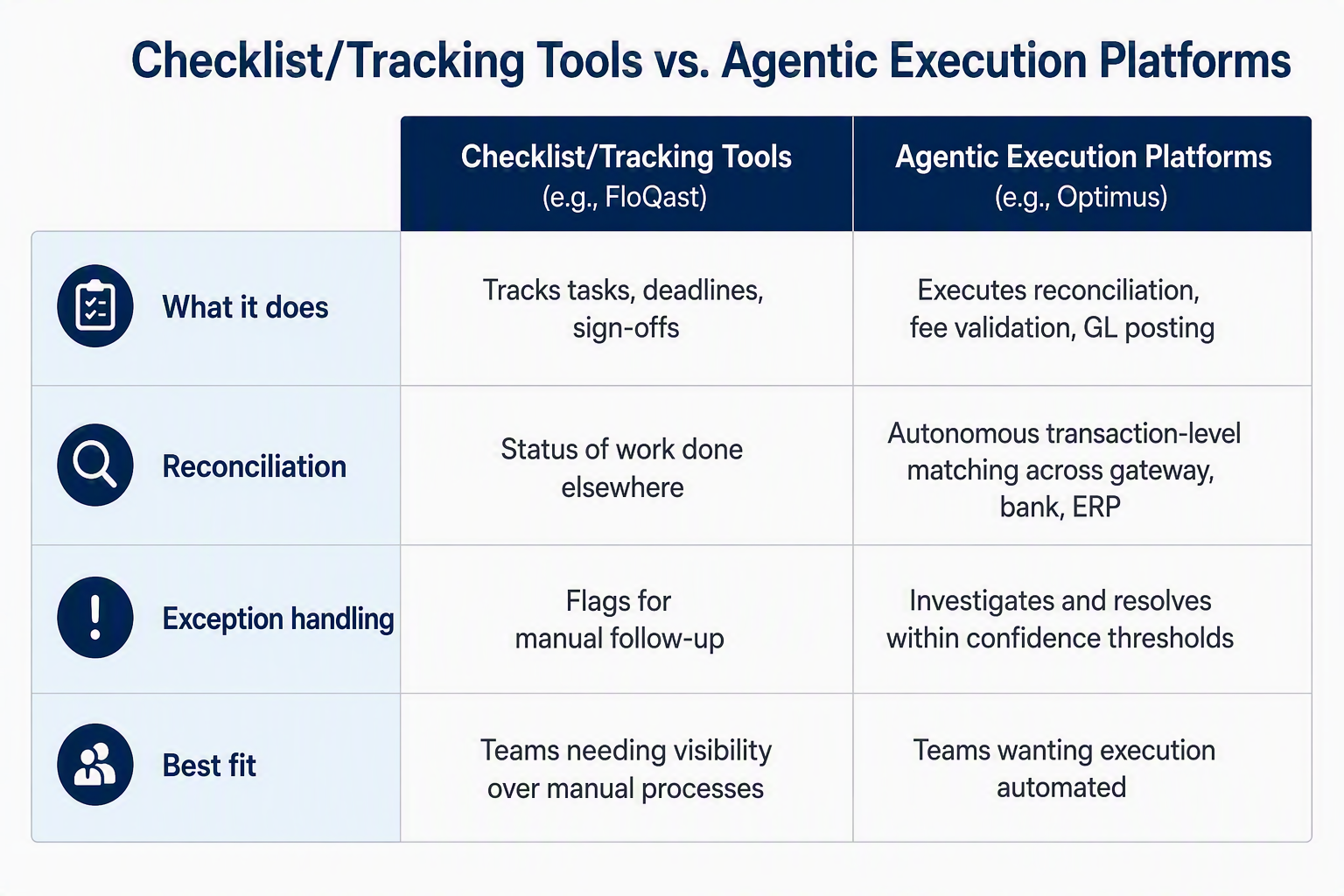
This distinction is also why more teams are moving toward continuous, always-reconciled books instead of a monthly close sprint managed through a checklist.
Why Finance Teams Are Moving Off FloQast
- The execution gap: FloQast manages the close checklist, but transaction coding, reconciliation, accrual prep, and variance analysis still happen outside the platform. Teams whose bottleneck is execution, not visibility, often find the underlying manual work unchanged.
- Pricing that scales past the entry tier: FloQast's published starting price is $999/month for its Basic plan. Fuller automation and enterprise tiers are quote-only, with cost scaling by users and entities.
- Multi-entity journal entry limitations: User reviews note that FloQast's journal entry posting is built for debits and credits hitting the same entity, which can be a real constraint for multi-entity organizations.
- Cross-team buy-in required: FloQast's value depends on adoption beyond accounting, including FP&A and Operations. Reviewers note that achieving that buy-in can take time, which delays the payoff.
Key Criteria for Evaluating a FloQast Alternative
Use this checklist as your shortlist filter before taking a vendor call.
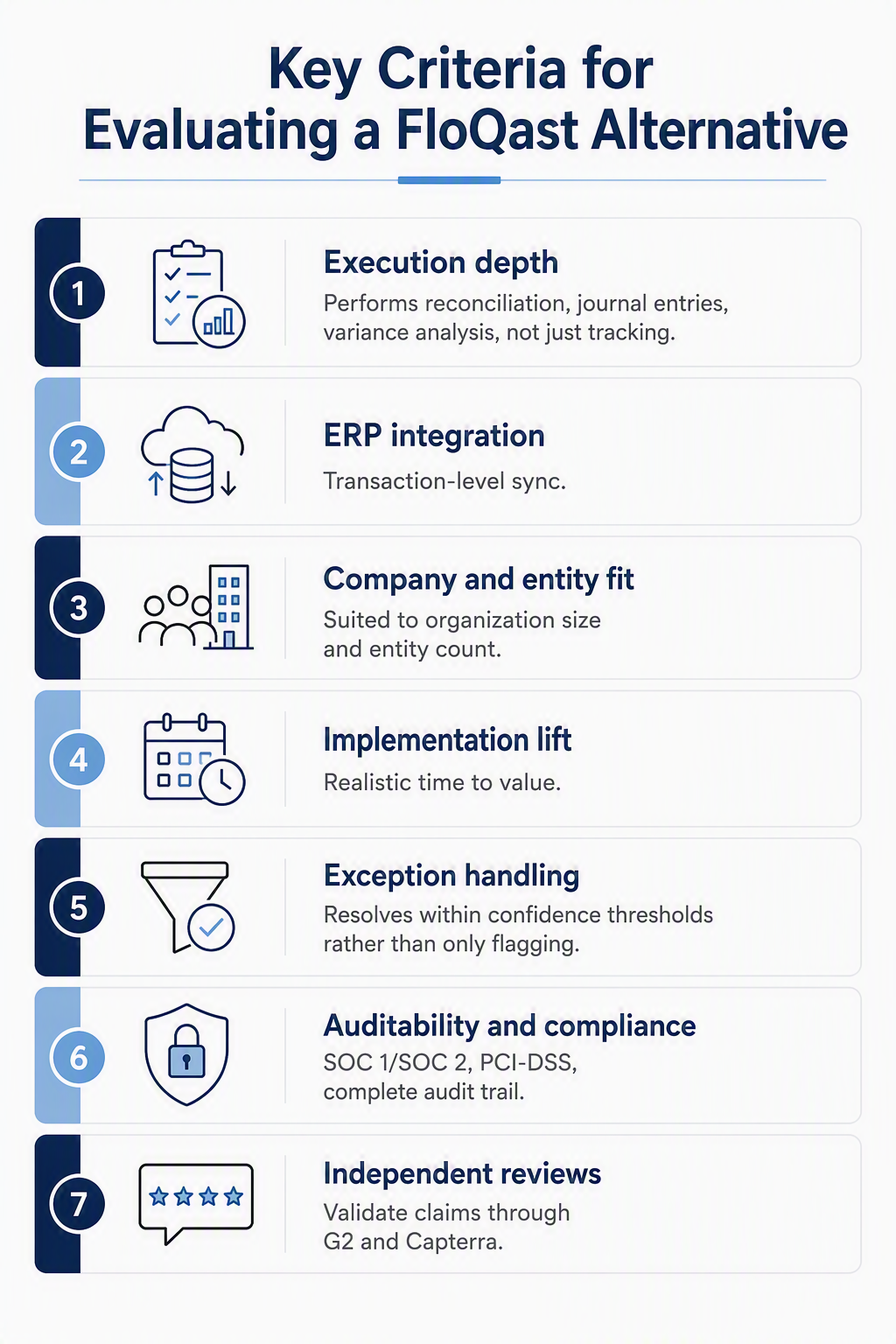
Questions to Ask Before Switching
- Does the platform track close tasks, or does it execute the reconciliation and journal entries itself?
- How deep is the ERP integration: transaction-level, or a batch/CSV sync?
- What happens at an exception: is it flagged for manual review, or investigated and resolved?
- How does pricing scale with entities, users, and transaction volume?
- What's the realistic time to value, not just the time to configure a checklist?
- Can the platform handle multi-entity, multi-currency complexity without manual workarounds?
If a vendor can't answer the first and third questions with specifics, that's worth noting.
FloQast Alternatives Compared (2026)
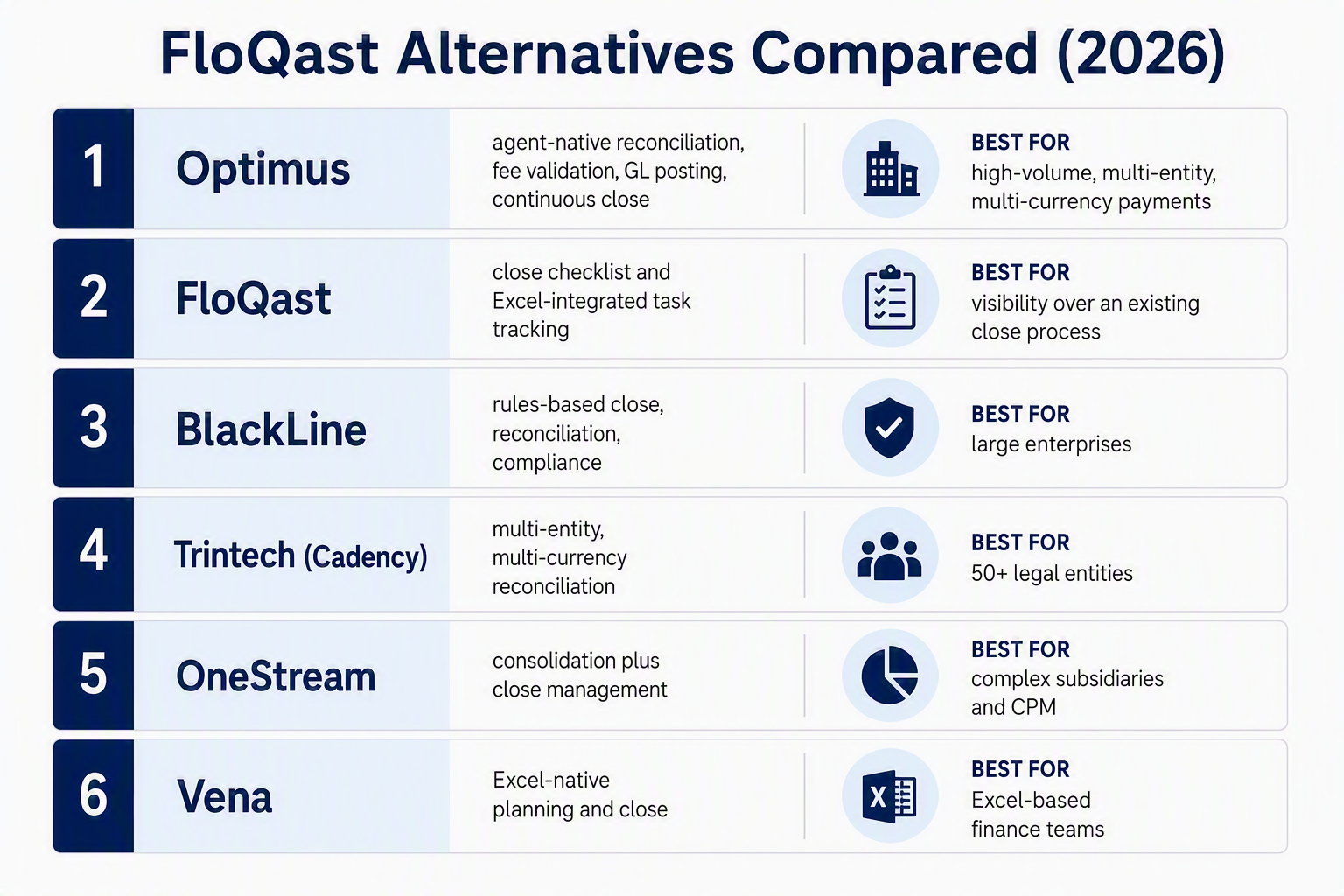
For a deeper look at how these last four compare on agentic depth specifically, see our companion guide: Best BlackLine Alternatives for Agentic Financial Operations.
Top FloQast Alternatives for Agentic Close Management, Reviewed
Optimus
Optimus is an autonomous financial operations platform built for agentic reconciliation, fee validation, and continuous close, the execution layer that checklist tools like FloQast surface status for but don't perform. The platform runs on named, purpose-built agents:
- Data Fusion Agent: Unifies fragmented payment data across systems into one financial model.
- Recon Agent: Matches transactions across payment gateway, bank, and ERP layers and autonomously resolves exceptions. See how this works on the payment reconciliation software page.
- GL Agent: Classifies and maps transactions to the general ledger before posting, including multi-entity postings.
- Cost Intelligence Agent: Validates fees and commissions and flags overcharges. See the fees and commissions reconciliation product page for detail.
- Insights Agent: Detects anomalies and prioritizes issues by financial impact.
- Financial Close Agent: Supports continuous, rolling close rather than a checklist-driven monthly sprint. See the financial close management product page.
- AI Copilot: Lets finance teams query reconciled data conversationally, without dashboards or SQL.
Optimus ships with 1,500+ pre-integrated payment ecosystem partners spanning ERPs (including NetSuite), billing systems, payment facilitators, and banks, with transaction-level sync rather than a nightly CSV. Implementation is measured in days rather than months. The platform is PCI-DSS certified and built toward SOC 1/SOC 2 compliance (see our agentic payment reconciliation overview and Security & Compliance page), and is used by enterprises including Tillo and T-Mobile to manage high-volume, multi-country payment reconciliation. Pricing is quote-based via demo request.
FloQast
FloQast is a well-reviewed, accountant-built platform for managing the close checklist, trusted by more than 3,000 accounting teams including Twilio and Snowflake. Its strength is visibility and collaboration: a single place to see task status, sign-offs, and deadlines. Its limitation is depth: reconciliations, journal entry prep, and variance analysis still happen outside the platform, and user reviews note that its journal entry posting is built for debits and credits hitting the same entity, a real constraint for multi-entity organizations. FloQast's published starting price is $999/month for its Basic plan, with fuller automation gated behind quote-only enterprise tiers.
BlackLine
BlackLine is the category-defining platform for financial close automation, with a comprehensive suite spanning reconciliation, task management, and compliance workflows, at enterprise cost and a 3 to 9 month typical implementation.
Trintech (Cadency)
Trintech's Cadency platform is built for multi-entity, multi-currency reconciliation at enterprise scale, a strong fit for companies with 50+ legal entities needing intercompany matching. For a deeper side-by-side, see the dedicated Optimus vs. Trintech comparison.
OneStream
OneStream unifies financial consolidation with close management, a strong option for organizations that need CPM (corporate performance management) and close automation in a single platform rather than stitching two tools together. It's a heavier, more consolidation-first platform than an execution-layer specialist.
Vena
Vena is built around Excel-native planning and close workflows, appealing to finance teams that want AI-assisted automation without leaving the spreadsheet interface they already know. Like FloQast, it trades execution depth for familiarity.
Why Optimus Stands Out
- Executes the close, doesn't just track it: Where checklist tools surface the status of reconciliation and journal entries, Optimus's agents perform that work directly. See how this compares to autonomous, rules-based tools in our agentic vs. autonomous financial operations breakdown.
- Transaction-level accuracy at high volume: Purpose-built for environments with millions of daily transactions across multiple payment service providers and complex fee structures, not summary-level matching.
- Native multi-entity handling: Unlike checklist tools constrained to single-entity journal entries, Optimus's GL Agent classifies and posts across multi-entity structures.
- A genuinely payments-native platform: Built specifically around the complexity of modern payment ecosystems, which shows up in how it handles fee and commission validation and ledger-level reconciliation.
- Compliance built in, not bolted on: PCI-DSS certified with a complete audit trail, built toward SOC 1/SOC 2. See how agentic reconciliation strengthens audit readiness in our guide to achieving SOC compliance via agentic payment reconciliation.
Move to Agentic Close Management With Optimus
Optimus builds agentic payment reconciliation and close software for finance teams that need the underlying execution automated, not just tracked. Explore the Security & Compliance overview for certifications and controls, or the AI in payment reconciliation page for how the agents work together.
- Coordinated agent architecture: A Data Fusion Agent, Recon Agent, GL Agent, Cost Intelligence Agent, Insights Agent, and Financial Close Agent each handle a distinct part of the workflow.
- Fast, pre-integrated go-live: 1,500+ partners across ERPs, billing systems, and payment processors. See the full list on the Optimus integrations hub.
- Audit-ready by design: PCI-DSS certified storage, built toward SOC 1/SOC 2, with a complete audit trail.
- Exception handling that resolves, not just flags: See our breakdown of exception management approaches for how agentic resolution compares to manual queues.
Frequently Asked Questions About FloQast Alternatives
What is a good FloQast alternative for agentic close management?
Optimus is built specifically for agentic close management: AI agents that execute reconciliation, fee validation, and journal entries directly rather than only tracking task status. Trintech and OneStream suit large multi-entity consolidation needs; Vena suits teams that want to stay Excel-native. See our companion guide on BlackLine alternatives for how these platforms compare on agentic depth specifically.
What's the difference between FloQast and an agentic close platform?
FloQast centralizes close checklist management: task tracking, deadlines, and sign-offs. An agentic close platform like Optimus goes further and executes the underlying work itself, reconciling transactions, validating fees, and preparing journal entries, then resolving exceptions within a defined confidence threshold instead of only flagging them for manual review.
How much does FloQast cost compared to alternatives?
FloQast's published starting price is $999 per month for its Basic plan. Fuller automation and enterprise-tier functionality are quote-only and scale with users and entities. Most agentic alternatives, including Optimus, also price on a quote basis tailored to transaction volume rather than publishing list pricing.
Can FloQast handle multi-entity journal entries?
User reviews note that FloQast's journal entry posting is built for debits and credits hitting the same entity, which can be a constraint for organizations managing complex multi-entity structures. Platforms built with native multi-entity GL posting, including Optimus, are typically a better fit at that scale.
Is Optimus a full replacement for FloQast or a complement?
For reconciliation, fee validation, and journal entry execution, Optimus is built as a direct, purpose-built replacement for the manual work FloQast tracks. Organizations that specifically value FloQast's cross-functional checklist visibility may still use a task-tracking layer alongside an execution platform, though most teams find that redundant once the execution layer includes its own status visibility.
How long does implementation typically take?
FloQast implementations are generally lighter than BlackLine's, though full-team adoption across accounting, FP&A, and Operations can take time to achieve. Optimus is built for go-live measured in days to weeks through its pre-integrated network of ERP, billing, and payment processor connectors.