

Quick answer: The best Trintech (Cadency) alternatives in 2026 - Optimus, BlackLine, FloQast, HighRadius, and OneStream - are all account reconciliation and financial close platforms competing for the same job Cadency does. What separates them is architecture, not category: Cadency, BlackLine, FloQast, HighRadius, and OneStream are rules-based, flagging exceptions for a human to resolve. Optimus is agentic, using AI agents to match transactions, validate fees, and post GL entries autonomously - then extends that same engine into high-volume payment-level matching most GL-first tools were never built to handle. The best Trintech (Cadency) alternatives in 2026 are Optimus, BlackLine, FloQast, HighRadius, and Ledge. Most of them, like Cadency, start at the general ledger and govern the close, and several (Cadency and BlackLine included) now add AI agents to close tasks such as variance analysis and account reconciliation. Optimus starts at the payment transaction instead: its agents work on the payment itself across PSPs, banks, and ERPs, investigating breaks, validating fees, and drafting ledger entries within approved policy. That lets teams replace Cadency where payment reconciliation is the main job, or run Optimus in front of it as the intelligence layer that feeds it clean, matched data.
Trintech (Cadency) is one of the more established names in enterprise account reconciliation - — and one of the more complex, expensive, and implementation-heavy platforms on the market, which is exactly why finance and payment operations teams keep searching for alternatives. Enterprise deployments in this category, Cadency included, commonly run into six-figure annual costs with multi-quarter implementations,are typically quote-based, often reach six figures a year once implementation and support are included, and commonly take three to six months or more to go live, a pattern the BlackLine alternatives landscape shows across the whole close-automation category, not just one vendor.
If you're evaluating Cadency alternatives, the search usually starts with one of two situations: you're already on Cadency and it's becoming harder to maintain than to use, or Cadency is on your shortlist and the price and timeline are giving your team pause. Either way, this guide breaks down what Cadency does well, where it falls short, and which alternatives make sense depending on what kind of reconciliation problem you're actually solving.which alternatives make sense depending on what kind of reconciliation problem you're actually solving, including when it makes more sense to complement Cadency than to replace it. For a deeper side-by-side specific to payment operations, see the dedicated Optimus vs. Trintech comparison.
What Trintech Cadency Does (and Where It Falls Short)
Trintech Cadency is an enterprise financial close platform built for GL account reconciliation, journal entry management, and close task orchestration. Its core strengths are matching ledger and balance sheet accounts against subledgers and external statements, workflow orchestration across close activities, and journal entry automation for large, multi-entity organizations — a serious platform for serious compliance requirements, particularly in regulated industries like banking and insurance.
Where teams consistently hit friction:
Implementation complexity. Cadency is not configured in weeks. Enterprise deployments routinely take three to nine months or longerthree to six months or longer, often require a third-party implementation partner, and involve significant internal IT resource - — a pattern that holds across the whole close-automation category, not just Cadency.
Rule-based matching architecture. Cadency's matching engine is built on rules, which works well for clean, structured GL data. When transaction data is messy - different formats across PSPs, missing reference fields, high exception rates - the rules-based approach creates a backlog of manual exceptions that still need human review.Accounting-first matching architecture. Cadency's matching is configured around GL accounts and data that arrives already prepared and aggregated. Trintech added AI agents in 2026, but they focus on close work such as variance analysis rather than on the payment transaction itself. When transaction data is messy (different formats across PSPs, missing reference fields, high exception rates), teams still spend hours preparing files before matching can run, and rule changes often depend on IT or professional services.
Product fragmentation. Trintech runs two effectively separate products, Cadency for enterprise and Adra for mid-market, plus standalone tools including ReconNET, Frontier, Accurate, and DATAFlow.plus ReconNET and T-Recs for high-volume transaction matching. For organizations whose needs evolve, navigating the product map is genuinely confusing.
No cost-of-payments validation. Cadency reconciles balances and transactions, but it doesn't validate processor, scheme, or interchange fees against contracts, so overcharges pass through unchecked unless someone audits them separately.
Cost. Cadency pricing is custom and quote-based, but large enterprise implementations regularly run into six figures annually once implementation, licensing, and ongoing support are factored in pricing comparable to , putting it in a similar range to BlackLine's enterprise tier.
None of this makes Cadency a bad product. For a large enterprise with stable GL reconciliation, a regulated industry, and a long implementation runway, it remains a solid choice. The problem is that many teams buying it don't fit that profile, or outgrow what it was designed to handle. or outgrow what it was designed to handle, especially when most of their reconciliation work is payment data from PSPs, acquirers, and banks rather than GL balances.
Why Agentic Account Reconciliation Outperforms Rules-Based Tools What Makes Account Reconciliation Truly Agentic
It's worth asking why finance teams evaluating Cadency increasingly end up comparing it against agentic platforms rather than another rules-based tool. The gap isn't which ledger or transaction type each vendor covers - Optimus reconciles GL and payment data the same way Cadency does. The gap is what happens when a match doesn't clear.Almost every close platform now advertises AI agents, Trintech and BlackLine included. So the useful question isn't whether a tool has agents, but what those agents work on. In GL-first platforms, agents typically help with close tasks: flux and variance analysis, account reconciliations, and document preparation. The underlying transaction matching still runs on configured rules, on data someone has already prepared. The gap shows up when a payment match doesn't clear.
Cadency and its category peers apply pre-configured rules:Rules-based matching works the same way everywhere: if a transaction fits a known pattern, it clears; if not, it lands in a queue for a person to resolve. That works reasonably well for clean, structured GL data. It breaks down as soon as data gets messy - — different formats across PSPs, missing reference fields, high exception rates - — because a static rule set has no way to adapt without someone rewriting the logic. Agentic platforms interpret the data, learn from correction patterns, and resolve exceptions autonomously instead of just routing them.An agentic platform works on the payment itself: it traces an unmatched item back through authorization, capture, settlement, and bank deposit, explains the root cause and financial impact, resolves routine breaks within approved policy, and escalates material ones to a person with the evidence attached. Autonomy expands only as data quality and controls are proven, so analysts review decisions rather than hunt through rows.
That only works if every system describes the transaction the same way. In most finance operations, payments, treasury, accounting, and billing each rebuild the same payment from their own data, which leaves five different definitions of "settled." AI agents amplify whatever data they are given, so automating on top of fragmented definitions scales errors faster than teams can catch them. That is why Optimus starts with a financial data foundation: a shared model that links each payment's order ID, authorization, settlement, fees, bank deposit, and GL entry into one governed record that every agent and analyst works from.
This is also where spreadsheet-based reconciliation tends to hide the same problem in a different wrapper - — teams patch a GL tool or a spreadsheet with manual normalization work instead of fixing the underlying architecture. Manual reconciliation that works with two data sources usually breaks down with five or ten, which is exactly when Cadency-style, rules-based tools start to strain.
The Real Operational Challenges Behind Switching
Execution is harder than the evaluation deck suggests, and most of the difficulty sits outside any one team's direct control.
Payment and counterparty data usually lives across several systems: an ERP's vendor and customer master, a handful of PSP portals, a billing platform, occasionally a spreadsheet a regional team maintains on its own. Each was populated differently, and cleaning it up is less a one-time project than an ongoing governance exercise.
Ownership is genuinely unclear in most organizations. IT owns the payment gateway, treasury owns the bank relationships, accounting owns the close process, and individual business units own their own customer records. A reconciliation-platform switch touches all four and tends to be owned fully by none of them until exceptions start piling up.
Exception handling compounds this during any transition. A newly implemented platform surfaces every mismatch a legacy process was quietly absorbing through manual review, which can look like a step backward before it becomes a step forward. Left unmanaged, unmatched items and unrecovered fees add up to real revenue leakage that a slower, cleaner rollout would have caught earlier.
Key Criteria and Practical Implementation Considerations
Before you shortlist Trintech alternatives, get clear on what you're actually solving for — and sequence the switch deliberately rather than trying to do everything at once.
• What type of reconciliation? GL financial close is different from payment reconciliation. Many alternatives specialize in one; few do both equally well.
• What's your transaction volume? A platform optimized for mid-market close management behaves differently at ten million transactions a month than at one million.
• How messy is your data? Rule-based matching works with clean data. Multi-source, multi-format payment data across PSPs, banks, and ERPs needs intelligent, no-code matching, not static rules.
• What's your implementation tolerance? Some platforms take quarters to deploy; others go live in weeks through pre-built data connectors.
• Do you need agentic AI or just automation? Traditional automation flags exceptions for humans to resolve. Agentic reconciliation reasons through exceptions and resolves them autonomously - a significant distinction for high-volume fee and commission validation as well as transaction matching.Where do the agents actually work? Many platforms now include AI agents for close tasks. Ask whether they also work on the payment data itself: investigating breaks across PSP, bank, and ERP data, handling fee and commission validation, and resolving routine exceptions within policy, with a full audit trail and human approval for material items.
Start with volume, not perfection: a small number of counterparties and payment corridors typically account for most transaction volume, so prioritizing cleanup there produces a faster drop in exceptions than a broad, shallow effort. Run the old and new systems in parallel for at least one close cycle before fully cutting over - — a defined exception path for the transition period is more realistic than assuming a clean switch.is more realistic than assuming a clean switch. A practical sequence is to baseline first (leakage, manual effort, match rates, close impact), spend roughly 30 days connecting sources into one governed record, run 30 days of agent-assisted operations under human review, and only then allow controlled autonomy for repeatable decisions within approved policy.
Best Trintech Cadency Alternatives in 2026
How we evaluated: each platform was compared on where it starts (general ledger or payment transaction), depth of transaction matching across PSPs and banks, fee validation, accounting output, close governance, what its AI agents actually work on, and time to value, using public product documentation as of September 2026. Optimus is our own platform, so we've called out where it is lighter as well as where it leads.
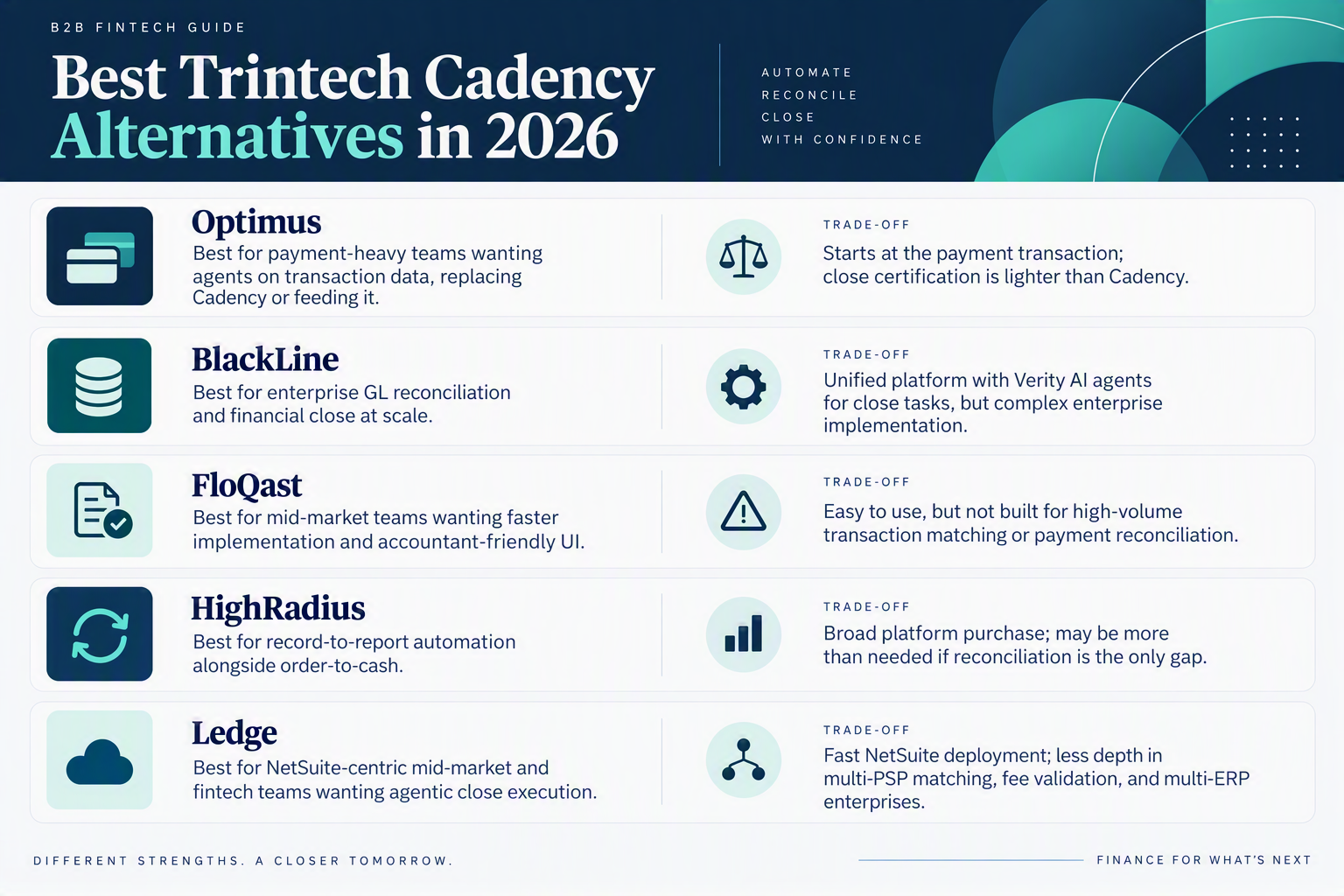
1. BlackLine
The most direct enterprise-grade Trintech alternative for teams whose primary need is account reconciliation, journal entry management, and financial close for a large, multi-entity organization. It holds the largest enterprise market share in the financial close space and integrates deeply with SAP, Oracle, and Workday.integrates deeply with SAP, Oracle, and Workday. It has also invested heavily in agentic AI through its Verity agents, which assist with close work such as preparing account reconciliations. It's more consistently unified as a single platform than Trintech's fragmented product line - — though its own alternatives are worth a look too, covered in the BlackLine alternatives guide. Implementation is still complex and pricing enterprise-grade, and it's built for accounting teams doing GL close, not payment operations reconciling high-volume transaction data.
Best fit: Large enterprise finance teams replacing Cadency for GL reconciliation, journal entries, and close management.
2. FloQast
Consistently cited as one of the easiest Trintech alternatives to actually implement and use. It pulls GL balances directly from your ERP, automates the tie-out process, and gives accounting teams a clean, task-oriented close workflow. The limitation: FloQast is built for mid-market close management, not high-volume transaction matching or payment reconciliation, and it doesn't offer the multi-entity, multi-currency depth Cadency handles at the enterprise tier.
Best fit: Mid-market accounting teams that need to simplify and accelerate their close without enterprise-scale complexity.
3. HighRadius
A broader platform than most Cadency alternatives, covering record-to-report (including account reconciliation and close management) alongside order-to-cash, accounts receivable, and treasury automation. It's the most natural fit for organizations that want to consolidate multiple financial workflows into one platform rather than run reconciliation alongside separate AR and treasury systems - — but it's a significant platform purchase, not a point solution, and teams that only need reconciliation improved will likely find it more than they need.
Best fit: Enterprise organizations looking to consolidate record-to-report and order-to-cash under one platform.
4. OneStream 4. Ledge
Positioned as a unified Corporate Performance Management platform, combining consolidation, planning, reporting, and account reconciliation in one system. The appeal over Cadency is platform breadth - CFO teams get a single source of truth across close, consolidation, and FP&A rather than managing reconciliation as a standalone silo. The limitation is that it's designed for large, complex enterprises with significant consolidation requirements; the implementation burden is comparable to Cadency.An agentic close platform based in New York and Tel Aviv, built around AI agents that prepare reconciliations, working papers, journal entries, and flux analysis. It's the closest comparison for teams specifically searching for agentic close automation: time to value is fast for NetSuite-based mid-market companies, it has a strong fintech and marketplace customer base, and it now positions itself as a full replacement for legacy close platforms. The limitation is that it's close-first and NetSuite-centric, with less depth in N-way payment matching, fee and commission validation, and complex multi-ERP enterprise environments.
Best fit: Multinational enterprises looking to replace both a close tool and a consolidation-and-planning tool simultaneously.Best fit: Mid-market and fintech finance teams on NetSuite that want AI agents to execute the close faster.
5. Optimus
Optimus does the same core job as Cadency - account reconciliation and financial close, built agent-first rather than retrofitted with AI. Its GL Agent classifies and maps transactions to the general ledger, and its Recon Agent matches ledger, bank, and payment data across PSPs, gateways, and ERPs extending the same agentic engine into high-volume payment-level reconciliation that GL-only tools like Cadency were never built to handle.Optimus approaches reconciliation from the opposite end to Cadency. Instead of starting at the general ledger, it starts at the payment transaction and follows it all the way to the ledger. A financial data foundation ingests and normalizes data from PSPs, acquirers, banks, billing systems, and ERPs into one governed record per payment, and AI agents work from that shared context: a Reconciliation agent matches and investigates breaks, a Cost Intelligence agent validates fees, and an Accounting agent maps reconciled transactions to your chart of accounts and drafts journal entries for approval. The platform is PCI-DSS compliant and processes over a billion transactions a year for enterprise merchants, PSPs, and banks across retail, travel, convenience and fuel, and financial services.
Where Optimus differentiates:
• Agentic reconciliation, not rule-based matching. A Recon Agent reasons through mismatches, traces root causes across the transaction chain, and takes action rather than flagging exceptions for a human queue.Agents that work on the payment itself. The Reconciliation agent traces mismatches across order, authorization, capture, settlement, and bank deposit, explains the root cause and financial impact, resolves routine breaks within approved policy, and routes material items to an analyst with the evidence attached.
• No-code multi-source data ingestion. The data preparation layer normalizes data arriving in different formats from processors, gateways, banks, and ERPs, so teams can set up N-way reconciliation corridors across their payment stack without IT involvement.
• Revenue leakage and fee validation. A Cost Intelligence Agent identifies transaction anomalies, missing payments, and fee discrepancies at the transaction level, including interchange and scheme fees.Revenue leakage and fee validation. The Cost Intelligence agent checks every fee at the transaction level, including interchange, scheme, and processor fees, against contracted rates and network rules, and flags missing settlements and anomalies. That moves fee control from periodic sampling to 100% coverage.
• GL-ready output. A dedicated ledgers reconciliation layer classifies and maps reconciled transactions to the general ledger, so the payment side and the accounting side stay in sync instead of requiring a separate close tool.GL-ready output. The Accounting agent maps reconciled transactions to your chart of accounts and drafts evidence-backed journal entries for approval, so the payment side and the accounting side stay in sync. Teams that keep Cadency for certification and close governance can feed it matched, explained data instead of raw files.
• Continuous close capability. Operates continuously rather than batching to month-end, backed by 1,500+ pre-integrated partners across ERPs, billing systems, and payment processors.
• Measured results, not projections. In production deployments, agents auto-resolving settlement mismatches across multiple PSPs have cut manual reconciliation investigations by 72%, and investigation effort has fallen from thousands of hours to 10–20. One enterprise merchant's back-office report card showed about 0.09% of revenue recovered from order-to-cash leakage and 0.02% saved on cost of acceptance, adding up to roughly $1.15M in annual savings and a 338% ROI.
Best fit: Organizations that want Cadency-style account reconciliation and financial close, but built agent-first, with the same engine also covering high-volume payment data most GL-only tools can't reach.Best fit: Payment-heavy merchants, PSPs, and banks that want agents working on transaction data, either as a direct Cadency replacement where payment reconciliation is the main job, or as the intelligence layer in front of Cadency or ReconNET.
Replace or Complement: Two Ways to Move Beyond Cadency's Limits
Not every team evaluating Trintech alternatives needs to rip Cadency out. Replacing an embedded close platform is expensive and risky, and Cadency's strengths in account certification, close task management, and SOX evidence are real. For many organizations the problem isn't the close itself; it's the payment data that arrives at the close unprepared, unmatched, and unexplained.
Complement. Keep Cadency or ReconNET for close governance and certification, and run an agentic layer in front of it that ingests and normalizes PSP, acquirer, and bank files, matches transactions N-ways, validates fees, and investigates breaks. Cadency then receives matched, summarized, and explained results instead of files your team rebuilds every month. Nothing gets switched off, and value is measured on your own data in a parallel run.
Replace. Going direct makes more sense when the renewal window is open, the implementation has stalled, payment reconciliation is the main use case, or a PSP or ERP migration is already under way.
A useful test: count how many files your team prepares before Cadency or ReconNET can run, and how long it takes to update a rule when a PSP changes its file format. If the answers are "a lot" and "weeks," the bottleneck sits upstream of the close.
An Enterprise and Scalability Perspective
For a single-entity, single-corridor business, choosing a reconciliation platform is mostly a workflow decision. For a multinational operating across a dozen PSPs, several ERPs, and multiple banking relationships, it's closer to an architecture decision.
Data volume itself changes the calculus at scale. Reconciliation systems built on rules tuned for GL statements need to ingest, index, and match against every field a modern payment stack produces, not just the reference number they used to extract from a bank file. Architecture originally built to parse narrow, semi-structured statement formats, then patched over time with translation layers to accept new file types, tends to strain as PSP count and transaction volume grow. Every new processor or market becomes another custom mapping project.
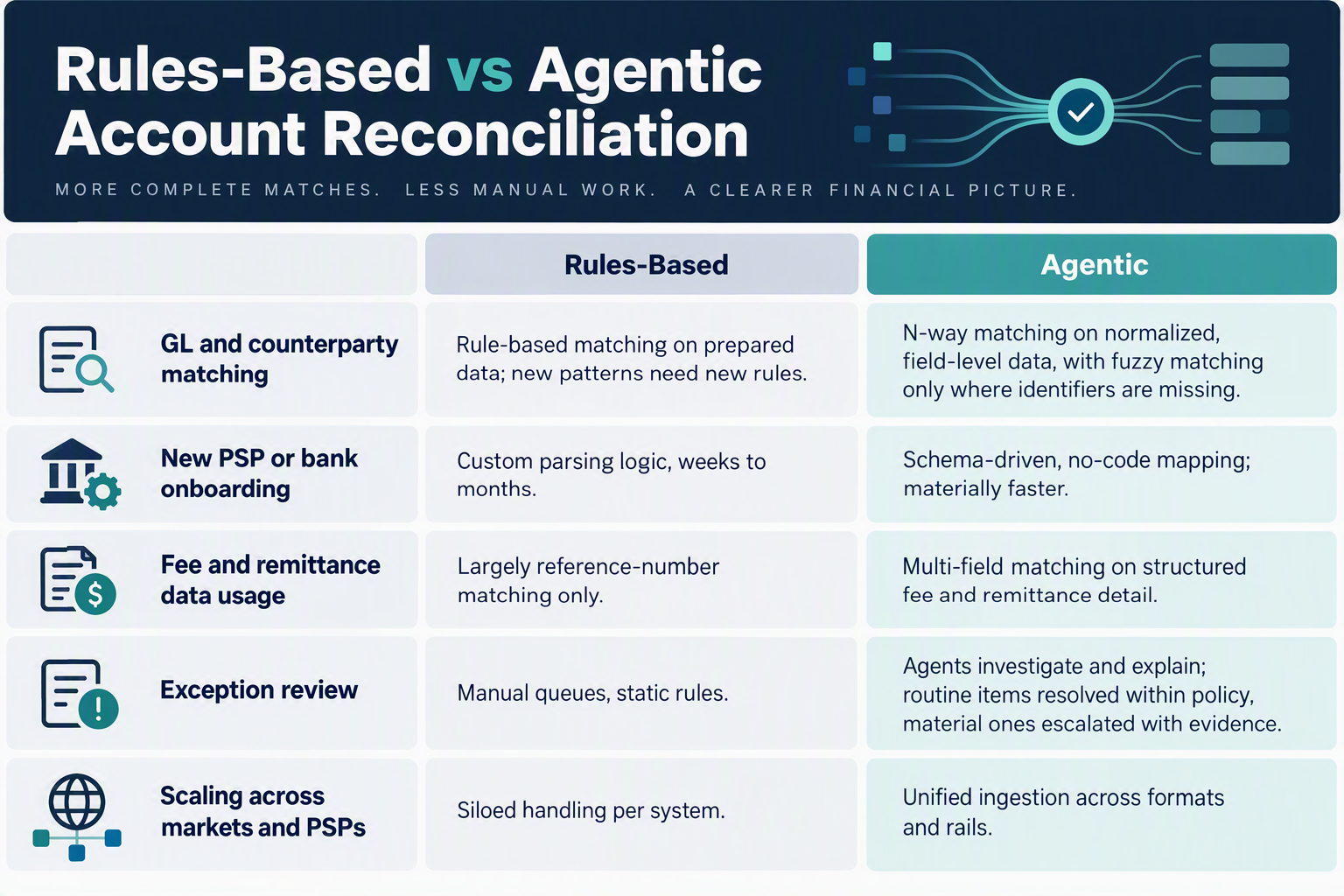
This is the practical distinction between reconciliation platforms today, more than any single feature comparison. Systems retrofitted onto older GL-parsing engines generally still get a close done, but the manual exception-handling burden stays roughly where it was, just shifted into a new tool. Agentic platforms built to reconcile both GL and payment data, with matching logic that adapts without a developer hand-coding each new source, are positioned to turn the same data into fewer exceptions rather than the same number in a new interface.
Looking Past the Switch
Treat a reconciliation-platform decision as a foundation, not a one-time fix. The category keeps moving: continuous, always-reconciled books are replacing month-end sprints, compliance expectations are extending toward SOC 1 and SOC 2 audit trails on top of PCI-DSS, and finance teams are increasingly expected to have AI-ready, structured financial data rather than clean-enough spreadsheets. Teams that use this decision only to stop the immediate pain will likely be back in a similar evaluation within about a year. Teams that use it to fix the underlying data architecture, how payment and remittance information is captured, matched, and consumed, will find each later milestone easier than the last, because the hard part will already be done.
Trintech Cadency is capable at what it was built for: enterprise GL reconciliation and financial close for large, complex organizations. But the implementation burden, rule-based architectureaccounting-first architecture, and cost mean many organizations underuse it or outgrow it in the wrong direction. For accounting teams managing month-end close, BlackLine and FloQast are the most mature options.BlackLine and FloQast are the most mature options, and Ledge is worth a look for NetSuite teams that want agentic close execution. For teams that want the same account reconciliation and close Cadency handles, but resolved by AI agents instead of routed to a human queue, including the high-volume payment data GL-only tools weren't built for, Optimus is the most direct fit.For payment-heavy teams, where most of the reconciliation work sits in PSP, acquirer, and bank data, Optimus is the most direct fit, whether it replaces Cadency or runs in front of it. It brings payment-level matching, fee validation against contracts, and ledger-ready output into one platform: the combination payment-heavy Cadency customers otherwise end up assembling from several tools. Request a demo with Optimus to see it against your actual data.
Frequently Asked Questions
1. What is the best Trintech Cadency alternative for enterprise account reconciliation?
For GL-focused enterprise reconciliation, BlackLine is the most direct Cadency alternative with comparable depth for multi-entity, compliance-heavy organizations,how it stacks up against agentic platforms. For the same account reconciliation and close workload, but built agent-first rather than rules-based, Optimus handles high-volume, multi-source transaction matching - GL and payment alike — continuously rather than batch-processing at month-end.For GL-focused enterprise reconciliation, BlackLine is the most direct Cadency alternative, with comparable depth for multi-entity, compliance-heavy organizations. For payment-heavy operations, Optimus is the stronger fit: its agents match and investigate high-volume, multi-source transaction data across PSPs, banks, and ERPs continuously rather than at month-end, and it can either replace Cadency or feed it clean, matched data.
2. What is agentic account reconciliation software?
Agentic account reconciliation software uses AI agents that don't just identify exceptions but investigate and resolve them autonomously, tracing root causes across transaction sources, pulling missing data, and closing exceptions without a human queue - distinct from traditional automation, which only flags exceptions for manual review. Optimus is built on an agentic architecture for account reconciliation and financial close, extending into payment reconciliation with the same engine.Agentic account reconciliation software uses AI agents that don't just flag exceptions but investigate them: tracing root causes across transaction sources, pulling missing data, explaining the financial impact, and resolving routine items within approved policy. Material or unusual items still go to a person, with the evidence attached and every action logged. Traditional automation, by contrast, only flags exceptions for manual review. Optimus applies this approach to payment reconciliation, fee validation, and accounting, with agents working from one shared record of each transaction.
3. How is Optimus different from Trintech Cadency?
Cadency and Optimus solve the same core problem — account reconciliation and financial close — but with different architectures. Cadency is rules-based: transactions that match a configured pattern clear, everything else routes to a human queue. Optimus is agent-first: a GL Agent and Recon Agent match ledger, bank, and payment data and resolve exceptions autonomously, then extend that same engine into high-volume payment reconciliation and revenue leakage detection that GL-only tools weren't built to handle. See the full Optimus vs. Trintech comparison for a feature-level breakdown.Cadency starts at the general ledger: it governs account reconciliation, certification, and close tasks, and in 2026 added AI agents for close work such as variance analysis. Optimus starts at the payment transaction: its agents reconcile PSP, acquirer, bank, and ERP data, validate fees against contracts, detect revenue leakage, and draft journal entries for approval. Many teams run the two together, with Optimus preparing and explaining payment data before it reaches Cadency. See the full Optimus vs. Trintech comparison for a feature-level breakdown.
4. Is Trintech Cadency suitable for payment companies and banks?
Cadency handles high-volume transaction matchingTrintech handles high-volume transaction matching (largely through ReconNET) and is used in banking and insurance for compliance and audit trail depth. But its rule-based matching architecture and GL-centric design mean it'sits accounting-first, GL-centric design means it's less suited to the multi-source, multi-format complexity of modern payment stack reconciliation, where data arrives from PSPs, processors, and gateways in inconsistent formats. Purpose-built platforms like Optimus handle that complexity more directly, including for banks and e-commerce specifically.
5. What does Trintech Cadency cost?
Cadency pricing is custom and quote-based, varying by organization size, number of entities, and implementation scope. Large enterprise deployments typically involve six-figure annual costs once licensing, implementation (often requiring a third-party partner), and ongoing support are included — pricing and implementation timelines comparable to BlackLine's enterprise tier. comparable to BlackLine's enterprise tier. Exact pricing requires direct engagement with Trintech.